

By Saad Iqbal
Two stories landed within 48 hours of each other this week, and together they say more about where upstream AI is headed than either one does alone. On October 28, the Energy Institute stood up its first formal body to govern how AI gets deployed across the energy sector. Two days later, a joint study from Adnoc, XRG and Microsoft put hard numbers on just how fast AI spending in oil and gas is climbing — and how far ahead of governance that spending has already run.
A governance body for energy AI finally arrives
The Energy Institute’s new Applied AI for Energy Committee is chaired by Dan Jeavons of Applied Computing, with Andy Webster of KBR serving as vice chair. The committee’s brief is narrower and more practical than it might sound: build an AI governance framework the industry can actually use, alongside a separate framework for evaluating, assuring and benchmarking AI systems before they touch field operations. Energy Institute leadership, including Martin Maeso, framed the committee as a response to a gap operators have been describing informally for a couple of years — plenty of AI pilots, very little shared language for deciding which ones are safe to scale.

That gap matters more in upstream than almost anywhere else in energy. A benchmarking framework for an AI model that schedules office meetings is a nice-to-have. A benchmarking framework for a model recommending choke settings or flagging an early kick is closer to a safety requirement. The committee hasn’t published its evaluation criteria yet, but the fact that drilling and production AI vendors now have a credible industry body to answer to is itself a shift worth watching.
Why energy executives are doubling down on AI spend
The Adnoc-XRG-Microsoft “Powering Possible” study, released October 29–30 and based on roughly 400 energy and finance executives, gives the governance story its urgency. Eighty-nine percent of respondents said their organizations increased AI spending over the past year. Sixty-three percent now expect a measurable return on that investment — a figure Adnoc Group CEO Dr. Sultan Al Jaber and Microsoft Vice Chair and President Brad Smith both pointed to as evidence that AI in energy has moved past the pilot-project phase and into budget line items executives are willing to defend.

The sharper number is the priority shift: 62% of executives now rank AI among their top two priorities, up from 42% a year earlier. That’s a twenty-point jump in twelve months, and it tracks with what we’ve seen covering AI drilling optimization platforms and failure-prediction tools move from vendor pitch decks into actual field deployments over the same period.
Part of what’s driving that spend is physical, not just digital. The same report cites global data-center electricity demand roughly doubling by 2030, from an estimated 475 TWh today to around 950 TWh — and 81% of surveyed executives said they expect that demand to exceed current forecasts, not meet them.
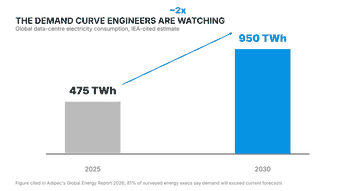
That’s the loop energy companies are now operating inside: AI drives the compute buildout, the compute buildout drives power demand, and power demand lands back on the same oil, gas and grid operators funding the AI in the first place.
What this means for upstream teams right now
Neither story is a reason to slow down a drilling optimization rollout or an artificial-lift monitoring pilot. But both are a reason to document how a given AI tool was validated before it goes into production — the kind of groundwork that lines up well with the calculations we’ve been walking through in fracture gradient and wellbore stability tutorials: know the governing physics, verify the automated output against it, and only then trust the tool to run unattended. The Energy Institute’s committee is, in effect, trying to formalize that same discipline at an industry scale.
We’ll keep tracking both threads — the governance framework as it takes shape, and the spending numbers as next quarter’s surveys land. If you’re weighing an AI tool for your own operation this week, our drilling optimization software comparison is a good place to start.
