By Saad Iqbal
Somewhere in last night’s drilling data, a bit spent two hours grinding through a stringer at a mechanical specific energy three times higher than the rock’s own strength. Nobody on the rig noticed. The driller was watching ROP, which looked fine, not the hidden efficiency number that would have told him the bit was bouncing instead of cutting. Multiply that two hours by every well in a multi-rig program, and you’re not looking at a rounding error. You’re looking at rig-days that never needed to be spent.
That gap, between what the driller can see on a screen and what the data actually contains, is exactly what AI drilling optimization software is built to close. Not rig-floor automation that physically moves the top drive (we covered that closed-loop control layer separately), but the engineering and analytics layer underneath it: the software that tells you, before and during the run, what the bit should be doing and whether it’s doing it.
What “Drilling Optimization Software” Actually Covers
It’s worth drawing this line clearly, because the category gets muddy fast. Rig automation platforms (NOV NOVOS, SLB DrillSync, Nabors SmartROS) physically execute setpoint changes at the top drive and drawworks. Drilling optimization software sits one layer up: it plans the well, ingests real-time and offset data, computes efficiency metrics like mechanical specific energy, and recommends or flags what the automation layer should do next. Some vendors do both. Most operators end up running at least two separate products, one for engineering and planning, one for execution, and the engineering layer is where most of the avoidable cost actually gets found.

The Math That Finds the Hidden Inefficiency: Mechanical Specific Energy
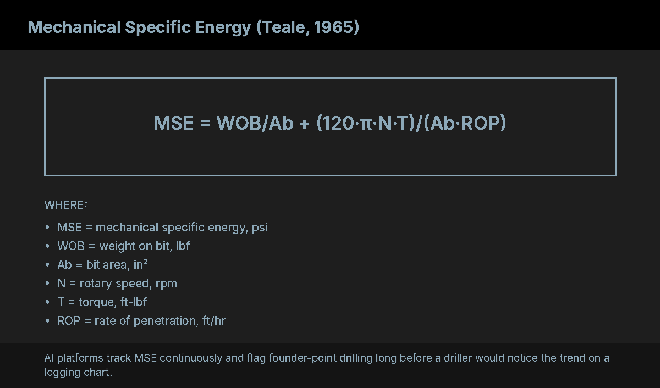
Every AI drilling optimization platform on this list leans on some version of the same governing equation. Teale (1965) defined mechanical specific energy, MSE, as the amount of energy it takes to remove a unit volume of rock. In U.S. field units:
MSE = WOB / Ab + (120 × π × N × T) / (Ab × ROP)
- WOB = weight on bit, lbf
- Ab = bit cross-sectional area, in²
- N = rotary speed, rpm
- T = torque, ft-lbf
- ROP = rate of penetration, ft/hr
Worked example: an 8.5-inch bit (Ab = π/4 × 8.5² ≈ 56.75 in²) drilling at WOB = 25,000 lbf, N = 150 rpm, T = 3,000 ft-lbf, ROP = 80 ft/hr.
WOB/Ab = 25,000 / 56.75 ≈ 440.5 psi. The rotary term: (120 × π × 150 × 3,000) / (56.75 × 80) ≈ 37,368 psi. MSE ≈ 37,800 psi. If offset logs put this formation’s confined compressive strength closer to 15,000–18,000 psi, that gap is the signature of founder-point drilling: the bit is re-cutting its own debris instead of removing fresh rock, usually because WOB has been pushed past the point where it still helps ROP.
A quick Python check you can run against your own drilling data to flag this automatically:
import math

def mse_psi(wob_lbf, bit_dia_in, n_rpm, torque_ftlbf, rop_fthr):
    if rop_fthr <= 0 or bit_dia_in <= 0:
        raise ValueError("ROP and bit diameter must be positive")
    ab = math.pi / 4 * bit_dia_in ** 2
    axial = wob_lbf / ab
    rotary = (120 * math.pi * n_rpm * torque_ftlbf) / (ab * rop_fthr)
    return axial + rotary

mse = mse_psi(25000, 8.5, 150, 3000, 80)
print(f"MSE: {mse:,.0f} psi")
# Flag founder-point drilling against an offset-log rock strength estimate
rock_strength_psi = 17000
if mse > 1.5 * rock_strength_psi:
    print("Likely founder-point drilling: WOB increase is hurting, not helping ROP")
This is exactly the comparison the platforms below automate across every foot drilled, continuously, instead of as a post-well review. For the full step-by-step walkthrough of MSE calibration against your own offset wells, see our AI ROP optimization tutorial.
The Best AI Drilling Optimization Platforms Right Now
1. Corva: Real-Time Analytics and an Edge App Marketplace
Corva is less a single optimization tool than a real-time data platform with a marketplace of drilling apps, including MSE tracking, NPT detection, and offset-well benchmarking, that run on top of whatever rig you’re on. Its edge-deployment model means the same app can run across a mixed fleet of rig contractors without a hardware retrofit, which is the main reason it shows up as a partner layer underneath multiple automation vendors rather than a standalone competitor to them.
2. Kelvin.ai: Autonomous Decision-Making for Upstream Operations
Kelvin.ai is a broader industrial-AI “system of action” platform, not a drilling-specific tool out of the box, but it has a real, named deployment in upstream oil and gas: Kelvin.ai’s partnership with Santos for autonomous onshore upstream production operations. The distinction matters when you’re evaluating it: ask specifically whether the deployment you’re being pitched is a drilling use case or a production-optimization one, because Kelvin’s public track record right now is stronger on the latter.
3. SLB DrillPlan: Well Planning and Engineering, Not Rig-Floor Control
SLB DrillPlan lives inside the Delfi environment and handles the pre-spud engineering side: well design, offset-data-informed parameter selection, and the engineering handoff to execution. This is the layer that decides what “good” looks like before the bit ever turns, which is a different job from DrillSync’s real-time rig control, even though both come from SLB. TotalEnergies’ decision to lock in a 15-year deployment of DrillPlan is one of the clearer signals that engineering-layer software, not just rig automation, is where operators are placing long-term bets.
4. NOV Novos: Where Closed-Loop Control Gets Its Optimization Target
NOV’s NOVOS is primarily a rig-floor automation system, covered in depth in our rig automation comparison, but it’s worth a mention here because its “reflexive” control loop needs an optimization target to chase, and MSE-style efficiency metrics are typically what feeds it. If you’re evaluating a closed-loop system, ask what engineering-layer analytics it’s actually optimizing against.

How These Tools Compare

Reading that table, the real decision isn’t “which one is best,” it’s “which layer am I actually missing.” An operator already running Corva for real-time data but with no formal pre-spud engineering platform is leaving ROP gains on the table at the planning stage, before the bit even spuds. An operator with a mature DrillPlan-based engineering process but no edge app layer is planning well but flying blind during the run. Very few operators need all four; most need to honestly identify which gap is costing them more rig-days this quarter.
What Do the ROP Gains Actually Look Like?
Vendor case studies are specific-well results, not guarantees, but they’re worth grounding in real numbers rather than marketing adjectives. Corva’s published Permian Basin case studies report a 26% ROP improvement on vertical sections, saving roughly $270,000 per pad, and a separate 37% ROP improvement on lateral sections. Nabors’ own Delaware Basin case study, run jointly with its NDS Predictive Drilling solution, reported a 36% average lateral ROP improvement.
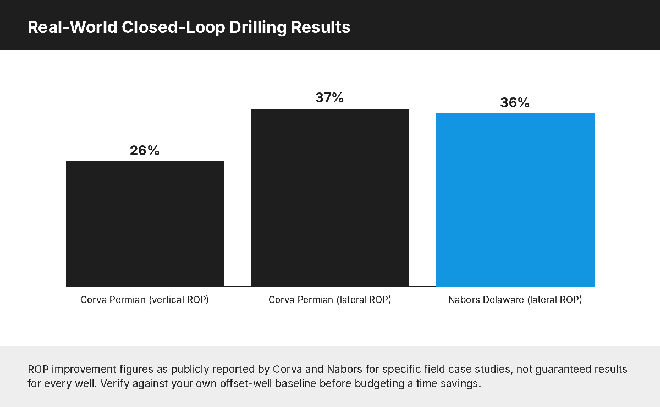
Two things are worth noticing in those numbers. First, lateral sections consistently show bigger gains than vertical ones, almost certainly because lateral drilling has more parameters actively fighting each other (torque, buckling, cuttings transport) for software to untangle. Second, these are case-specific results on formations the vendor chose to publish. Ask any vendor for the offset-well baseline methodology behind their number before you put it in a budget.
Common Pitfalls When Rolling Out Drilling Optimization Software
- Treating MSE as a single magic threshold. Rock strength varies by formation and even by bedding orientation within the same formation; a founder-point threshold calibrated on one basin will misfire on another. Recalibrate against your own offset wells before trusting an alert.
- Buying the engineering layer and skipping change management. DrillPlan or an equivalent only pays off if the engineers who build the well plan and the drillers executing it are actually looking at the same numbers. A plan that lives in one system and gets re-typed into another loses most of its value in translation.
- Confusing a broad industrial-AI platform’s logo with a drilling track record. Kelvin.ai is real and its upstream deployment with Santos is real, but it is not the same claim as “built for drilling.” Ask for the specific use case, not the vendor’s full client list.
- Comparing ROP gains across different rock types as if they were the same claim. A 37% lateral ROP gain in one Permian sub-basin and a 37% gain in a different lithology elsewhere are not interchangeable numbers, even though the headline looks identical.
A Practical Checklist Before You Buy
- Separate the evaluation into two buckets explicitly: engineering/planning software and rig-floor execution software. Most vendor pitches blur this line on purpose.
- Ask which efficiency metric the platform actually optimizes against (MSE, torque-and-drag model, cuttings transport ratio) and whether you can see the raw number, not just a “green light.”
- Run a side-by-side MSE comparison on one already-finished well before trusting a new platform’s dashboard on a live one.
- Confirm whether the tool needs continuous connectivity or can run usefully on cached/edge data when the rig loses its link.
- Check who owns the data model if you later want to swap vendors. A platform that locks your offset-well history into a proprietary format is a switching-cost decision, not just a software decision.
Where This Fits With the Rest of Your Drilling Stack
Drilling optimization software is most useful paired with the problems it’s designed to catch early. If stuck pipe risk is part of what you’re trying to get ahead of on the same wells, our breakdown of AI stuck pipe prediction covers the differential-sticking signal that MSE alone won’t show you. And if you want the rig-floor execution side of this story, the one that actually turns the top drive, read our full comparison of AI rig automation tools for drilling next.
