

By Saad Iqbal
Two stories this week point at the same shift from opposite ends of the drill string: one teaches a model to read the rock in real time, the other locks a supermajor into fifteen years of shared digital well planning. Neither is a press-release exaggeration — both come with real numbers and real caveats attached, which is exactly why they’re worth five minutes of your Sunday. Here’s what actually happened, and what it means if you’re the one holding the drilling parameters or the AFE.
AI Finds Up to 68% More ROP Hiding in Drilling Data That Already Exists
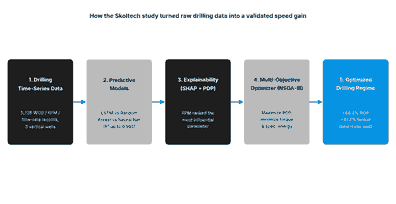
Shadfar Davoodi, an assistant professor at Skoltech’s AI Center, published a study in the journal Results in Engineering this week showing how much performance is sitting unused in ordinary drilling records. Working from 5,738 records across three vertical wells in a heterogeneous carbonate formation, the team compared LSTM, Random Forest, and multilayer neural network models for predicting rate of penetration and torque — the LSTM came out on top. They layered in SHAP and partial-dependence explainability to see which parameters actually drove the predictions (rotational speed led the pack), then ran a multi-objective optimizer, NSGA-III, to search for better combinations of weight on bit, RPM, and flow rate.
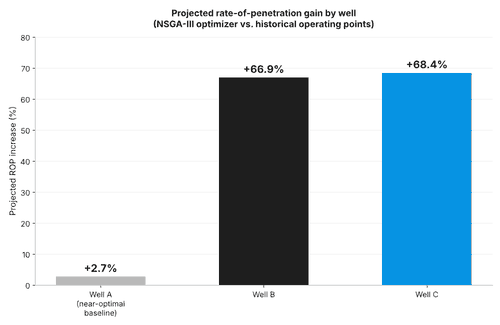
The headline number — a 68.4% projected ROP increase — came from just one of the three wells, alongside a 41.2% torque reduction and 17.9% lower specific mechanical energy. A second well showed a 66.9% ROP gain with a 59.6% torque cut. The third well, already drilled close to optimal, only had about 2.7% left on the table, so the model’s advice there shifted toward cutting load and energy use instead of chasing speed. The honest caveat: these are surrogate-model projections from historical data in one carbonate formation, not confirmed field trial results yet — Davoodi’s team flags full-scale validation as the logical next step.
TotalEnergies Commits to 15 Years of SLB DrillPlan
SLB announced on October 8 that TotalEnergies has signed a 15-year agreement to deploy DrillPlan across its worldwide upstream portfolio. Worth being precise here: DrillPlan is a digital well planning and engineering platform, not an AI model — it brings offset well data, trajectory design, casing and completion inputs, and planning assumptions into one shared environment so subsurface, drilling, and completions teams work from the same numbers instead of reconciling spreadsheets after the fact. SLB’s Rakesh Jaggi, president of the company’s Digital business, framed it as operators moving toward solutions that “improve consistency, strengthen collaboration” — and a foundation SLB expects to keep building workflows on top of. Neither company disclosed a contract value or specific well count.
It’s not a flashy AI headline, and it shouldn’t be dressed up as one. But a fifteen-year, portfolio-wide commitment to one planning data model is exactly the kind of unglamorous infrastructure decision that determines whether an operator’s future AI tools — ROP optimizers like the one above included — have clean, consistent data to actually learn from. Models like Davoodi’s are only as good as the well records feeding them; standardized planning data at this scale is how an operator eventually gets enough clean history to train one well.

Want the hands-on version of this week’s ML theme? We just published a full Hall plot analysis tutorial with a governing equation, worked skin-factor example, and Python code you can run today. For more on where AI is already paying off at the rig, see our roundups on AI rig automation tools and AI stick-slip detection.
