By Saad Iqbal
It’s 2 a.m. and the driller’s chair is the loneliest seat on the rig. The bit just crossed into a stringer nobody logged on the offset well, WOB is spiking, and the only thing standing between a smooth run and a twisted-off string is how fast a tired human reacts to a trend on a screen. Multiply that moment by every crew change, every driller’s personal feel for “too fast,” and every rig in the fleet, and you get the real reason upstream operators are done treating drilling as a purely manual craft.
Rig automation, AI-assisted, closed-loop control of surface and downhole drilling parameters, exists to take that 2 a.m. decision away from gut feel and hand it to a system that reacts in milliseconds, never gets tired, and treats every crew’s wells the same way. It’s one of the fastest-moving categories in upstream software right now, and the gap between the best platforms and a generic “automation” pitch deck is wide.
What Counts as “Rig Automation” in 2026 (It’s Not Just Autopilot)
Rig automation sits on a spectrum. At the bottom is setpoint automation, software that holds weight-on-bit, RPM, and flow rate to a target the driller still chooses. In the middle is supervisory control, where the system recommends or auto-adjusts parameters within guardrails and the driller approves exceptions. At the top is true closed-loop control, where downhole and surface sensors feed a control system that adjusts drilling parameters in real time with minimal driller intervention, and the driller’s job shifts from “hands on the controls” to “exception manager watching for what the system can’t yet handle.”
Most rigs running “automation” today sit in the middle of that spectrum. Full closed-loop runs are real but still the exception rather than the rule, which is exactly why they make the news when they happen. Knowing where a vendor’s product actually sits on that spectrum, rather than where their marketing places it, is the single most useful question you can ask in a sales call. Ask specifically which parameters the system adjusts without a human in the loop, and which ones it only recommends, because that one distinction tells you more about real capability than any brochure will.
How Closed-Loop Drilling Automation Actually Works
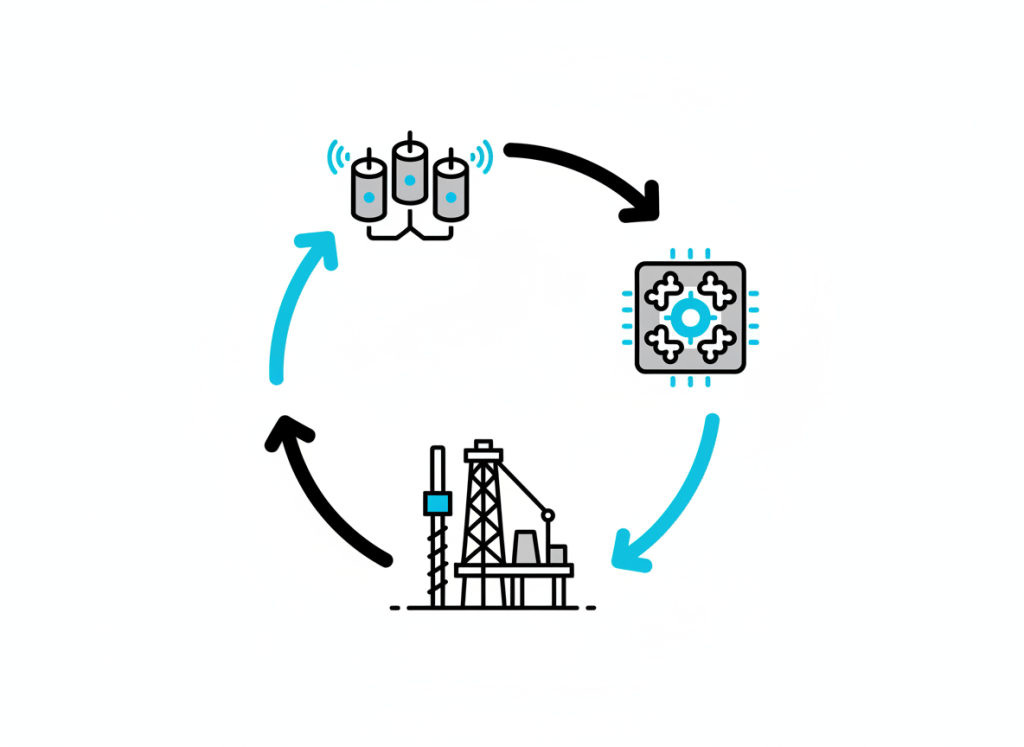
The loop has four parts: surface and downhole sensors (WOB, torque, RPM, vibration, ROP, and increasingly downhole dynamics data transmitted in near-real time); a control layer that compares what’s happening to what the drilling plan expects; an automation engine that computes a parameter adjustment; and the rig’s own equipment, top drive, drawworks, pumps, that executes it. Close that loop fast enough and consistently enough, and you get drilling that no longer depends on which crew is on shift.
This isn’t hypothetical anymore. Halliburton and Eni reported an industry-first fully closed-loop rig automation run in deepwater Indonesia, and separately Halliburton and ExxonMobil deployed closed-loop automated drilling and automated well placement offshore Guyana in 2026, both real, named deployments, not vendor slideware.
The Best AI Rig Automation Platforms Right Now
1. NOV NOVOS Reflexive Drilling System
NOV’s NOVOS is built around a “reflexive” idea: the system continuously senses downhole and surface conditions and reflexively adjusts drilling parameters, the way a driver’s reflexes correct a car before conscious thought catches up. It’s rig-equipment-agnostic in principle and has one of the longest track records of any dedicated drilling-automation platform on this list.
2. SLB DrillSync Automated Controls Platform
SLB’s DrillSync platform is notable for being deployable agnostically on third-party rig control systems. SLB has demonstrated deploying a DrillSync oscillation controller on a rig without modifying the existing rig control system, which matters a lot to an operator who doesn’t want to re-equip an entire fleet just to get one automation feature.
3. Nabors SmartROS
Nabors SmartROS is the rig operating system underneath Nabors’ automation stack, and the company has paired it with Corva‘s real-time data platform through a strategic alliance, a useful reminder that the automation engine and the real-time data layer underneath it are often two separate products from two separate vendors, even on the same rig.
4. Helmerich & Payne Rig Floor Automation
H&P’s Rig Floor Automation package focuses on the physical rig floor, automating pipe handling and connections, not just downhole parameter control, which is a different and often underrated automation surface from the drilling-parameter platforms above.
5. Corva: The Real-Time Data Layer
Corva isn’t a closed-loop control system by itself, it’s the real-time drilling and well data platform that automation engines, rig-state apps, and NPT detection increasingly run on top of. If your rig’s data pipeline isn’t solid, no automation engine bolted on top of it will be either, which is why Corva shows up as a partner layer across multiple vendors on this list rather than a standalone competitor to them.
One thing worth noticing across that list: who actually owns each platform matters as much as what it does. NOVOS and DrillSync come from equipment and service companies and tend to travel with their own hardware or controls packages. SmartROS and H&P’s Rig Floor Automation are rig-contractor platforms, meaning the economics are usually baked into your day rate rather than a separate software line item. Corva sits above all of them as an independent data layer, which is exactly why it gets paired with more than one of the other four. Knowing which category you’re negotiating with changes the conversation from “which automation feature do we want” to “who already owns the rig we’re drilling with, and what does their platform already include.”
What These Platforms Actually Move: ROP, NPT, and Consistency
The metric that matters most isn’t peak rate of penetration in a press release, it’s the variance between your best driller’s ROP and your average driller’s ROP on the same formation. Automation’s real value shows up as that gap shrinking: every crew drilling closer to what your best crew already achieves, plus fewer non-productive-time events caused by a slow human reaction to a kick-off trend. The Halliburton-Eni and Halliburton-ExxonMobil closed-loop deployments mentioned above are being watched closely for exactly this reason, not because the headline rate is dramatic, but because the result repeats shift after shift. That repeatability is also what makes automation easier to defend in a budget review than almost any other digital upstream spend: a 5% average ROP gain that holds across every crew, every week, compounds into far more saved rig-days per year than an occasional best-case run that only your top driller can reproduce.
A Practical Rollout Checklist for Adopting Rig Automation
Rig automation programs fail more often from sequencing mistakes than from bad software. Work through this order before you sign a fleet-wide contract:
- Fix your real-time data pipeline first. A Corva-style platform that gets every sensor onto one consistent feed is the foundation everything else sits on.
- Start with surface setpoint automation (WOB, RPM, flow) before chasing full closed-loop control, it’s lower risk and still measurably improves consistency.
- Pick one champion rig and run a genuine automated-vs-manual A/B comparison on comparable formation sections before rolling out fleet-wide.
- Train drillers as automation supervisors, not spectators, the crews that fight automation are almost always the ones who were never taught how to use it.
- Define a clear, pre-agreed trigger for handing control back to the driller, and rehearse it before you need it.
Common Pitfalls
- Automating on top of a shaky data pipeline. A closed-loop system fed by inconsistent or laggy sensor data will automate the wrong reaction just as confidently as the right one.
- Skipping change management. Drillers who were never trained to supervise the system will override it constantly, and the program gets blamed for “not working.”
- Comparing ROP gains across different formations without normalizing for lithology. A 20% ROP improvement on a soft shale section and a 20% improvement drilling through a hard stringer are not the same claim, and treating them as equivalent is how automation programs lose credibility with skeptical crews.
- Buying the control engine before the equipment can actually execute the command. A top drive or drawworks that can’t respond fast enough to the automation engine’s output will cap your results no matter how good the software is.
Rig automation doesn’t operate in isolation from the rest of your drilling data stack. For the NPT side of this problem specifically, see our breakdown of AI rig state detection and NPT tools, and for the formation-risk side, our piece on AI lost circulation detection covers a failure mode that automated control still needs a human, or a very good model, to catch early. And if your crews are still compiling drilling reports by hand, our guide to AI tools for automating daily drilling reports is the natural next read.
