By Saad Iqbal

Three hours into a plug and perf job on a Midland Basin lateral, the treating pressure on Stage 14 climbs where it should be falling. Somewhere downhole, a fracture has found the offset well drilled eleven months earlier, a hydraulic fracturing interference event, and the completions engineer has about ninety seconds to decide whether to pump through it, drop rate, or shut down. That decision used to rest on gut feel and a scrolling pressure chart. Today it rests on four very different pieces of software, each built for a different moment in the life of a hydraulic fracturing job, and most engineers only ever learn one of them well.
That’s the real story behind “AI tools for hydraulic fracturing”: it isn’t one tool doing one job. It’s a relay race, design, execution, mapping, and diagnosis, and the handoffs between them are where wells get left on the table. Here’s what’s actually running at each leg, what each platform verifiably does, and how to choose between them when budget or bandwidth won’t stretch to all four.
Table of Contents
Why hydraulic fracturing diagnostics is really four separate jobs
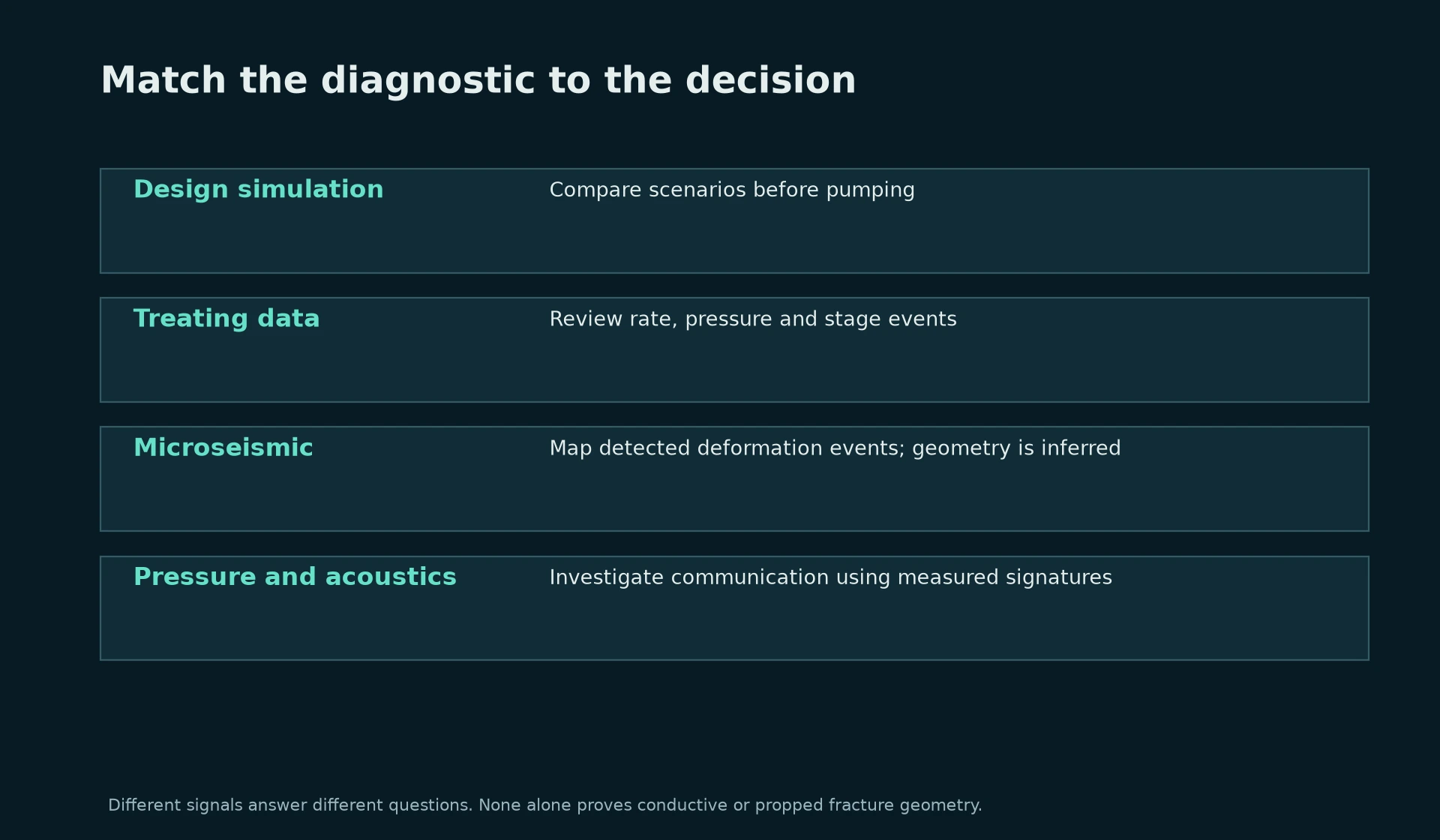
Ask five completions engineers what “frac diagnostics” means and you’ll get five different answers, because the term covers four distinct problems that happen to share a wellbore. Before pumps ever start, an engineer has to size the treatment, proppant volume, fluid rate, stage spacing, against a reservoir that fights back the moment you fracture it.
While pumps are running, someone has to watch the live pressure and rate data for signs the plan isn’t matching reality. During and after the job, a separate discipline maps where the fractures actually went, since rock rarely cooperates with the hydraulic fracturing model. And weeks later, engineers still need to know whether that stage communicated with a neighboring well and, if so, how badly.
Four jobs require different data types. Compare each product against the decision you need to make, and confirm current capabilities and integration requirements with the supplier.
What AI tools cover hydraulic fracturing design and diagnostics?
| Tool | Core method | Best for | Verified scale |
|---|---|---|---|
| ResFrac | Coupled physics based fracture + reservoir simulation | Pre job design & refrac planning | 75+ operators across North American shale plays |
| Corva | Real time treating data streaming & alerting | Live pump rate & proppant adjustments | Cloud completions platform across multiple basins |
| MicroSeismic Inc. | Surface/downhole microseismic event monitoring | Fracture geometry & stage spacing validation | 2,400+ wells monitored across 19 countries |
| Momentum AI | Surface pressure and acoustic sensing | Interference detection & well spacing diagnostics | Six integrated diagnostic products |
Figures above are drawn from each vendor’s own published materials, not independent audits, treat them as the scale each company claims for itself, not a verified head to head benchmark.
ResFrac, coupling the fracture and the reservoir before pumps start
ResFrac is a physics based simulator, not a black box predictor, that distinction matters. Instead of representing a fracture as a high permeability zone the way older simulators do, ResFrac meshes fractures as explicit, propagating cracks and solves fracture mechanics, proppant transport, and multiphase reservoir flow simultaneously, at every timestep. That’s what lets it model stress shadowing between adjacent stages, hindered proppant settling, and the geomechanical feedback loop between a fracture and the rock around it, the same physics that governs whether a refrac communicates with a depleted parent well.
ResFrac reports 75+ operators using the platform across North American shale plays, and the company says it’s currently testing automated history matching tools to close the loop between simulation and field results. For an engineer, the practical use case is upfront: run the design before committing a spread to location, and re run it before refraccing a well that’s already produced for years.
Corva, watching the treating pressure while pumps are live
Once ResFrac’s design becomes an actual pump schedule, the job shifts to Corva’s territory. Corva streams treating pressure, fluid volumes, and proppant concentration into a unified operational dashboard in real time, which is what lets an engineer at the wellsite, or in an office hundreds of miles away, catch a pressure abnormality and adjust pump rate or fluid volume before a bad stage becomes a wasted one.
This is the difference between reactive and proactive completions work: instead of reviewing what went wrong in tomorrow’s post job report, the team watching Corva’s feed can see subsurface pressure responses that indicate formation complexity as they happen, and change the plan mid stage. It’s also where per stage cost tracking lives, so the same screen that flags an anomaly is the one showing whether the adjustment was worth it.
MicroSeismic Inc., interpreting hydraulic fracturing event locations
Treating pressure tells you what happened at the wellhead. It doesn’t tell you where the rock broke. That’s the gap MicroSeismic Inc. fills, using surface and downhole monitoring arrays to detect the tiny seismic events, microseismic events, generated as a fracture propagates through the formation. Automatic moment tensor inversion turns those event locations into a real map of fracture geometry, revealing structural hazards like strike slip faults and giving completions teams the evidence to validate whether their stage spacing actually matches what the rock is doing, rather than what the type curve assumed.
The company reports more than 2,400 wells monitored across 19 countries over 16 years of real time completions monitoring, enough of a track record that its observations can complement other diagnostics. Event locations do not directly prove the conductive or propped fracture geometry.
Momentum AI, catching interference with pressure and acoustic sensing
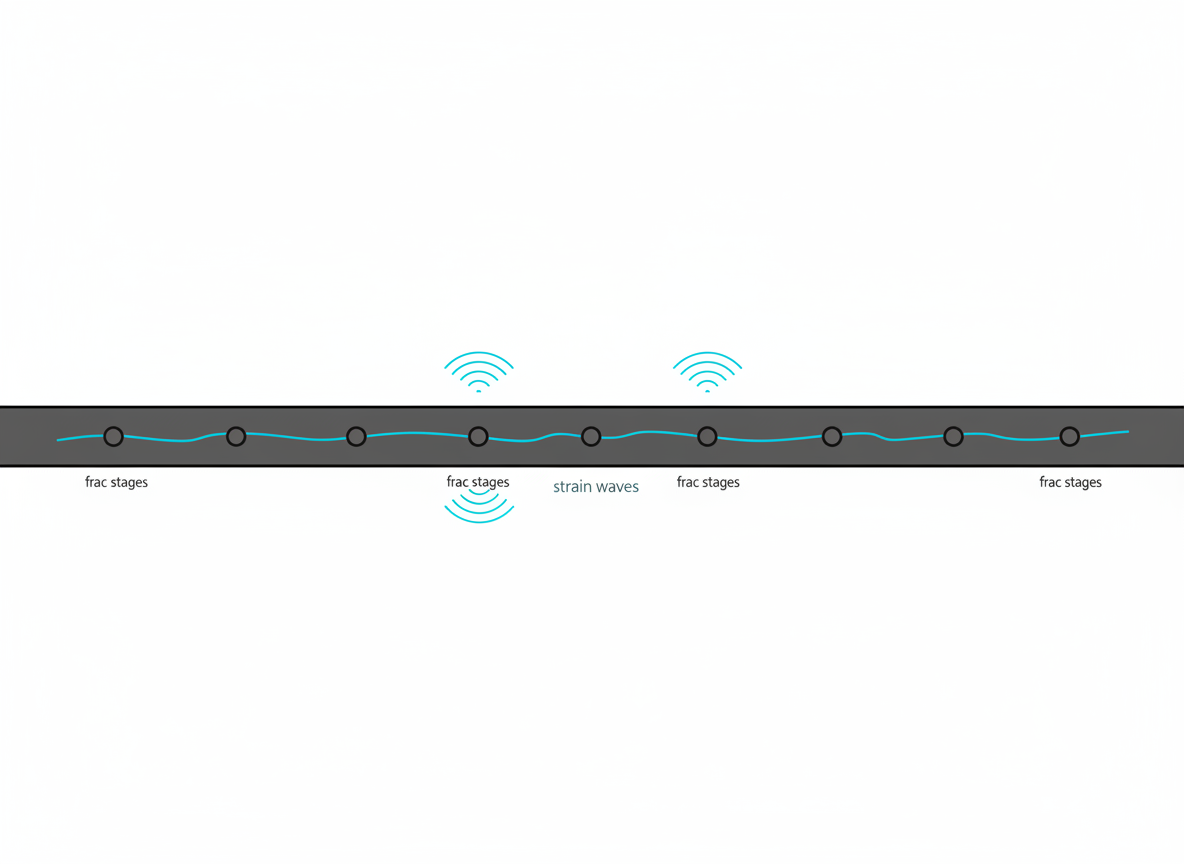
Momentum AI describes surface mounted sensors that measure pressure and acoustic energy changes for fracture driven interference detection. Its published platform includes FDai, design analysis and screenout prediction. This is a pressure and acoustic intelligence workflow; it should not be described as distributed downhole fiber optic sensing. Ask the supplier which signals are measured directly, what processing delay applies and how alerts are validated against your field data.
How to choose hydraulic fracturing diagnostics
The honest answer is that most completions teams don’t choose one, they stack them by lifecycle stage, the same way the table above is organized. But if budget or bandwidth forces a single starting point, match the tool to the failure mode costing you the most right now. If refracs and infill spacing decisions are the pain, start with ResFrac’s design simulation, bad spacing decisions are expensive precisely because they’re made before any data exists to correct them.
If your team is flying blind during the job itself, real time treating visibility from something like Corva closes that gap fastest and cheapest. If you’ve already got treating data but no idea where the frac actually propagated, microseismic monitoring from a provider like MicroSeismic Inc. answers a question no amount of surface pressure data can.
And if parent child frac hits are quietly eating EUR on your infill program, live offset pressure monitoring and appropriate acoustic or fiber sensing can help detect communication during pumping.
Limits of hydraulic fracturing software
Worth saying plainly: none of this software replaces geomechanical judgment. A coupled simulator like ResFrac is only as good as the rock properties and in situ stress state fed into it, and those are still measured, not invented. Real time treating dashboards can show you a pressure anomaly, but deciding whether it means a natural fracture, a screenout, or simply a stage transition through a different facies still takes an engineer who has pumped enough jobs to recognize the shape of trouble.
And microseismic and fiber optic diagnostics both depend on sensor placement and calibration, a poorly sited array will confidently report the wrong geometry. Treat every output here as a decision input, not a decision.
Related reading
The stress state that drives fracture geometry is the same input that drives mud weight design, see AI Wellbore Stability Tools: 5 Picks for 2026 for how AI assisted geomechanics workflows handle that upstream of the hydraulic fracturing job. And if your DFIT or pressure falloff analysis needs a permeability and skin estimate to sanity check a hydraulic fracturing design, the same math underpins Horner Plot: 5 Essential Python Analysis Steps.
Select diagnostics according to uncertainty, well risk and expected value. A simple pressure monitoring program may be sufficient for one pad; a more complex development may justify several complementary measurements. Agree on actions, owners and operating limits before the first alert arrives.
Practical questions about AI tools for hydraulic fracturing
Does an event cloud show the productive fracture? No. Microseismic detects rock deformation events. Detection limits, location uncertainty and deformation outside the hydraulically connected region can influence the cloud. Compare it with pressure communication, fiber measurements, tracer observations and production before inferring effective drainage.
How should a pilot be evaluated? Select comparable pads and define a baseline before deploying AI tools for hydraulic fracturing. Track actionable detection time, false alerts, stage delays, completion cost and subsequent well performance. Record changes in geology and treatment design so an apparent improvement is not credited to software alone.
What information should a supplier deliver? Request signal definitions, units, synchronization accuracy, missing data handling, export formats and uncertainty estimates. A result should link back to the underlying measurement and stage time. Confirm that historical data remains accessible after the contract ends.
Can alerts change pump settings automatically? An alert and a control command are different responsibilities. Establish approved limits, escalation rules and manual override procedures with the operating team. Test recommendations in an observation period before permitting any control integration. The engineering objective is a better decision with a documented basis.