

By Saad Iqbal
Wellbore stability tools help drilling teams investigate a difficult question: what pressures can support the exposed formations without creating unacceptable influx, collapse or loss risk? On a narrow-window well, a polished plot is not enough. The inputs, uncertainty and operating pressure at each depth must be defensible.
This guide compares five practical software approaches, explains where AI may assist, and provides a tested Python pressure-conversion check. They are not five interchangeable AI products: geomechanics simulators, a transparent calculation script and a language assistant perform different jobs. None supplies an approved drilling program merely because its output looks precise.
What Must Wellbore Stability Tools Calculate?
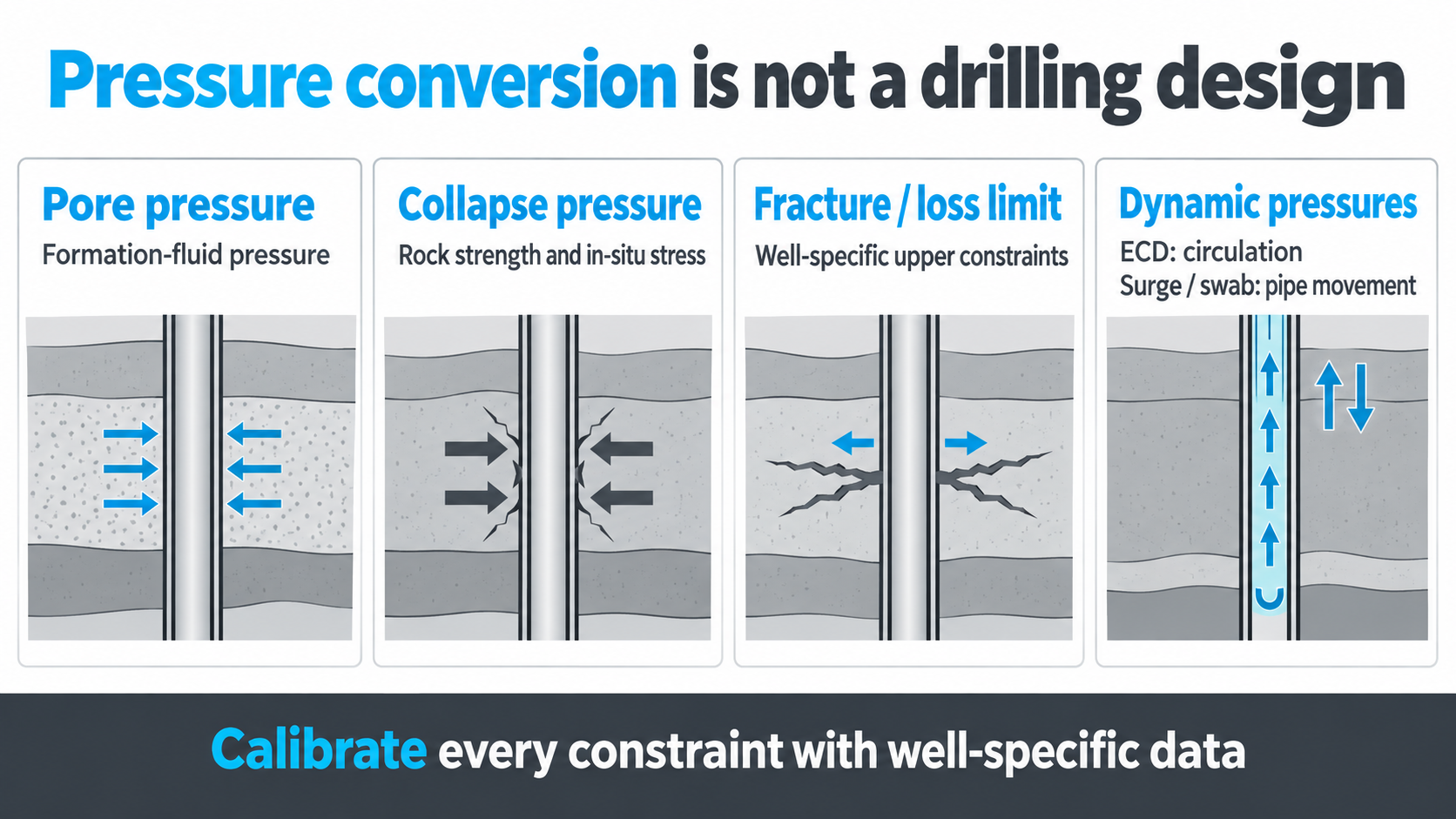
The mud weight window is bounded on the low side by pore pressure (and, in shales, by the collapse pressure needed to keep the borehole wall from shearing inward) and on the high side by the fracture gradient. Everything in between is converted to a single comparable unit — equivalent mud weight (EMW) — using:
EMW (ppg) = Pressure (psi) ÷ [0.052 × TVD (ft)]
For an illustrative depth of 11,500 ft TVD, gradients of 0.62 and 0.86 psi/ft correspond to 7,130 and 9,890 psi. Dividing each by 0.052 × 11,500 gives 11.92 and 16.54 ppg. These are pressure equivalents, not a safe operating window. They omit collapse pressure, trajectory-dependent stresses, weak formations above the bit and dynamic pressure changes.
Subtracting arbitrary 0.5 ppg margins does not fix those omissions. A real mud program needs calibrated pore pressure, rock strength and stress constraints, hydraulics, surge/swab, temperature effects and the operator’s approved design criteria. Compare every limit at a consistent depth and pressure datum. ECD at the bit alone cannot protect a weaker exposed interval higher in the hole.
How Should New Measurements Update the Model?
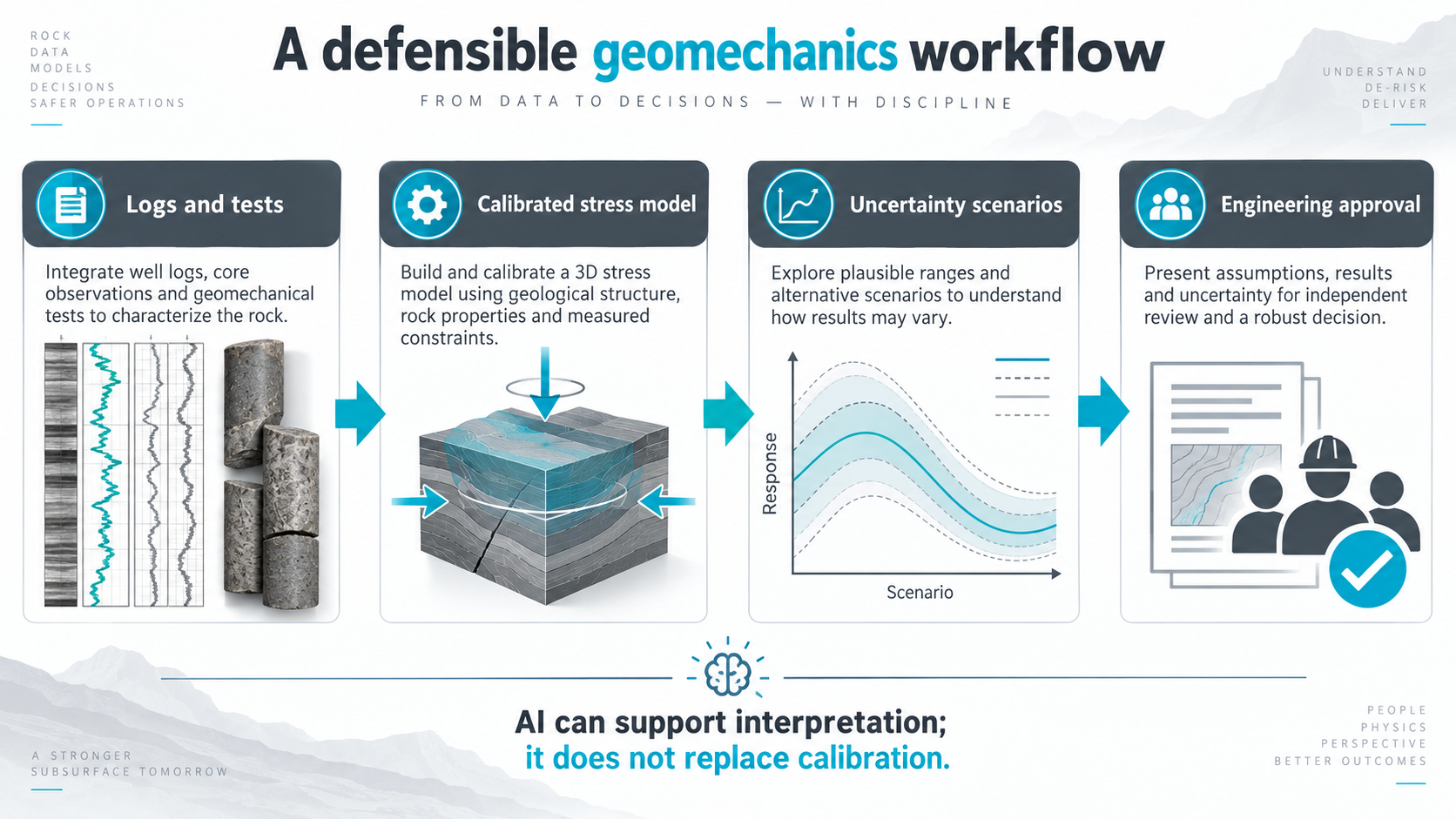
The traditional workflow builds a 1D pore-pressure and fracture-gradient model from offset logs before spud, then the wellsite engineer eyeballs it against connection gas, d-exponent trends, and ROP breaks as the bit goes deeper. That works until the offset data is thin, the structure changes laterally, or the well is landed in a basin where every operator’s “type log” disagrees with the next. The gap between a pre-drill model and what the bit is actually seeing is where kicks, stuck pipe, and unplanned casing points come from.
Some wellbore stability tools support updates as measurements arrive. For example, SLB describes real-time wellbore stability workflows in Techlog. This does not establish that every platform continuously retrains a machine-learning model. Ask which calculation is physics-based, which step uses ML, how updates are approved, and what happens when input data become unreliable.
5 Wellbore Stability Tools and Supporting Approaches
1. Baker Hughes JewelSuite GeoMechanics
JewelSuite Geomechanics provides documented workflows for pore-pressure prediction, stress and wellbore-stability analysis, breakout analysis and sand production. Its advanced stress settings include inclined stress fields, bedding and thermal effects. Confirm the applicable modules and calibration workflow with the supplier; do not equate a time-dependent model with a validated shale-swelling prediction for your well.
2. SLB Petrel Geomechanics
Petrel Geomechanics builds the geomechanical earth model directly inside the same subsurface environment used for reservoir characterization and well planning, so the stress model, the pore-pressure prediction, and the trajectory design are working off one shared dataset instead of three exported files that drift apart. For operators already standardized on Petrel for subsurface work, this is usually the path of least resistance to a defensible mud weight window.
3. Rockfield Elfen Wellbore
Elfen Wellbore supports detailed near-wellbore modelling, including stability, losses, fines migration and mud-cake effects. Rockfield describes constitutive models that can represent mechanisms such as creeping shale and breakout. It is an option when simplified analytical assumptions are inadequate, provided rock properties and boundary conditions support the additional model complexity. Numerical detail is not a substitute for trustworthy measurements.
4. Python for a Transparent Pressure-Conversion Check
Use Python to independently check units and arithmetic used by wellbore stability tools. The following example uses only the standard library—no petroleum package is needed. It checks finite values, rejects nonpositive TVD, and includes known-answer assertions. It does not calculate rock failure, pore pressure from logs or an operating mud window.
Save the code as pressure_check.py. Open a terminal in that folder and run python pressure_check.py. The two expected outputs are 11.92 and 16.54 ppg. The 0.052 field-unit factor relates pressure in psi to density in pounds per US gallon and vertical depth in feet; use TVD from the appropriate pressure datum, not measured depth along an inclined hole.
import math

def emw_ppg(pressure_psi, tvd_ft):
    if not all(math.isfinite(v) for v in (pressure_psi, tvd_ft)):
        raise ValueError("Inputs must be finite")
    if pressure_psi < 0 or tvd_ft <= 0:
        raise ValueError("Pressure must be nonnegative; TVD must be positive")
    return pressure_psi / (0.052 * tvd_ft)

tvd = 11500.0
pore_psi = 0.62 * tvd
upper_psi = 0.86 * tvd
pore_emw = emw_ppg(pore_psi, tvd)
upper_emw = emw_ppg(upper_psi, tvd)
print(f"Pore-pressure equivalent: {pore_emw:.2f} ppg")
print(f"Illustrative upper-pressure equivalent: {upper_emw:.2f} ppg")
print("NOT a mud-weight recommendation or wellbore stability calculation")
assert abs(pore_emw - 11.9230769231) < 1e-8
assert abs(upper_emw - 16.5384615385) < 1e-8
for pressure, depth in [(1, 0), (-1, 100), (float('nan'), 100)]:
    try:
        emw_ppg(pressure, depth)
    except ValueError:
        pass
    else:
        raise AssertionError("Invalid input was accepted")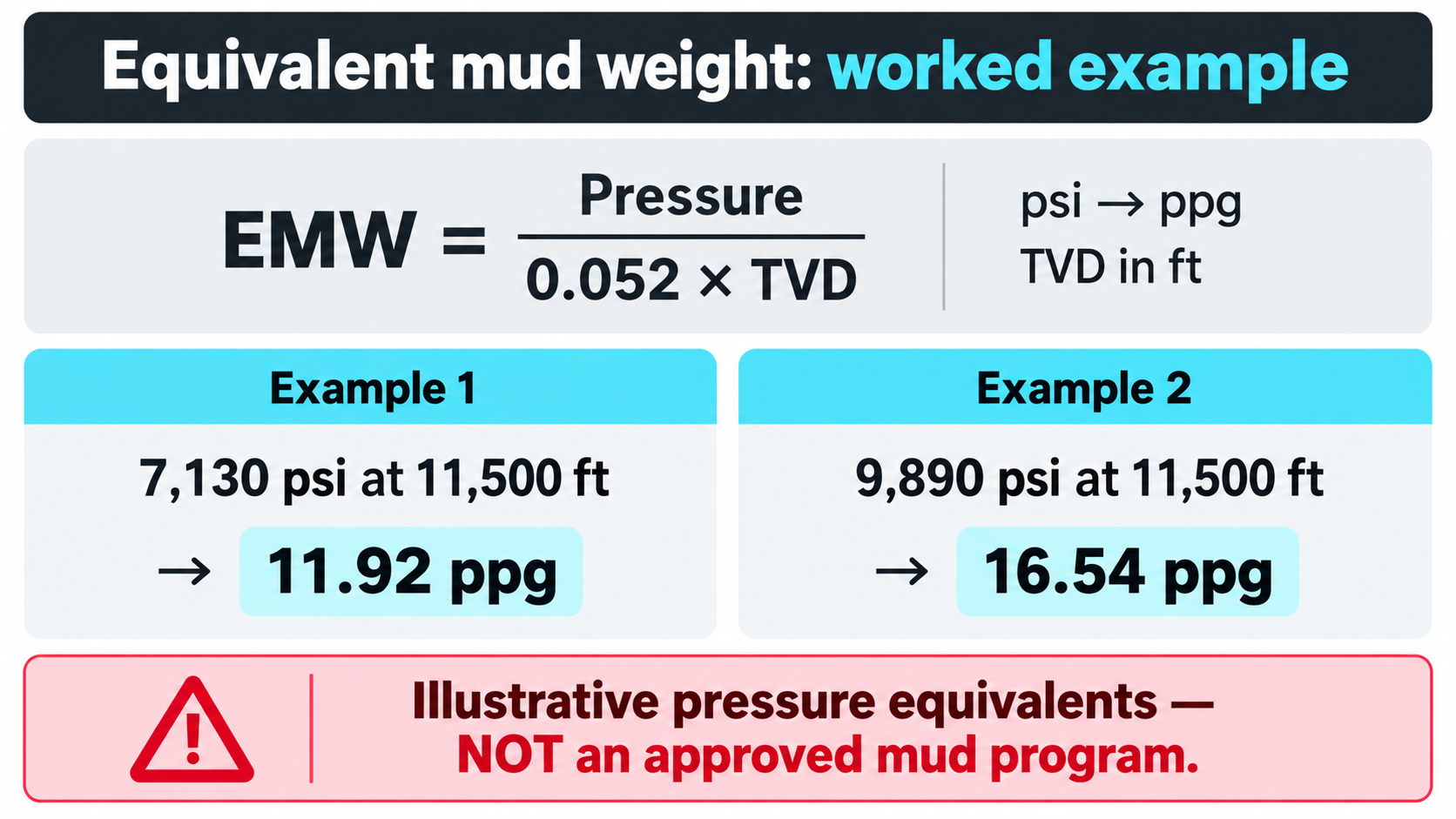
5. ChatGPT or Claude as a Second Pair of Eyes
A language assistant can help draft a review checklist or organize an already-approved calculation narrative. It must not invent gradients, rock properties or acceptance margins, and its arithmetic needs an independent deterministic check. Only share well data through an organization-approved service and data-governance process. Treat generated text as a draft requiring technical review—not an authorization to change mud weight.
How to Choose Between Them
- Already standardized on a subsurface suite? Petrel Geomechanics or JewelSuite will cost you less integration pain than a standalone specialist tool.
- Drilling in rock that does not behave elastically (depleted, salt-adjacent, naturally fractured)? Evaluate Elfen Wellbore against the specific mechanisms, calibration data and specialist expertise required.
- Need a same-day sanity check before a modeling study is even scoped? A standard-library Python conversion check can identify arithmetic and unit errors; it cannot establish an operating limit.
- Writing up the program, not calculating it? An LLM assistant speeds up the document without touching the geomechanics.
Where AI-Generated Windows Still Get Engineers in Trouble
- Offset well bias: a model trained heavily on wells from one flank of the field will under- or over-call pressure on the other flank. Check which offsets fed the calibration before trusting the output.
- Time-dependent shale swelling: a window that was safe when the section was drilled can tighten with exposure time if the model does not account for time-dependent effects.
- Extrapolation past the calibration range: once you drill deeper or into a lithology the training data barely covered, confidence intervals widen fast even when the displayed number looks precise.
- Ignoring the well itself: connection gas trends, torque and drag anomalies, and ROP breaks are still real-time evidence. A model update that contradicts what the string is telling you is a reason to stop, not a reason to trust the software over the driller.
How to Know the Tool Is Actually Helping
Before trusting a new geomechanical model on a live well, run it against a well you already finished and know the outcome of. Feed it the pre-drill offset data only, generate the predicted window, then compare that prediction against what the actual drilling events told you — the depth of any stuck-pipe incident, the loss zone that showed up in the mud logs, the casing point you were forced to move. A successful retrospective test is only one validation step; it does not authorize deployment or prove performance on a different well. A model that only looks accurate with the benefit of hindsight has not, no matter how convincing the dashboard looks.
It is also worth budgeting for the rollout itself rather than assuming the software works on day one. The amount of calibration data required depends on the formation variability and intended decisions, and the team still needs to agree on who owns the go/no-go call when the AI-generated window disagrees with what the mud logger is seeing in real time. Get that governance settled before the disagreement happens on an actual well, not during it.
None of these five tools replace judgment at the rig — they compress the time between “the well is telling us something changed” and “here is an updated, defensible mud weight window.” The value of wellbore stability tools is the traceable engineering workflow, not an AI label. If you are also tightening up the trajectory side of the well plan, our guide to automating directional drilling surveys with the minimum curvature method is a natural next stop, and if hole-cleaning and drag are part of the same problem well, see our breakdown of AI torque and drag optimization tools.
