
By Saad Iqbal
It’s 2 a.m. and a pumper is driving out to a well pad because a sucker rod pump just “pumped off” — the barrel ran dry mid-stroke, the rod string took a shock load it was never designed for, and somewhere in that string a fatigue crack just got a little closer to parting. Multiply that drive by the thousands of rod-lift wells most operators run, and it’s easy to see why AI pump-off controller tools have quietly become one of the highest-ROI deployments in artificial lift. They don’t need a human to notice the dynamometer card has gone wrong-shaped at 2 a.m. They already know.
Rod lift still pumps more wells worldwide than any other artificial lift method, which is exactly why the tooling around it has gotten so much smarter. This isn’t about replacing the pumper. It’s about giving the controller at the wellhead — and the engineer tuning a fleet of them — the same card-reading instinct a twenty-year pumper has, running continuously, on every stroke, on every well.
What a dynamometer card is actually telling you
A dynamometer card plots polished-rod load against stroke position. A healthy pump traces something close to a parallelogram: smooth load up on the upstroke, smooth unload on the down. The moment the pump barrel stops filling completely — pump-off, from a falling fluid level or a gassy well — that shape collapses. The upstroke flattens early, the downstroke drops off a cliff, and the rod string free-falls for a few inches before it catches load again. That free fall is what breaks rods.
Gas interference leaves its own signature: a scalloped, ragged edge on both strokes as gas pockets compress and expand instead of liquid transmitting load cleanly. A classifier trained on enough of these shapes doesn’t need a human to “feel” the difference — pattern-matching a curve is exactly the kind of problem machine learning is good at.

The AI rod lift and pump-off controller tools worth knowing in 2026
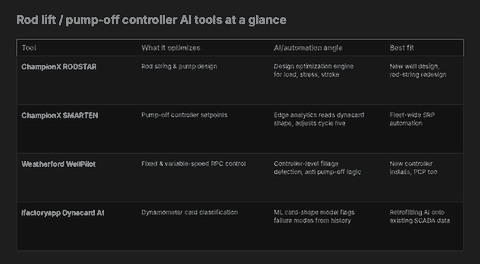
Four tools come up constantly when operators talk about AI pump-off controller tools and rod-lift optimization software, and they solve different parts of the problem — from first design, to stroke-by-stroke control, to retrofitting analytics onto a fleet that already has controllers in the ground.
ChampionX RODSTAR — rod string and pump design
ChampionX’s RODSTAR sits upstream of the controller problem entirely: it’s a design engine for the rod string and pump itself, calculating loads, stresses, and stroke behavior before a well is ever lifted. Get the rod taper and pump size wrong at design time and no amount of clever control at surface fixes a string that’s chronically overloaded. RODSTAR is where ChampionX’s artificial lift modeling lineage has consolidated.
ChampionX SMARTEN — edge analytics for pump-off control
ChampionX SMARTEN is the edge-analytics side: software that reads the dynamometer card shape in near real time and adjusts the pump-off controller’s cycle accordingly, instead of running on a fixed idle-time timer that was right for yesterday’s fluid level and wrong for today’s. For a fleet of SRP wells, that’s the difference between a controller that reacts to a well’s actual behavior and one that’s just guessing on a schedule.
Weatherford WellPilot — controller-level fillage detection
Weatherford’s WellPilot rod-pump controllers run anti-pump-off logic at the controller itself — fixed-speed and variable-speed rod drive both included — detecting fillage loss from the card shape and trimming stroke speed or idle time before a full pump-off event develops. For an operator standardizing controller hardware across a new installation, or adding PCP wells to the same fleet, this is the “buy the box and the logic is already in it” option.
ifactoryapp Dynacard AI — ML card classification for existing SCADA data
ifactoryapp’s Dynacard AI comes at the problem from the retrofitting side: a machine-learning model that classifies card shape from data you’re probably already collecting in SCADA, flagging failure modes — pump-off, gas interference, worn valves — without requiring new controller hardware at every wellhead. If your fleet already has fixed-speed controllers and a historian full of card data nobody’s really mining, this is the path that doesn’t mean replacing hardware first.
The closed loop running underneath all of it
Strip away the vendor branding and every one of these tools is automating the same loop, every stroke: sensors on the polished rod report load and position, a classifier reads the card shape against what “normal” looks like for that well, the controller adjusts stroke speed or idle time, and — if it’s working — the pump stays filled and the rod string stops taking shock loads it was never designed for.

Build your own first-pass pump-off flag in Python
You don’t need a vendor platform to get a feel for this. A surprisingly effective first-pass pump-off flag just compares how much of the stroke carries load against a rolling baseline for that well — if the loaded fraction of the stroke collapses relative to its own recent history, that’s your early signal.
import numpy as np

def pump_off_flag(card_load):
    """
    card_load: 1D array of polished-rod load samples for one stroke.
    Returns the loaded fraction of the stroke (share of samples
    above the stroke's own midline load).
    """
    load_norm = (card_load - card_load.min()) / (card_load.max() - card_load.min() + 1e-9)
    loaded_fraction = np.mean(load_norm > 0.5)
    return loaded_fraction

def rolling_check(history, new_fraction, window=50, drop_threshold=0.25):
    baseline = np.mean(history[-window:]) if len(history) >= 5 else new_fraction
    dropped = (baseline - new_fraction) / (baseline + 1e-9) > drop_threshold
    history.append(new_fraction)
    return dropped, baseline

# history = []
# fraction = pump_off_flag(card_load_array)
# is_pump_off, baseline = rolling_check(history, fraction)
It’s deliberately crude — no card-shape classification, just a loaded-fraction trend — but running this against a week of historian data on one well will tell you fast whether your SCADA already holds the signal a tool like Dynacard AI would be modeling properly. If a simple threshold already flags real pump-off events in your data, you’ve got a strong case for the investment in doing it right.
Where this fits with the rest of your artificial lift fleet
Rod lift rarely runs in isolation — most production engineers are tuning gas lift and ESP wells on the same pad. If you’re building out the gas-lift side of that picture, we’ve compared the AI gas lift optimization platforms doing closed-loop setpoint control the same way SMARTEN does for rod pumps, and if ESPs are in the mix too, our breakdown of AI tools for ESP failure prediction and run-life optimization covers the equivalent signal-reading problem for submersible pumps.
The bottom line
Pick RODSTAR when you’re designing or redesigning the rod string itself. Pick SMARTEN or WellPilot when you want the controller acting on card shape in real time — SMARTEN if you’re already in the ChampionX ecosystem, WellPilot if you’re standardizing new controller hardware. Pick Dynacard AI when the hardware’s already in the ground and the opportunity is in the historian data you’re already paying to store. None of these replace a pumper’s judgment entirely — they just make sure the 2 a.m. call happens because something actually needs a wrench, not because nobody noticed the card shape changed three days ago.
