

By Saad Iqbal
A pumper drives out to a gas-lifted well that used to make 600 barrels a day and now makes 390. The injection gas rate hasn’t changed since the completion engineer set it eighteen months ago. Nobody touched it, because nobody had a reason to touch it — the well was “fine.” That single unchanged number is probably costing the lease more than any mechanical failure on the pad, and it is exactly the kind of slow, invisible loss that gas lift optimization software built on live well data is designed to catch before a pumper ever has to notice.
Gas lift is deceptively simple on paper: inject gas into the tubing, lighten the fluid column, let the reservoir push harder. In practice, the right injection rate shifts constantly as reservoir pressure declines, water cut climbs, and compressor capacity gets reallocated across a pad. Get it wrong and you’re either starving a well of lift gas or wasting compression on a well that’s already gas-locked. This is the problem a new generation of AI-driven artificial lift platforms is built to solve, and in this post we’ll walk through the real, currently-available tools doing it — what each one actually does, where it fits, and where the automation still has limits worth knowing before you buy.
What Gas Lift Optimization Actually Means
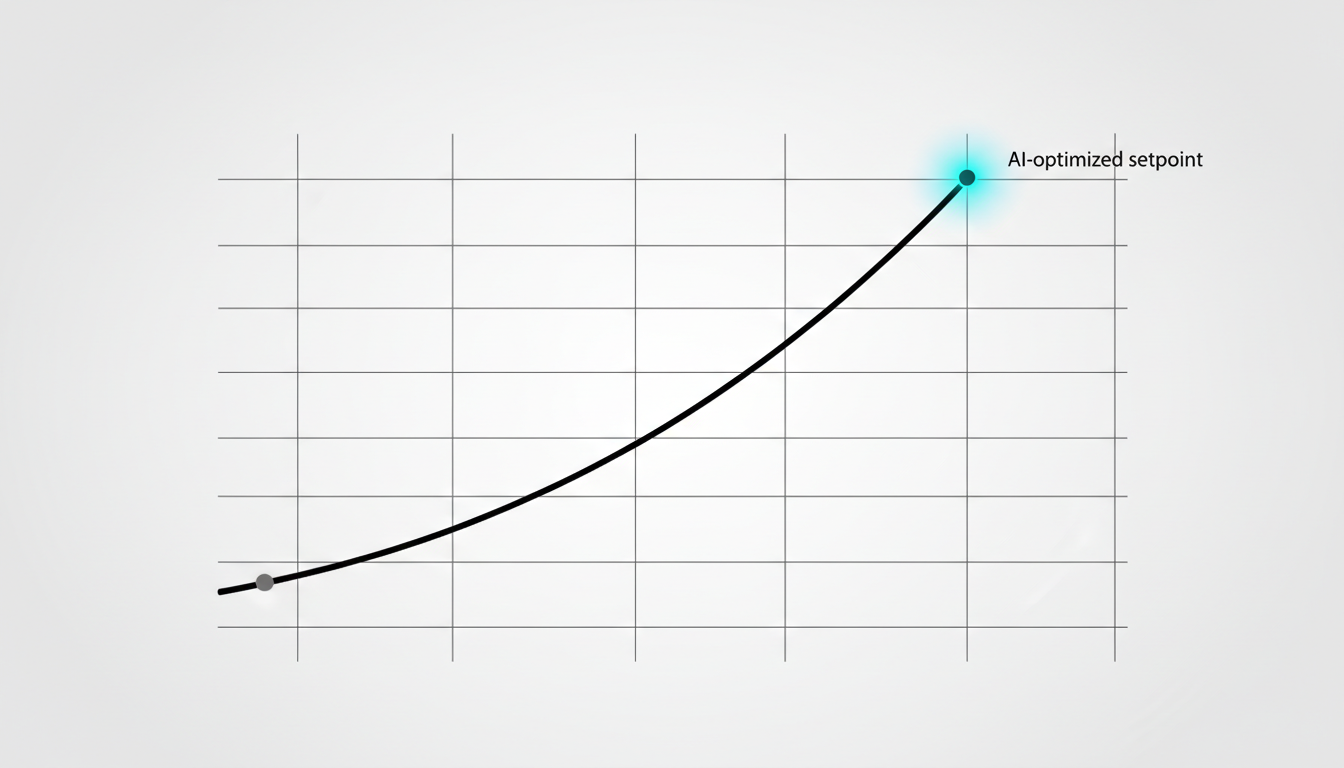
Every gas-lifted well has a gas lift performance curve (GLPC): a relationship between how much gas you inject and how much liquid the well produces in response. Inject too little and the fluid column stays heavy, holding bottomhole pressure up and choking inflow. Inject too much and friction losses in the tubing start eating the benefit, flattening — and eventually reversing — the production gain. Somewhere on that curve is an economic optimum, the point where the value of the next barrel no longer justifies the cost of the next Mscf of compressed gas.
The catch is that the GLPC isn’t static. It moves every time reservoir pressure declines, water cut rises, tubing scales up, or a nearby well on the same gas distribution system gets choked back. A setpoint that was optimal in January can be meaningfully wrong by June. Manual nodal analysis, run well-by-well on a spreadsheet a few times a year, simply can’t track a curve that’s moving in real time across a few hundred wells — which is the gap every platform below is trying to close.
Why Manual Gas Lift Tuning Leaves Barrels on the Table
Three things make hand-tuned gas lift chronically sub-optimal in the field. First, visibility: most operators only get a full well test every 30 to 90 days, so the setpoint is built on data that’s already stale the day it’s set. Second, scale: a field engineer managing 150 wells cannot re-run nodal analysis on every well every week, so attention defaults to whichever well is loudest — usually the one that just failed, not the one quietly underperforming. Third, interaction effects: wells sharing a compressor or gas distribution header compete for a fixed gas supply, and reallocating that gas optimally across dozens of wells simultaneously is a constrained optimization problem that doesn’t fit on a single-well spreadsheet.
AI-based artificial lift optimization platforms attack all three at once: continuous telemetry replaces the periodic well test, machine-learning models replace the engineer as the thing scanning every well every hour, and field-wide setpoint optimization replaces the single-well view. Here are the tools actually doing that in upstream oil and gas today.
The Best AI Gas Lift and Artificial Lift Optimization Platforms
1. Baker Hughes Leucipa Lift Optimizer
Leucipa Lift Optimizer is the artificial lift module of Baker Hughes’ Leucipa automated field production platform, and it’s the most lift-method-agnostic tool on this list. It combines physics-based well modeling with AI analytics to generate real-time recommendations across gas lift, plunger lift, rod pumps, progressing cavity pumps, and naturally flowing wells from a single interface. For gas lift specifically, it optimizes gas distribution using live reservoir and well data rather than a periodic test. Baker Hughes describes it as modular and vendor-agnostic, meaning it’s designed to sit on top of whatever SCADA and controller hardware a field already has rather than requiring a hardware swap. That makes it a strong fit for mature, mixed-lift fields where gas lift, rod pumps, and plunger lift all show up on the same pad.
2. Weatherford ForeSite Production Optimization Platform
ForeSite is Weatherford’s production optimization platform, and it’s built to control any artificial lift type rather than specializing in one — Weatherford markets this as the ability to “adapt for any control logic.” Its PetroVisor artificial-lift application layers on top to handle the well-performance tuning itself, continuously re-prioritizing which wells need attention using asset-wide data rather than a well-by-well review cycle. ForeSite’s predictive-failure capability is explicitly described as machine-learning based, used to flag artificial lift components heading toward failure before they actually fail — a meaningful complement to pure setpoint optimization, since a gas lift valve on its way out will make any optimization recommendation moot. Operators already running Weatherford completion and lift equipment get the cleanest integration path here.
3. SLB OptiLift
OptiLift is SLB’s unconventional lift-optimization software, built on the established XSPOC and Pump Checker applications and extended into a single platform for managing lift performance at scale. It gives remote monitoring and bidirectional well control, nodal analysis and lift-specific dashboards, and — today — a manage-by-exception workflow that flags anomalies like tubing holes or a broken ESP shaft and recommends setpoint changes such as a new gas-injection rate. SLB has stated that closed-loop automation — self-tuning setpoint adjustments applied without a human in the loop — is arriving in 2026, which makes this one worth watching rather than assuming is fully autonomous today. If your fleet leans ESP and rod lift with gas lift as a smaller slice, OptiLift’s dashboarding is built squarely for that mix.
4. SLB DesignRite
DesignRite sits a step upstream of real-time control: it’s artificial lift design and optimization software used to select and size a lift method — gas lift, ESP, or otherwise — for a new completion or a lift-method conversion. It’s the tool you reach for before a well is gas-lifted at all, or when a declining well needs to be re-evaluated for a lift-method change. Pair it with LiftSELECT, SLB’s strategic production-planning service, when the decision spans a multi-well development plan rather than a single wellbore.
5. ChampionX (Ambyint) Autonomous Gas Lift Control
Ambyint built one of the earliest commercially deployed autonomous gas lift controllers — adaptive, closed-loop systems that adjust injection setpoints without waiting for an engineer to approve the change — and was acquired by ChampionX, which itself became part of SLB through SLB’s 2025 acquisition of ChampionX. If you’re evaluating this lineage of technology today, you’re effectively evaluating it as part of SLB’s broader production and artificial lift portfolio rather than as a standalone vendor — worth knowing before a conversation with a sales rep assumes otherwise.
How These Platforms Actually Pick a Setpoint
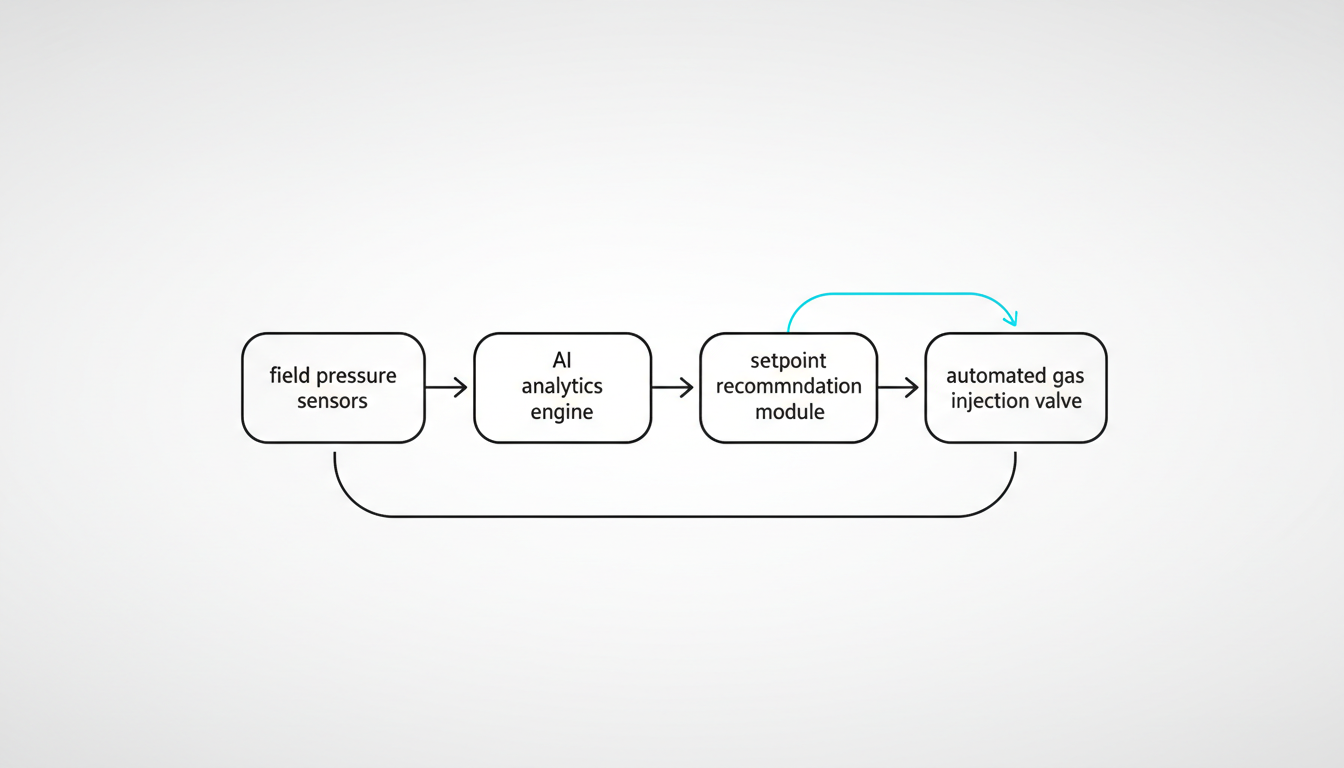
Strip away the branding and the core loop is consistent across every platform above: field sensors stream casing pressure, injection rate, and wellhead data continuously; an analytics engine runs nodal analysis and machine-learning models against that stream to flag wells drifting off their optimal curve; the platform proposes a new setpoint — a different injection rate, or in some cases a lift-method change; and, where closed-loop control is enabled, the system applies that setpoint directly through the injection valve or choke rather than waiting on an operator. The loop then repeats continuously, which is the entire point — it re-tunes as the well’s GLPC moves, instead of waiting for the next scheduled well test.
Where platforms differ most in practice is how much of that loop runs without a human: Leucipa and ForeSite both describe autonomous or near-autonomous operation today; OptiLift is explicit that it’s currently recommendation-based, with closed-loop control targeted for 2026; DesignRite isn’t a real-time control tool at all. Ask a vendor directly which stage of that loop is automated versus advisory for your specific lift type — the marketing language doesn’t always make the distinction obvious.
Finding the Economic Optimum: A Simplified Worked Example
To make the GLPC concept concrete, here’s a simplified version of the kind of curve-fitting these platforms run continuously in the background — not their proprietary algorithm, just the same underlying idea using a generic concave production-response curve and a basic grid search for the point where incremental gas stops paying for itself.
import numpy as np

# Simplified illustrative GLPC: liquid rate (bbl/d) vs. injection gas rate (Mscf/d)
def glpc(q_gas):
    return 900 * (1 - np.exp(-q_gas / 420)) - 0.00012 * q_gas ** 1.6

oil_price = 70.0      # $/bbl
gas_cost = 3.50        # $/Mscf of compressed lift gas

q_gas = np.linspace(1, 1400, 1400)
q_liq = glpc(q_gas)

# Marginal revenue per incremental Mscf of injection gas
marginal_bbl_per_mscf = np.gradient(q_liq, q_gas)
marginal_value = marginal_bbl_per_mscf * oil_price

# Economic optimum: where marginal value of the next barrel equals marginal gas cost
optimum_idx = np.argmin(np.abs(marginal_value - gas_cost))
print(f"Economic optimum injection rate: {q_gas[optimum_idx]:.0f} Mscf/d")
print(f"Production at optimum: {q_liq[optimum_idx]:.0f} bbl/d")
Run that against this post’s illustrative curve and the optimum lands around 760 Mscf/d of injection gas for roughly 748 bbl/d of liquid — meaningfully past where a lot of wells sit when nobody’s revisited the setpoint in a year. The AI platforms above are doing a far more sophisticated version of this same marginal-value logic, continuously, against a real GLPC rebuilt from live well data rather than a static textbook curve, and against oil and gas prices that move daily rather than ones hard-coded into a script.
Gas Lift AI Platforms Compared
| Platform | Lift methods covered | Closed-loop automation | Vendor-agnostic | Best fit |
|---|---|---|---|---|
| Baker Hughes Leucipa Lift Optimizer | Gas lift, plunger, rod, PCP, natural flow | Near-autonomous today | Yes | Mature fields with mixed lift types |
| Weatherford ForeSite (PetroVisor) | Any lift type, adaptable control logic | Autonomous well-operations module | Partial | Operators already on Weatherford lift equipment |
| SLB OptiLift | ESP, rod lift, gas-injection setpoints | Recommendation-based now; closed-loop in 2026 | Partial | Large ESP and rod-lift fleets |
| SLB DesignRite | Gas lift and ESP design/redesign | Design tool, not real-time control | Partial | New completions and lift-method selection |
| ChampionX / Ambyint (part of SLB) | Gas lift | Closed-loop adaptive control (legacy platform) | No | Operators evaluating it within SLB’s wider portfolio |
Feature claims are drawn from each vendor’s own product pages, verified in October 2026 — confirm current capability directly with the vendor before a purchase decision, since closed-loop features in particular are evolving quickly across this category.

Common Pitfalls When Rolling Out AI Gas Lift Optimization
- Bad instrumentation in, bad recommendations out. A platform optimizing against a drifting pressure transducer will confidently recommend the wrong setpoint. Calibrate and validate field instrumentation before trusting closed-loop control.
- Ignoring gas-system constraints. A per-well recommendation that’s optimal in isolation can still be wrong if the compressor or distribution header can’t actually deliver that much incremental gas across every well simultaneously.
- Treating closed-loop as “set and forget.” Every platform above still needs an engineer reviewing exception flags and sanity-checking recommendations, especially in the first few months after rollout, while the model is still learning each well’s behavior.
- Comparing marketing claims instead of your own data. Run a pilot on a representative subset of wells before committing fleet-wide — the uplift numbers vendors quote come from their best-case deployments, not necessarily your field’s geology or gas supply constraints.
Which Tool Fits Your Field?
If your pad mixes gas lift with rod pumps and plunger lift, start with Leucipa or ForeSite — both are built to span lift types rather than specialize. If your fleet is ESP-heavy with gas lift as a smaller slice, OptiLift’s dashboards are purpose-built for that split, with closed-loop control landing in 2026. If you’re not optimizing an existing gas-lift well at all but deciding whether a new completion or a declining well should even be on gas lift, start with DesignRite before you start with any real-time platform. And if a vendor pitches you “Ambyint,” know you’re now talking to SLB.
None of these platforms replace the physics — they replace the delay between the well drifting off its optimal curve and someone noticing. For the mechanics of the artificial lift methods these platforms are optimizing, the related reads below on plunger lift cycle timing and sucker rod pump volumetric efficiency are good next stops, alongside our breakdown of AI tools for ESP failure prediction if your field runs a mixed lift fleet.
