
By Saad Iqbal
A pipeline right-of-way is, from the air, one of the longest exhibits in industrial archaeology — decades of buried and above-ground steel, wrapped in coatings that are quietly failing in ways no one walking the line can see from the ground. For most of the industry’s history, the only way to find a corroding patch of pipe, a cracked valve, or a methane plume drifting off a wellhead at a remote pad was to send a person: a truck, a harness, sometimes a helicopter, always a day lost and an invoice to follow. A drone that launches itself from a weatherproof dock, flies the route without a pilot, and hands an AI model a severity-ranked list of defects before the inspector has finished their coffee is not a demo reel anymore. It is a line item in several operators’ maintenance budgets, and it is worth knowing which platforms are actually flying it.
Below are four AI drone platforms with real hardware, named customers, and verifiable use on pipeline and wellpad infrastructure — what each is built to do, the physics of why inspectors fly two cameras instead of one, and a rollout checklist for the regulatory and organizational speed bumps that trip up a first deployment more often than the hardware does.
How a Drone-in-a-Box AI Inspection Loop Actually Works
The appeal of a drone-in-a-box system is that nobody has to remember to use it. A weatherproof dock sits at the pad or along the right-of-way, charges the aircraft between flights, and launches it on a schedule or a trigger — a scheduled daily patrol, a gas sensor alarm, a pressure anomaly reported by SCADA. The drone flies a pre-mapped route using GPS where it is available and vision-based navigation where it is not, which matters enormously for the GPS-denied interior of a tank or a compressor shed. Onboard or in the cloud, an AI model scans the captured imagery for the handful of defect classes it was trained to recognize: corrosion, coating failure, vegetation encroachment, thermal hotspots, visible gas plumes. Each finding gets a severity score and a GPS coordinate, and the whole package lands in the asset-management or GIS system the operator was already using — not a new silo demanding its own login.

What makes this different from flying a consumer drone with a good camera is everything that happens after the shutter clicks. A human inspector reviewing a thousand photographs gets tired, skips frames, and misses the one pixel cluster that matters. A model trained specifically on corrosion, coating blisters, and thermal anomalies does not get tired, and it treats frame 847 with exactly the same attention as frame 1.
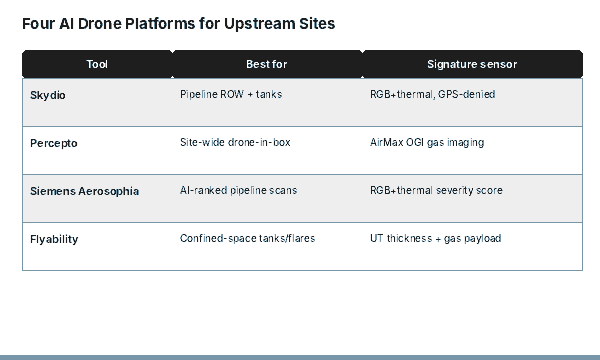
Four AI Drone Platforms for Upstream Sites
Skydio — pipeline right-of-way and tank interiors
Skydio built its name on autonomous obstacle avoidance — drones that fly fast through cluttered environments without a pilot white-knuckling the stick — and has since extended that into asset inspection for utilities, bridges, and oil and gas facilities. Its fixed-wing F10 Lightrunner covers long linear right-of-way efficiently, while the indoor-capable R10 handles GPS-denied interiors like tank farms, pairing RGB and thermal sensing with the same obstacle-avoiding autonomy that made the company’s name.
Percepto — site-wide drone-in-a-box programs
Percepto’s Air portfolio is a drone-in-a-box platform built for exactly the routine, scheduled patrol pattern a wellpad or tank farm needs. Its AirMax OGI configuration adds optical gas imaging, turning the same autonomous dock-and-fly loop into a standing methane-detection program rather than a one-off inspection, with the AIM software layer handling scheduling, geospatial data management, and the AI analysis that turns raw flights into flagged findings.
Siemens Aerosophia — AI-ranked pipeline and well-station findings
Aerosophia is a drone operations intelligence platform rather than a drone manufacturer — it combines drone-captured RGB and thermal imagery with computer vision and AI analytics to find and rank defects, and its Oil & Gas Pipeline & Site Monitoring offering is built specifically to inspect pipelines, pipe racks and well stations for corrosion, leaks, insulation defects and encroachment, then feed the results into existing GIS, CMMS and EAM systems rather than a standalone app.
Flyability — confined-space tanks, flares and vessels
Flyability’s Elios 3 is built for the inspections none of the other three platforms will touch: the inside of a tank, a flare stack, or a pressure vessel, where there is no GPS, no room to maneuver, and every wall is a collision risk. Its collision-tolerant cage lets it bump into structure without crashing, and payload options including ultrasonic thickness measurement and gas sensing turn a confined-space entry that used to require scaffolding and a permit crew into a flight that takes minutes. In practice, few operators buy all four platforms at once. Most start with one outdoor system for the long, repetitive right-of-way or tank-farm patrol — where the flight hours and the avoided truck rolls add up fastest — and only add a confined-space-capable drone once that first program is proven out and a flare stack, separator vessel, or tank interior becomes the obvious next item competing for the inspection budget.
RGB vs. Thermal: Why Inspectors Fly Both
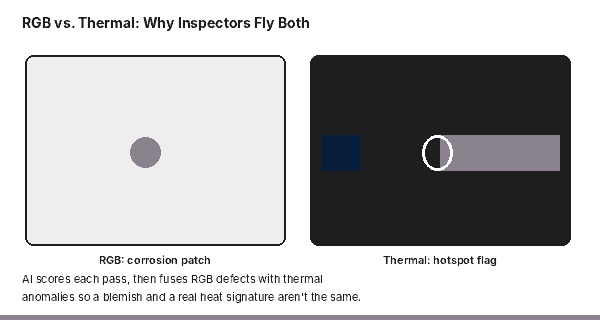
Every object above absolute zero radiates infrared energy in proportion to its temperature — a direct consequence of Planck’s law, the same physics that makes a cooling star visibly redden before it fades. A thermal camera is simply a sensor tuned to see that radiation instead of visible light, and on a pipeline it turns a hidden problem into an obvious one: a coating disbondment traps a thin layer of air or moisture against the steel, which changes how quickly that patch of pipe heats and cools relative to its healthy neighbors, showing up as a stubborn warm or cool patch no visible-light camera could ever register. RGB imagery, by contrast, is what actually confirms the problem to a human reviewer — a visible rust streak, a cracked coating, a dented shell. Flying both together, and letting the AI model fuse the two instead of inspecting each in isolation, is what separates a real anomaly from a shadow that merely looks like one in a single frame.
This is also why optical gas imaging, the sensor behind methane-focused drone programs, is really a specialized cousin of the same thermal principle: certain hydrocarbon gases absorb infrared light at specific wavelengths, and an OGI camera tuned to that wavelength renders an invisible plume as a visible, moving shape on screen. It is the same underlying electromagnetic bookkeeping, just pointed at gas absorption instead of surface temperature.
Rollout Checklist: AI Drone Inspection

- Map your BVLOS (beyond visual line of sight) flight rules before buying any hardware — the regulatory approval timeline, not the drone, is usually the long pole in the schedule.
- Pick two or three high-value routes first: the longest truck-patrol pipeline, or the highest-risk tank farm, rather than trying to cover every asset on day one.
- Confirm the platform routes AI findings to a human reviewer before anything gets actioned — autopublishing a false positive to a work-order system erodes trust fast.
- Integrate severity-ranked findings into your existing EAM or GIS system rather than standing up a new silo nobody outside the pilot team will ever log into.
- Track the false-positive rate against confirmed defects for the first 90 days before scaling sitewide; a program that cries wolf gets ignored.
- Keep a confined-space-capable drone on hand for flares, tanks and vessel interiors — an outdoor-only platform will leave exactly the inspections that are most dangerous for people to do unsolved.
If methane detection specifically is the driver behind a drone program rather than general corrosion inspection, AI Methane Leak Detection at the Wellpad lays out the EPA Super-Emitter threshold and how continuous ground sensors complement the kind of OGI flights described above, and Best AI Methane Monitoring Tools for Upstream O&G covers the satellite and fixed-sensor side of the same problem. And if the inspection you actually need is below ground rather than from the air, AI Well Integrity: Catching Corrosion Before It Leaks covers the downhole version of the same wall-loss story these drones are hunting for on the surface.
A drone in a box will not replace the engineer who understands why a pipeline fails — it replaces the truck roll, the harness, and the thousand bored minutes spent scrolling through photographs looking for the one frame that matters. Pick the platform that matches your actual inspection problem, fly RGB and thermal together, and let the severity ranking do what reliability teams have never had enough hours to do themselves: look at everything, every time.
