By Saad Iqbal

Energy AI connects two upstream stories: growing electricity demand from computing and better use of operational data within oil and gas. The Texas gas discussion becomes useful when an engineer separates a signed power agreement from actual fuel consumption, then links the demand scenario to wells, pipelines and facilities. This article reviews a September 2026 company announcement and explains how to assess its implications. Sources and interpretation were reviewed on 4 October 2026.
Table of Contents
Energy AI in Texas: what the Odessa announcement says
On 21 September 2026, New Era Energy & Digital announced a twenty year agreement with a Vistra affiliate for at least 200 MW and up to 207 MW of power for the first phase of its Texas Critical Data Center project. The stated source is Vistra’s existing 1,180 MW natural gas fired Odessa facility. This is a company announcement about contracted power, not evidence that the campus is already consuming that electricity.
The distinction matters for an upstream engineer following energy AI. A power purchase agreement defines an electricity relationship. It does not by itself establish a new gas purchase from a particular lease, a pipeline capacity reservation or a completed data center. Those additional links need separate evidence. A nearby gas plant can serve an electricity customer while continuing to buy fuel through its existing supply arrangements.
The announced allocation is only part of the plant’s stated generating capacity. Do not confuse the 207 MW customer agreement with a new 1,180 MW generating project. Nor should an engineer multiply a possible long term expansion by a headline capacity factor and treat the result as a committed gas market. Separate the contracted first phase from any future development concepts.
Question 1: does energy AI create incremental gas demand?
The engineering answer depends on the counterfactual. If an existing plant was already generating at the same output, moving part of its electricity sales to a new customer may create limited additional fuel demand at that plant. If the customer increases total output or changes the dispatch schedule, incremental consumption can be larger. The relevant quantity is additional generation compared with the case without the customer.
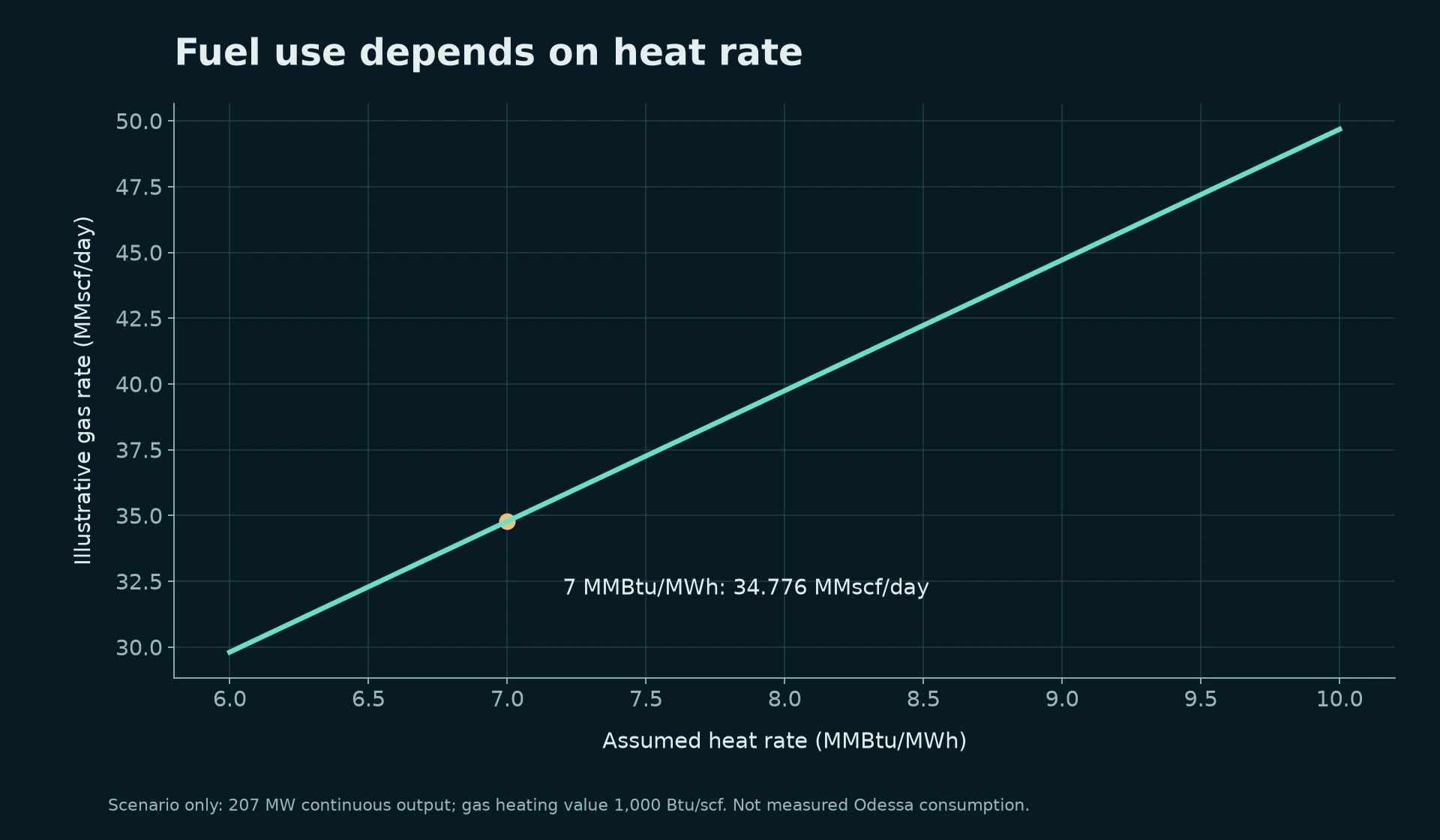
A simple illustrative conversion is fuel energy per hour = electrical output in MW × heat rate in MMBtu/MWh. At 207 MW and an assumed heat rate of 7 MMBtu/MWh, the arithmetic is 1,449 MMBtu/h. With an assumed gas heating value of 1,000 Btu/scf, that corresponds to 1.449 MMscf/h at full output. These are scenario assumptions, not measured operating values or a disclosed fuel requirement for the Odessa plant.
At that same illustrative full output, twenty four hours would consume 34.776 MMscf. Actual use depends on dispatched output, heat rate at load, outages and fuel heating value. A plant can have different efficiency at part load, so a constant heat rate calculation is a screening tool. It should not replace a performance curve or the generator’s fuel consumption forecast.
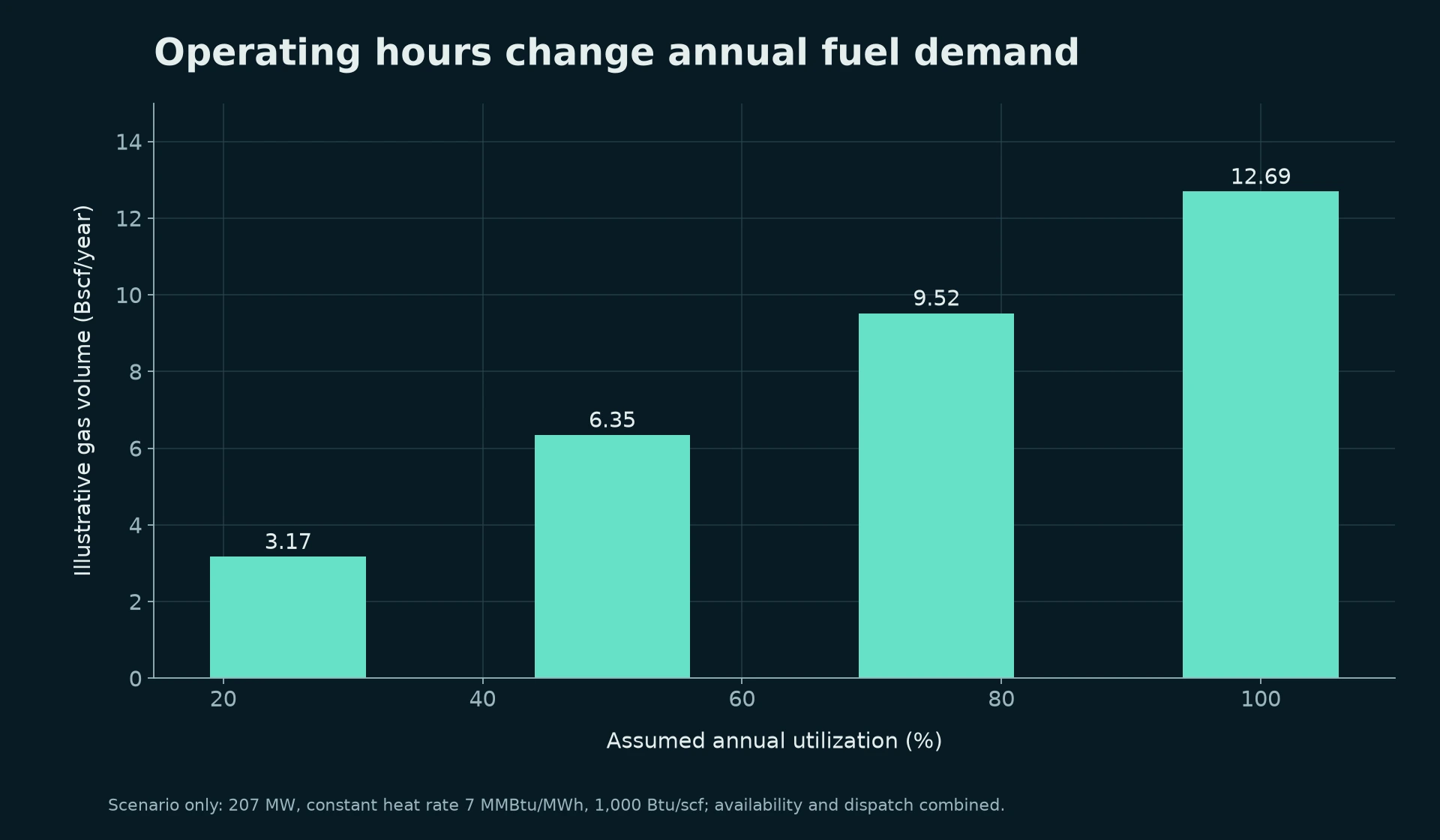
Energy AI demand discussions also need a time basis. Nameplate capacity is measured in MW, while electricity consumed over time is measured in MWh. Gas rate and annual gas volume are different outputs again. Write each conversion and its assumptions explicitly. A capacity figure without operating hours cannot establish yearly fuel use, even when the arithmetic looks precise.
Question 2: what can upstream planners infer from energy AI?
Treat energy AI announcements as scenario inputs with a maturity level. A useful project record separates a concept, a signed agreement, final investment approval, construction, commissioning and actual consumption. These milestones do not have equal predictive value. Update a development case as evidence improves rather than assuming every proposed campus reaches its maximum advertised load.
The U.S. Energy Information Administration’s March 2026 analysis examined how faster data center demand growth could affect generation under a higher demand scenario. It is a scenario study, not a guarantee of a particular plant’s dispatch or a basin’s gas price. Its value here is the reminder that demand growth, generation capacity and regional market conditions must be considered together.
For a field model, retain the existing reservoir and well performance evidence. An electricity announcement does not increase permeability, reserves or a well’s deliverability. The commercial case may change through realized gas price, local basis, takeaway capacity or the timing of infrastructure investment. Keep those assumptions separate from the subsurface forecast so the effect of each scenario remains visible.
Follow the physical route from well to customer. Confirm gathering pressure, processing needs, transport contracts and any constraint between the production system and the power plant. Proximity on a map does not prove available firm capacity. Gas composition, contaminants and heating value can also determine whether a stream is suitable for the intended fuel market.
An energy AI opportunity can be attractive while remaining uncertain. Compare a case with no incremental demand, a phased commissioning case and a higher demand case. Use realistic well decline and facility availability in each. Test whether the recommended drilling or compression plan still makes sense if the customer starts later or consumes less electricity than expected.
Question 3: how does energy AI help the operator itself?
Energy AI also describes industrial applications inside oil and gas operations. In its published AI overview, Aramco reports $2.6 billion of AI driven Technology Realized Value for 2025. This is the company’s reported value metric, rather than a universal savings rate that another operator should apply to its budget. It should also be distinguished from the larger value attributed to technology overall.
For a production team, the more useful question is which operational decision the model improves. Candidate applications include prioritizing suspect ESPs, screening liquid loading, checking well test data and coordinating a calibrated production network. Each needs usable measurements, defined outcomes and a workflow that puts the result in front of the person responsible for action.
Avoid comparing a planning cycle with the physical time to drill a well. Faster analysis can shorten the process of reviewing alternatives without making the drilling operation itself take only a few days. An energy AI result should name the task, baseline, observation period and outcome. A vague claim about speed can hide a change in scope rather than a real engineering improvement.
Evaluate an application against a simple existing baseline. Compare a predictive maintenance model with established rules using the same observations and alert frequency. For a forecasting tool, compare errors on future periods, not only on the data used to fit it. Include investigation time, missed events and data maintenance in the operational assessment.
A practical energy AI review workflow
Start with a source register. Store the announcement date, source, stated project phase and the assumptions that affect the engineering case. The date of an announcement is not the start of electricity deliveries. Check whether a later release changes scope or timing, and preserve the earlier version so a forecast update can be explained.
Next, translate the proposal into physical quantities. Keep MW, MWh, fuel energy and standard gas volume in separate columns. Document heat rate, operating hours and heating value. The charts below illustrate sensitivity to these assumptions; they do not represent a plant performance guarantee or a supplier commitment.
Then connect the scenario to the asset model. Apply any change in sales pressure, capacity or commercial assumptions at the appropriate boundary. Run the existing reservoir and well models through the same period. Inspect active constraints and conservation before accepting a higher field rate merely because a new outlet is proposed.
Finally, record a trigger for the next decision. An energy AI monitoring list becomes useful when a confirmed milestone causes a defined scenario update. The trigger might be commissioned capacity, actual fuel consumption or a signed transport arrangement. A headline alone is a reason to investigate, not sufficient evidence to change a reserves estimate.
Related upstream engineering reading
The underlying production forecast remains central to the energy AI discussion. Review decline curve analysis and forecasting tools for handling fit quality and uncertainty, and integrated asset modelling for linking wells, networks and facilities. These workflows help translate a demand scenario into a defensible operating case.
For an operational example of energy AI closer to the wellhead, see AI ESP failure prediction and its validation checks. The common requirement is the same: keep measurements, assumptions, inferred results and decisions clearly connected so a useful model remains auditable as conditions change.
An energy AI planning case should also record where the gas is delivered. A plant can be close to a producing basin and still face a constrained connection, maintenance outage or incompatible nomination schedule. Ask for the delivery point, pressure requirement, quality specification and firm transport arrangements before linking an electrical contract to a particular upstream supply opportunity. A basin total hides these local limits.
For energy AI demand scenarios, separate annual consumption from the peak day requirement. The utilization chart changes annual fuel use while holding output and heat rate assumptions explicit. It does not establish a dispatch schedule or a firm daily nomination. Startup fuel, auxiliary load, ambient conditions and partial load efficiency could alter the result. Replace the simple assumptions with plant operating data when it becomes available, and keep the original scenario as an auditable comparison.
An upstream investment decision also needs a price and reliability case. Test what happens when power demand grows more slowly, transport costs rise or a large customer delays commissioning. Compare those sensitivities with the timing of drilling, completion and pipeline commitments. Energy AI headlines can identify questions worth investigating, but the decision should rest on signed obligations, deliverability, economics and a documented downside case. Review the assumptions when a contract or operating milestone changes.