
By Saad Iqbal
Every driller has felt that sinking moment: the string stops moving, the weight indicator won’t budge past a certain pull, and somebody reaches for the phone to line up a fishing crew. Before any of that, though, there is a free point calculation to run — a few minutes of stretch-and-pull math that tells you how many feet of pipe are still free to move, and roughly where the stuck point sits. Get it right and you back off or sever in the correct joint on the first try. Get it wrong, and you cut good pipe while the actual problem sits somewhere else entirely.
This tutorial walks through the free point formula from first principles, works one full numeric example by hand, and then hands the math to a ten-line Python function so you never have to reach for a calculator on the rig floor again.

What a Free Point Calculation Actually Tells You
When pipe gets stuck — differential sticking, a keyseat, junk in the hole, packed cuttings, it doesn’t matter which — the string above the stuck point is still free. Pull on it, and that free section stretches elastically, exactly the way a spring does. The stuck section below doesn’t move and doesn’t stretch. So if you measure how much the pipe stretches at surface for a known overpull, and you know the pipe’s weight per foot, you can solve for the length of free pipe using nothing more than Hooke’s Law. That length, subtracted from your measured depth, gives you the approximate depth of the stuck point — the free point.
Before you start — what you need
Pipe weight per foot (W), in lb/ft, from your pipe tally
Overpull applied (P), in lb, measured above the free-hanging string weight
Recorded stretch (e), in inches, surface travel between slack-off and the applied pull
String depth (reference), in ft, so you can sanity-check the answer
Optional: a free-point-indicator (FPI) run, to cross-check the calculated depth
Step 1 — Why Stretch Reveals Depth
Hooke’s Law says stress is proportional to strain for an elastic material like steel, well within its yield strength. A hanging length of pipe under tension stretches by an amount proportional to its own length, the applied force, and inversely proportional to its cross-sectional area and Young’s modulus. Flip that relationship around and length becomes the unknown: the longer the free section, the more it stretches under the same pull. That’s the entire trick behind a free point calculation — it’s really just Hooke’s Law solved for length instead of stretch.
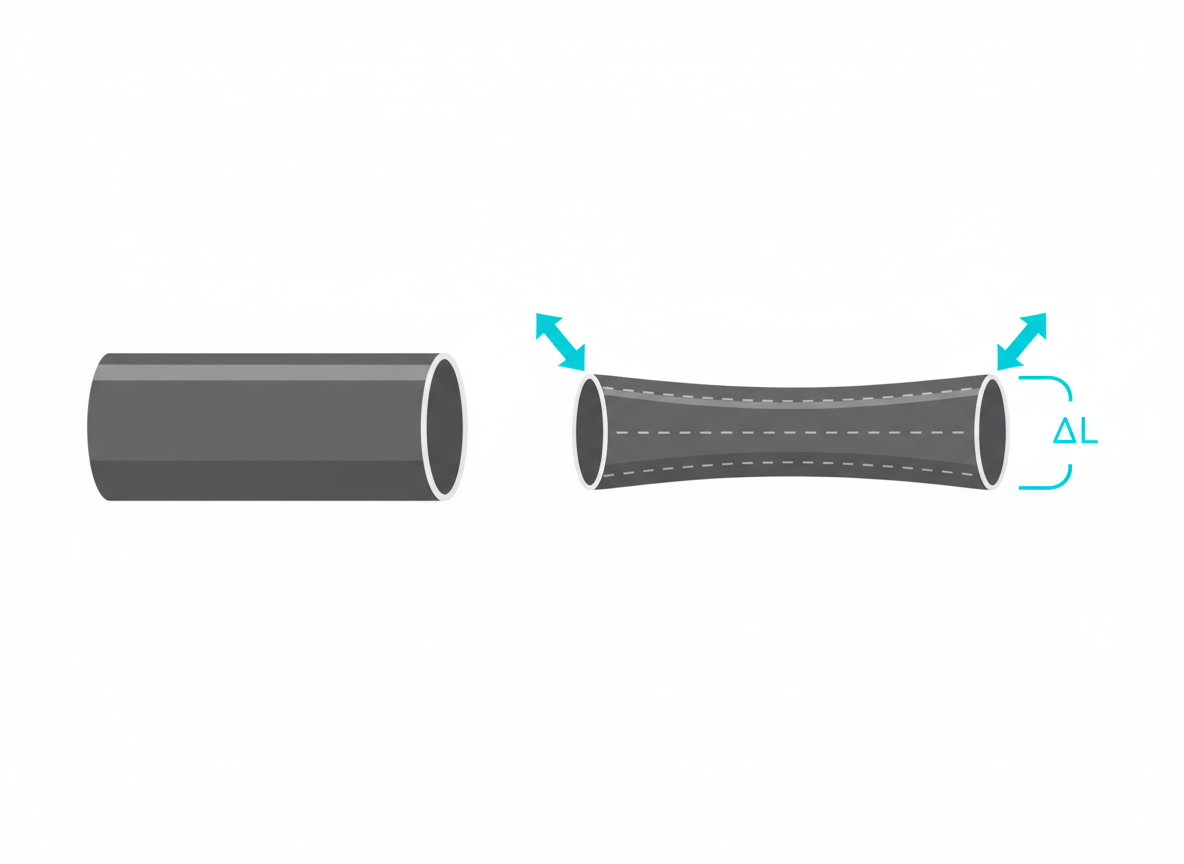
Why it matters: this is why a stuck pipe deeper in the hole always shows more stretch for the same overpull than a shallower stuck point would — more free steel means more spring to stretch.
Step 2 — Gather Your Numbers
Pull the pipe tally for the weight per foot of the string section you’re working with — don’t use a rounded “nominal” weight if you have the actual tally figure. Then run a controlled pull test: slack off to a known reference weight, mark the string at surface, pull to a measured overpull, and record how far that mark travels. That travel is your stretch, in inches.

| Input | Symbol | Example value |
|---|---|---|
| Pipe weight per foot | W | 16.6 lb/ft |
| Overpull applied | P | 20,000 lb (20 klb) |
| Recorded stretch | e | 18.0 in |
| String depth (reference) | — | 13,000 ft |
Why it matters: the free point formula is only as good as these four numbers — a rounded weight-per-foot or a sloppy stretch reading throws the whole answer off by hundreds of feet.
Step 3 — Work the Equation by Hand Once
Start from Hooke’s Law for a uniform steel string in tension:
e = (P × L) / (A × E)
where e is stretch in inches, P is the applied pull in lbf, L is the free length in inches, A is the pipe’s cross-sectional wall area in in², and E is Young’s modulus for steel (about 30 × 10⁶ psi). Solve for L, convert to feet, and substitute the standard steel relationship between weight per foot and cross-sectional area (W ≈ 3.4 × A), and the equation collapses to a form you can use directly with a pipe tally instead of a mill certificate:
L (ft) ≈ 735 × e × W / P
with e in inches, W in lb/ft, and P in klb (thousands of pounds)
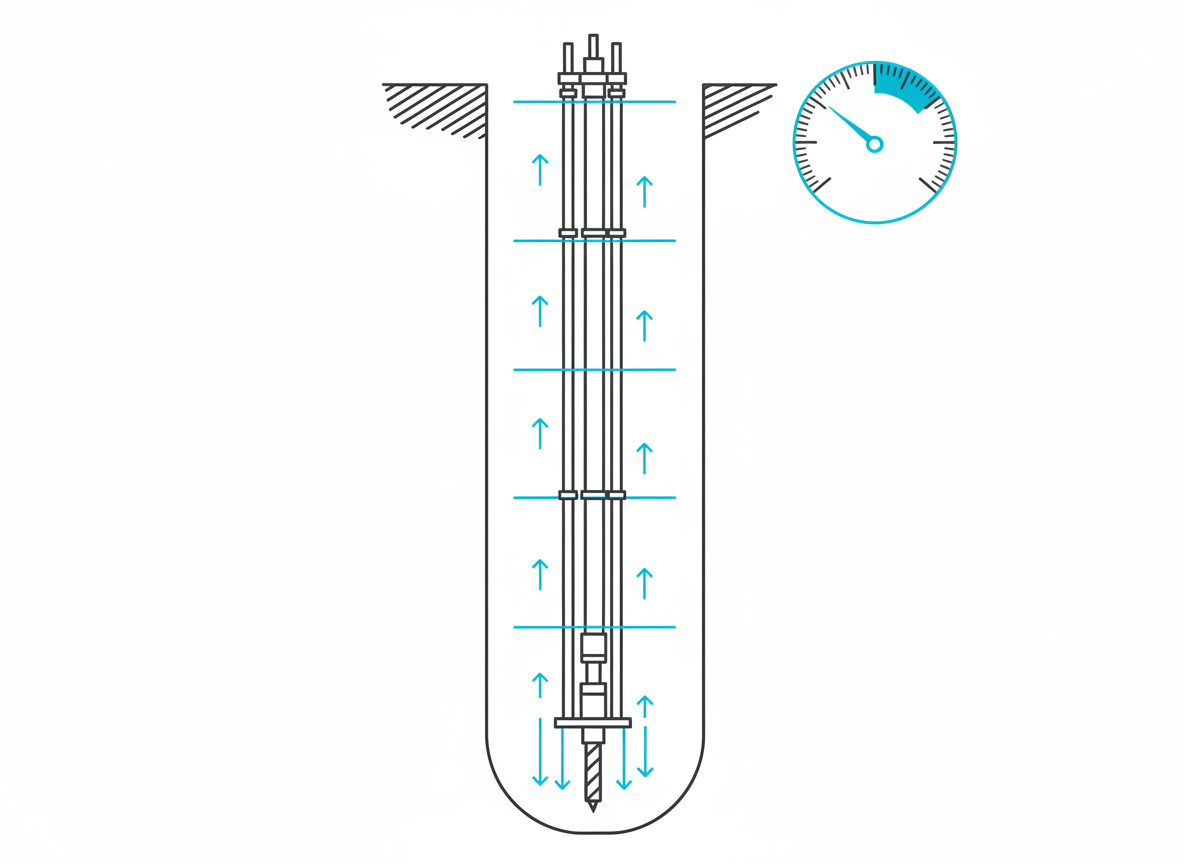
Worked example — 16.6 lb/ft drill pipe, stuck somewhere below 13,000 ft measured depth:
- e = 18.0 in, W = 16.6 lb/ft, P = 20 klb
- L = (735 × 18.0 × 16.6) / 20
- L = 219,582 / 20
- L ≈ 10,979 ft — the depth to the free point
Why it matters: once you can do this by hand, you’ll spot instantly if a script or spreadsheet gives you a nonsense answer — a critical habit before you trust any automated tool with a decision this expensive.
Step 4 — Automate It in Python
Once the formula is proven out by hand, there’s no reason to ever type it into a calculator again. A short Python function turns it into a one-line lookup, and you can run it from a laptop, a phone via a notebook, or wire it into a rig-floor spreadsheet with a couple of extra lines.

# free_point.py — automate the stuck-pipe free-point calc

def free_point_ft(stretch_in, weight_lb_ft, overpull_lb):
    """Return the depth to the free point, in feet."""
    K = 735.0  # derived from Hooke's Law, E = 30e6 psi steel
    overpull_klb = overpull_lb / 1000
    return (K * stretch_in * weight_lb_ft) / overpull_klb

depth = free_point_ft(stretch_in=18.0, weight_lb_ft=16.6, overpull_lb=20000)
print(f"Free point: {depth:,.0f} ft")
# -> Free point: 10,979 ft
Why it matters: a function beats a spreadsheet formula because it’s easy to unit-test against your hand calculation, version-control alongside your other well-engineering scripts, and reuse across every stuck-pipe event without re-deriving anything.
Step 5 — Sanity-Check the Result
Before you commit to a back-off depth, run the numbers through two checks. First, the result has to be physically possible — it must be less than or equal to your string’s measured depth; if the formula returns a free length longer than the hole, something upstream (weight per foot, unit conversion, or the stretch reading) is wrong. Second, re-run the calculation at a second overpull level. Because the formula is linear in stretch and inversely proportional to pull, a correct pair of readings should converge on the same free-point depth within a few percent — if they don’t agree, distributed friction or a dogleg is corrupting the reading, and it’s time to trust a free-point-indicator run over the surface calculation.

Why it matters: the surface calculation is a fast first estimate, not a substitute for a wireline free-point-indicator run when the fishing job is expensive enough to justify one — treat the two as complementary, not competing, tools.
Expected Result and How to Verify It
For the worked example above, you should land on a free point of roughly 10,979 ft out of a 13,000 ft string — meaning about 2,000 ft of pipe near the bottom is stuck. Verify it by repeating the pull test at a different overpull (say 15 klb instead of 20 klb) and confirming the calculated depth stays within a few percent, or by running a free-point-indicator tool if one is on location.
Common Pitfalls
- Mixing units. The practical form of the formula expects overpull in klb (thousands of pounds), not raw pounds — forgetting the /1000 conversion inflates the answer by 1,000×.
- Ignoring buoyancy and friction. This formula assumes a straight, frictionless, air-weight string. In a highly deviated hole, with heavy mud, or through a long dogleg, friction and buoyancy can shift the real stuck point meaningfully from the calculated one — treat the result as a strong first estimate, not a guaranteed depth.
- Using a blended average weight. On a tapered string (different weights or grades spliced together), plug in the weight per foot for the section you actually believe is stuck, not a single average for the whole string.
Free point math is one small piece of the well-control and fishing toolkit — the same “derive it by hand once, then automate it” approach pays off across the rest of your drilling calculations too. A few related tutorials worth bookmarking next: Kill Sheet Calculation in Python, ECD Calculation: Automate It With Python, and Minimum Curvature Method for Directional Drilling Surveys.
