
By Saad Iqbal
Three weeks. That’s roughly how long a manual history match can eat on a moderately complex field model — run, compare to production, adjust permeability multipliers by hand, run again, and repeat until the simulator finally agrees with what the wells have been doing for the last ten years. Meanwhile the asset team is waiting on that model to sanction the next infill pad. AI reservoir simulation tools exist for exactly this bottleneck: not to replace the physics, but to search the parameter space faster than a reservoir engineer manually iterating case files ever could.
2026 has been a pivotal year for this corner of the industry — the biggest AI-native reservoir engineering shop just got acquired by the largest oilfield services company, which tells you the majors are done treating this as a science project. Here’s what’s actually available, what each tool does differently, and where a good Python script still beats a six-figure license.
What AI-Assisted History Matching Actually Changes
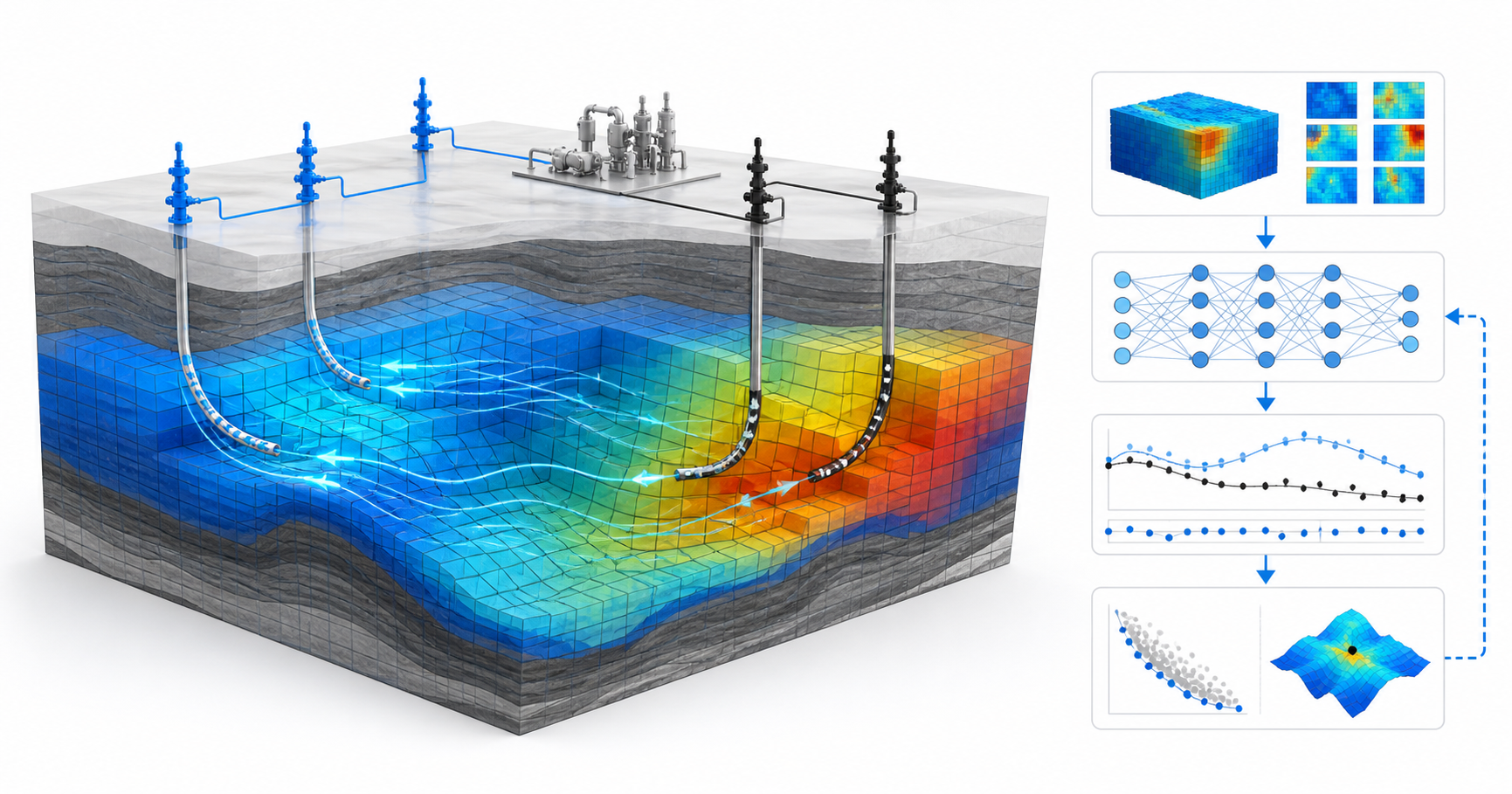
Classical history matching is an inverse problem: given the production history, find the reservoir properties (permeability, porosity, fault transmissibility) that would have produced it. Engineers have automated pieces of this for decades with assisted history matching (AHM) — gradient-based or ensemble methods bolted onto a conventional simulator. What’s changed in the last few years is the addition of machine-learning proxy models trained on a set of full-physics simulation runs, which can then predict the outcome of a new parameter combination in seconds instead of hours. The simulator still does the real physics; the ML layer just decides which cases are worth running next, which is why the tools below describe themselves as “physics plus data science” rather than pure black-box AI.

How Long Does AI-Assisted History Matching Actually Take?
There’s no single number, because it depends entirely on what “matched” means for your field, but the shape of the improvement is consistent across the vendors above: model build time drops from months to weeks because the proxy trains on a bounded set of full-physics runs instead of requiring every scenario to be hand-built, and scenario testing drops from hours per case to minutes because the trained proxy is what’s answering the “what if” question, not the full simulator. That compounds. A team that used to test three waterflood redesigns before a capital deadline can realistically test thirty. The physics simulator doesn’t disappear from the workflow — it’s still what validates the winning case before money moves — but it stops being the bottleneck on every iteration in between.
The AI Reservoir Simulation Tools Worth Knowing
1. Tachyus — physics-informed ML for waterflood and unconventional optimization
Tachyus builds what it calls “Data + Physics + Machine Learning” reservoir models — combining known reservoir physics with data-driven components so the model trains in weeks rather than the months a full-field simulation build can take, then runs what-if scenarios in minutes instead of hours. The company reports production increases up to 20% and operating-cost and emissions reductions up to 40% on optimization projects, with models running orders of magnitude faster than traditional physics-based simulators once trained. In 2026, SLB announced it would acquire Tachyus specifically to bring AI-driven reservoir management into its mainstream software stack — a strong signal that physics-informed ML for waterflood, CO2 flood, and unconventional well design is moving from niche vendor to standard offering. Best for: operators running active waterfloods, EOR projects, or large unconventional programs who want optimization recommendations, not just a matched model.
2. CMG CoFlow — collaborative integrated production system modeling
CMG’s CoFlow tackles a different pain point: getting reservoir, well, and facility engineers working on the same integrated asset model instead of three disconnected ones stitched together by hand. It’s built as an Integrated Production System Modelling (IPSM) platform with flexible model fidelity — engineers can dial component accuracy up or down depending on the question being asked — and it plugs into CMG’s CMOST uncertainty and optimization engine for the history-matching and investment-decision workflow. Best for: teams whose bottleneck isn’t the simulation run itself but the handoffs between reservoir, wells, and surface facilities teams during integrated asset modelling.
3. SLB Petrel and Intersect — the industry-standard simulator, now with AI workflows layered in
Intersect, run through Petrel’s reservoir engineering environment, is still the high-fidelity simulator most large operators build their base case in. It’s not the fastest way to explore uncertainty on its own, which is exactly why SLB’s acquisition of Tachyus matters: the plan is to fold physics-informed ML directly into that existing Petrel/Intersect workflow so the same engineers get faster history matching without switching platforms entirely. If your field model already lives in Petrel, this is the path of least resistance for adding AI-assisted history matching rather than maintaining a second toolchain. Best for: teams already standardized on Petrel/Intersect who want AI-assisted workflows without a platform migration.
4. Python + petropt — the DIY option for smaller assets
Not every asset justifies an enterprise license. petropt is an open-source Python library covering PVT, IPR, decline curves, and multiphase flow calculations, and it pairs naturally with general-purpose tools like Python, Jupyter, and pandas plus a standard optimization library (scipy’s differential evolution or a Bayesian optimizer) to build a lightweight assisted-history-match loop: define your uncertain parameters, wrap a fast proxy or material-balance model, and let the optimizer search for the combination that minimizes misfit against production history. It won’t replace a full-physics simulator for a complex, highly faulted field, but for a single-well or small-pad material-balance match, it costs nothing but engineering time. Best for: independents and small teams matching single wells or small pads who don’t need (or can’t justify) a full simulation license.

How Do These Reservoir Simulation Tools Compare?
| Tool | Approach | Best for | Typical entry point |
|---|---|---|---|
| Tachyus | Physics-informed ML, waterflood/EOR optimization | Active floods, unconventional programs | Field-scale optimization project |
| CMG CoFlow | Integrated production system modeling | Reservoir/wells/facilities collaboration | Enterprise IPSM license |
| SLB Petrel/Intersect | Full-physics simulation, AI workflows layering in | Teams standardized on Petrel | Enterprise simulator license |
| Python + petropt | Open-source material balance/proxy + optimizer | Single-well or small-pad matching | Free, engineer’s time only |
What the 20% Production Gain Actually Means

It’s worth being precise about what a vendor claim like “up to 20% production increase” is actually describing, because it isn’t the simulator inventing oil. A faster, better-calibrated model lets engineers test more waterflood patterns, injection rates, and well placements against history before committing capital — the production gain comes from picking a better operating strategy sooner, not from the AI changing the reservoir. That distinction matters when you’re building the business case internally: the ROI argument isn’t “the software finds oil,” it’s “the software lets your engineers evaluate ten times more scenarios in the time they used to spend on one,” which is a much easier claim to defend to a skeptical asset manager.
Where to Start
- Match the tool to the decision, not the field size. A single-well material balance match doesn’t need an enterprise simulator; a field-wide waterflood redesign usually does.
- Audit your existing simulator license first. If your team already runs Petrel/Intersect or CMG, check what AI-assisted history matching capability already ships with your current version before buying a separate platform.
- Start the proxy model on your most-drilled analog. ML proxies need training data — a well-characterized analog with a long production history gives the model something reliable to learn from before you point it at a wildcat.
- Keep an engineer in the loop on every accepted match. An automated history match that fits production data can still be non-unique or physically implausible; the fastest tool here still needs a reservoir engineer’s sanity check before it drives a capital decision.

The Bottom Line
The direction of travel here is obvious now that SLB has moved to acquire the sector’s leading AI-native reservoir engineering shop: physics-informed machine learning is becoming a standard layer on top of conventional simulation, not a replacement for it. Whether that shows up as an enterprise IPSM license, an AI-assisted module inside Petrel, or a Python script wrapping petropt for a two-well pad, the underlying idea is the same — spend the engineer’s time deciding which scenarios matter, and let the machine chew through the ones that don’t.
If nodal analysis and IPR/VLP work is part of your workflow alongside history matching, the related tool comparison below covers PROSPER, PIPESIM, KAPPA Rubis, and a free Python alternative. The water cut prediction piece is a useful companion for flagging breakthrough before it shows up in the production data you’re matching against.
Related reading: Nodal Analysis Software Comparison: 5 Tools, AI Water Cut Prediction: Spotting Breakthrough Early, and AI Frac Monitoring Tools for Upstream Teams.
