
By Saad Iqbal
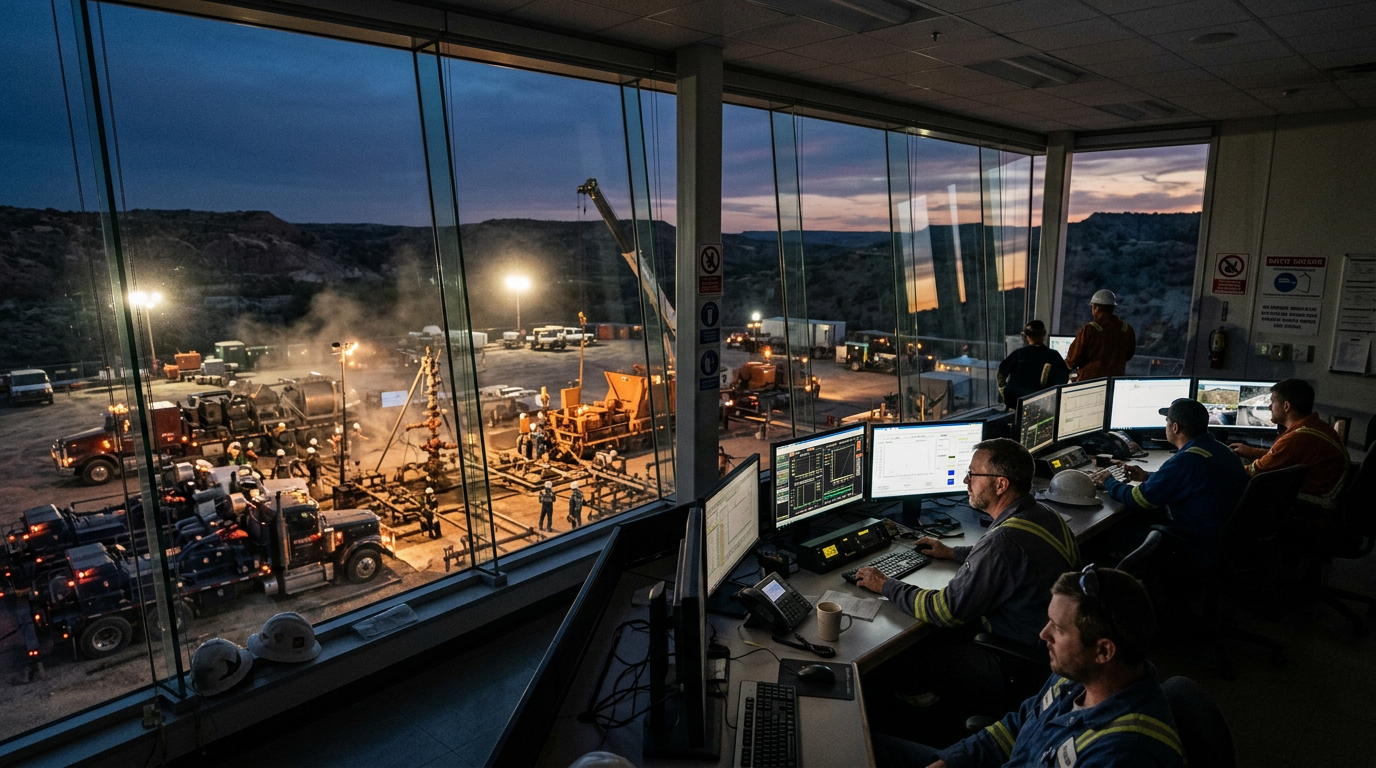
AI frac monitoring tools earn their keep somewhere around stage 14, when treating pressure begins to climb against a slurry rate that has not changed. It is not a spike yet—only a slope steeper than the previous stages. The frac van operator is simultaneously watching proppant concentration, annulus pressure, truck count and several other signals. By the time the pressure trace looks obviously wrong, the crew may already be fighting a screenout, pumping down and explaining a costly delay to the completions lead.
That forty-five minutes is exactly what a handful of AI platforms are now built to buy back. Not by replacing the engineer watching the van monitor, but by catching the slope change three or four data points before a human would flag it as more than noise. Here’s what’s actually running on frac locations in 2026, what each platform is genuinely built for, and where the line sits between “AI monitoring” and marketing copy.
What Real-Time Frac Monitoring AI Actually Watches
Every frac stage produces a dense, high-frequency stream: treating pressure, slurry rate, proppant concentration, annulus pressure, and on modern pads, downhole and offset-well pressure gauges too. A human operator can track maybe three or four of those series meaningfully at once, and only in relation to what “normal” looked like on the last few stages — which is exactly the kind of pattern-matching a model trained on thousands of prior stages does faster and without fatigue.
The failure mode these platforms are built to catch isn’t usually a total surprise. A screenout almost always announces itself first as treating pressure climbing against a slurry rate that hasn’t changed — proppant is bridging in the perforations or near-wellbore area, friction is building, and the well is telling you before it actually screens out. The value of AI monitoring is shrinking the gap between when that pattern starts and when a human notices it.

That’s the pattern in the chart above: slurry rate holding flat while treating pressure breaks away from its baseline. A trained model flags that divergence in seconds; a busy operator watching six screens might catch it a stage later. On a pad running twenty-plus stages a day, that gap compounds fast.
The economics behind that gap are straightforward even before you get to the AI layer. A screenout costs pumping time, sometimes a coiled tubing cleanout run, and occasionally a sidetrack around a stuck plug — real money on a day-rate spread crew. Shaving even a few minutes off the detection-to-decision window across a multi-well pad adds up over a completion program faster than most of the line items engineers scrutinize more closely.
4 AI Frac-Monitoring Platforms Worth Knowing

1. Corva
Corva built its name in real-time drilling data before extending the same platform into completions, and that lineage matters: it means your frac data can sit next to the drilling and production data from the same pad instead of living in a separate silo. Corva’s edge is its open app ecosystem — operators and third parties build custom monitoring apps on top of the same live data feed, so the anomaly detection you get is only as good as what’s been built for your specific completion design, but the platform underneath is genuinely real-time and genuinely open.
2. ZEUS iQ — Halliburton
ZEUS iQ is Halliburton’s intelligent fracturing platform, and unlike the other tools here, it doesn’t stop at flagging an anomaly — it’s built to close the loop and adjust pump rate or proppant concentration automatically on Halliburton’s own frac fleets. Chevron and Halliburton’s publicized joint work on intelligent fracturing in 2025 was built on this platform. The tradeoff is the obvious one: this level of automated response only works if you’re running Halliburton iron on location.
3. BullsEye — Momentum AI (mxv.ai)
BullsEye, from Momentum AI, is built specifically around pressure diagnostics and frac-hit detection across offset wells — the question of whether the well you’re stimulating is communicating with a producing neighbor. That’s a narrower job than full stage-by-stage operations monitoring, but it’s a job the broader platforms don’t do as a primary focus, and it’s a genuinely expensive problem to get wrong on infill pads.
4. FracIQ
FracIQ positions itself as an operations-intelligence layer for the completions crew rather than a single-vendor fleet system, aggregating field data into stage-level dashboards. It’s the option worth evaluating if your pad runs equipment from more than one pressure-pumping provider and you need one monitoring view that doesn’t care whose iron is on location.
From Raw Sensor Data to a Stop-Pumping Decision
Underneath the product names, every one of these platforms runs roughly the same pipeline: high-frequency sensor data goes in, an anomaly-detection model trained on historical stage data flags a deviation, and that flag becomes an alert an operator can act on — or, in ZEUS iQ’s case, an adjustment the system makes on its own.

None of that pipeline is exotic machine learning — it’s mostly time-series anomaly detection, the same family of technique used for predictive maintenance on rotating equipment. What makes it hard is latency: a model that flags a screenout risk thirty seconds after it happens is barely more useful than the operator who caught it visually. The platforms worth paying for are the ones that get that alert to a human, or to a valve, inside a couple of pump strokes.
How to Pilot One of These Platforms Without Betting the Pad
Every vendor conversation starts with a demo showing a clean anomaly catch on someone else’s pad. The questions that actually separate a useful platform from an expensive dashboard come later, and they’re worth asking before you sign anything:
- Where does the model come from? Ask whether the anomaly-detection thresholds are trained on your basin’s completion designs or a generic dataset. A model tuned on Permian slickwater jobs will misfire constantly on a Marcellus hybrid design.
- Does it integrate with your existing frac van software, or replace it? Corva and FracIQ are built to sit alongside whatever data acquisition system is already on location; a fleet-level system like ZEUS iQ assumes you’re running that vendor’s equipment end to end.
- Who owns the data once it leaves the wellsite? Real-time pressure and rate data is commercially sensitive, particularly frac-hit detection across offset wells that might belong to a different operator. Get the data-ownership terms in writing before the first stage.
- What’s the false-positive rate in practice, not in the pitch? Ask for a stage count, not a percentage — “94% accurate” means something very different on 40 stages than on 4,000.
The lowest-risk way to answer these is a single-pad pilot with a hard evaluation window — two or three days where the AI system runs alongside your normal monitoring without being the thing anyone actually acts on. Compare its flags against what your engineers caught manually, and don’t extend the pilot to full deployment until you’ve seen it catch something a human missed, not just confirm something a human already saw.
Common Pitfalls With AI Frac Monitoring
- Alert fatigue. A model tuned too sensitively flags every minor pressure fluctuation, and crews start ignoring alerts entirely — the same failure mode as a smoke detector that goes off every time someone makes toast.
- Training data mismatch. A model trained mostly on plug-and-perf stages in one basin’s rock won’t generalize cleanly to a different completion design or formation. Ask any vendor what their model was actually trained on before trusting it on your pad.
- Treating the alert as the answer. The AI tells you pressure is diverging from baseline; it doesn’t tell you whether that’s a near-wellbore screenout, a mechanical issue at surface, or a real geological effect. That diagnosis is still the engineer’s job.
The honest pitch for any of these platforms is the same one that applies to AI tools everywhere in upstream: they’re pattern-matching at a speed and consistency no human sustains across a twelve-hour pumping day, not a replacement for the judgment call about what to do once the pattern shows up. If you’re building out your own frac data pipeline before committing to a platform, the related read below on drilling anomaly detection covers the same underlying technique from the other side of the completion.
For more on AI catching operational anomalies before they become expensive, see how AI predicts stick-slip before it wrecks your BHA and the AI tools actually predicting energy failures.
