
By Saad Iqbal
It’s 3 a.m. and a pumper is standing at the wellhead of a rod-lift well that’s been quietly losing barrels for six days. Nothing alarmed. Nothing shut down. The pump card just drifted — a little more gas interference each stroke, a little less fillage — until Monday’s production report finally showed the dip. Multiply that by four thousand wells across a basin, each with its own rod string, its own gas lift valve depths, its own ESP frequency curve, and you get the real problem with AI artificial lift optimization software: it isn’t a nice-to-have dashboard, it’s the only way anyone actually sees six days of drift on well 4,000 before Monday.
Rod pumps, gas lift, ESPs, and plunger lift each fail in their own particular way, and each throws off a different signature — a dynocard shape, an injection-pressure trend, a motor amp curve — long before a human would notice. The tools in this piece are the ones actually doing that work in the field right now: reading the signature, running it against a physics model, and telling an operator (or, increasingly, a controller) exactly what to change. Here’s what each one covers, how the underlying loop works, and what you’d actually see if you logged in tomorrow morning.
Why Artificial Lift Needs an AI Co-Pilot
A field engineer with a laptop and a stack of dynamometer cards can diagnose a struggling rod pump in twenty minutes. The trouble is scale: a mid-size operator running 3,000 lift wells can’t put an engineer on every well every week, so most fields default to a monthly walk and a call-in-if-it-breaks policy. Artificial lift software closes that gap by running the same diagnostic logic — pump fillage, gas interference, injection efficiency, motor loading — continuously, on every well, and surfacing only the handful that actually need a human decision.
That’s the pitch behind every platform below, but “AI-powered” covers a lot of ground. Some tools stop at surveillance: they’ll flag that WELL-207’s gas lift injection rate has drifted, and leave the fix to you. Others close the loop entirely, writing a new setpoint straight to the RTU without a human in between. Knowing which is which matters more than the marketing copy, so the comparison below is built strictly from what each vendor documents publicly — not what the sales deck implies.
Four Platforms, and What Each One Actually Covers
Four names come up constantly in artificial lift optimization conversations, and they are not interchangeable — each grew out of a different corner of the lift business, and it shows in what they do and don’t cover.
- Ambyint — built specifically for optimization, not just monitoring. Its Infinity suite (InfinityRL for rod lift, InfinityGL for gas lift, InfinityPL for plunger lift) uses physics-informed models plus AI to classify setpoints and, distinctively, execute the optimized setpoint automatically across the well portfolio rather than just recommending it.
- ChampionX XSPOC — the broadest single platform, covering rod lift, gas lift, ESP, plunger lift, PCP, and even free-flow and facilities monitoring. XSPOC runs its own four-step loop — identify, diagnose, recommend, control — and can deploy on-premise, in the cloud, or fully hosted.
- SLB Pump Checker — narrower by design: it applies machine learning and physics-based optimization specifically to ESP and gas lift systems, prioritizing underperforming wells across a portfolio and handing back transparent, ranked recommendations rather than autonomous control.
- SLB Intelligent Lift — less a piece of software you log into and more a managed service: 24/7 remote surveillance and virtual flow-rate analytics run through SLB’s Performance Live centers, with domain experts in the loop alongside the algorithms, aimed mainly at ESP and PCP systems.
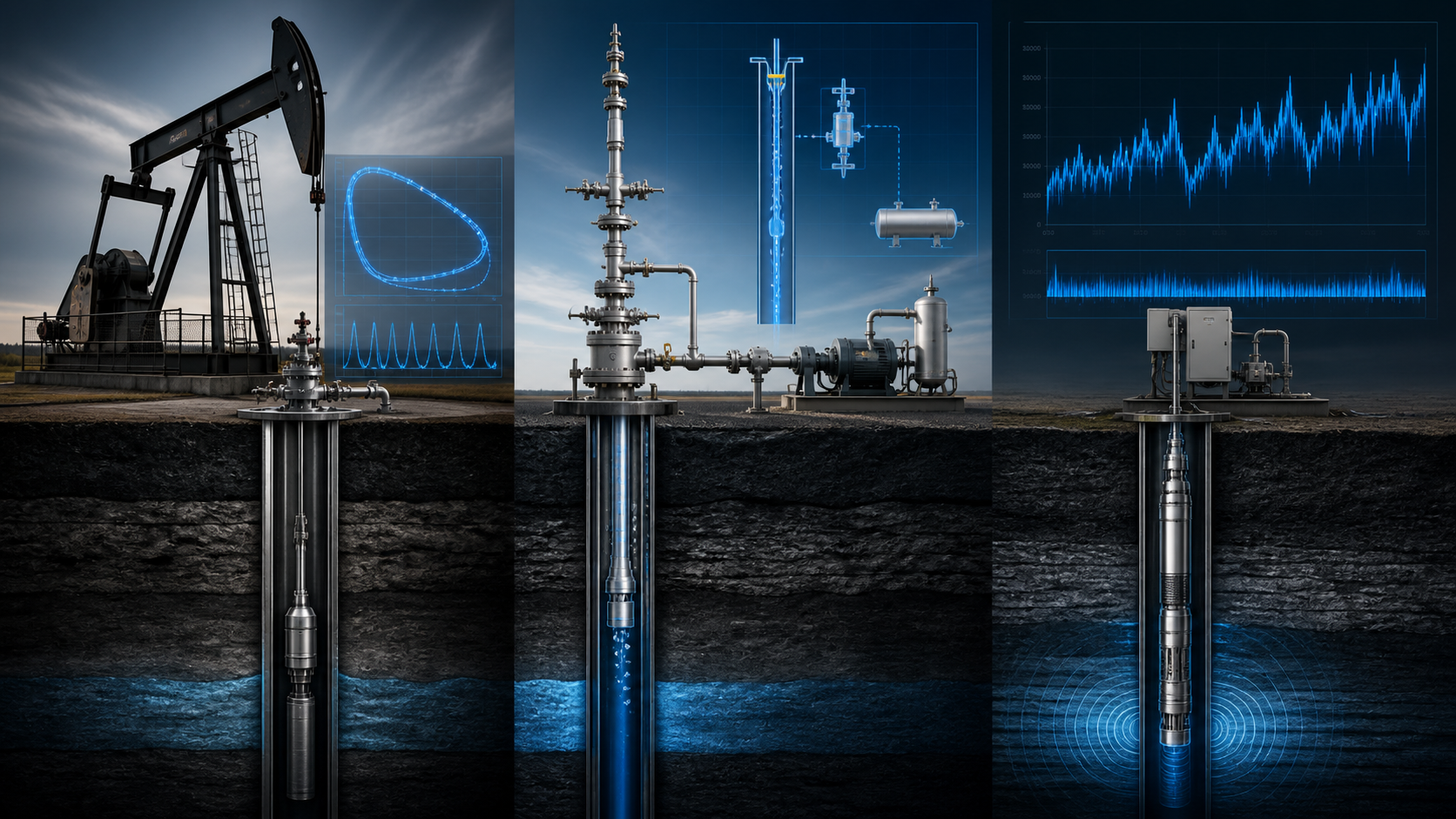
Notice the pattern: XSPOC and Ambyint are genuinely built to span the whole lift portfolio, while the two SLB products are narrower and ESP/gas-lift-leaning. If half your field is rod pumps, that alone should steer the shortlist.
How Does AI Artificial Lift Optimization Actually Work?
Strip away the branding and every one of these platforms runs some version of the same loop. It starts with the same raw data a pumper would use — dynamometer cards, injection rates and pressures, motor amperage, casing and tubing pressure — except it’s pulled continuously through SCADA instead of walked once a week. A physics model of that specific well (its pump, its rod string, its perforations) gets cross-checked against the live readings, and where the two disagree is exactly where the well is underperforming.
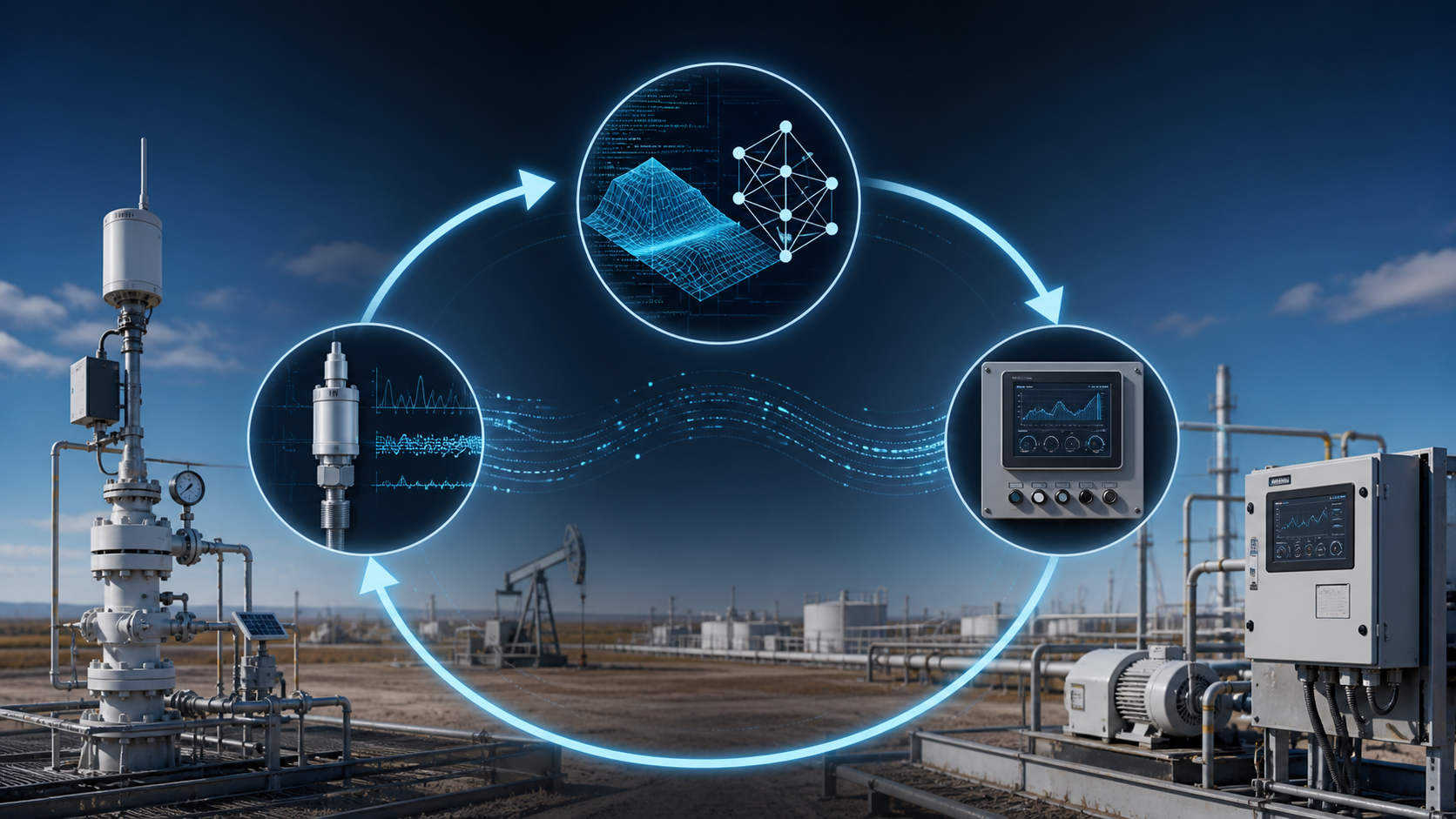
ChampionX describes its own version of this as a literal four-step sequence, and it’s a useful mental model regardless of which vendor you’re evaluating:

Where platforms genuinely differ is what happens at step four. Ambyint and XSPOC both support writing the new setpoint straight back to the field controller — a closed loop with no human in the middle unless you want a review gate in place. SLB Pump Checker and Intelligent Lift stop one step earlier: they hand you (or a Performance Live analyst) a ranked, physics-backed recommendation, and a person makes the final call. Neither approach is wrong; it depends on how much you trust automated control on wells where a bad setpoint can mean a stuck pump or a burned-out motor.
What Does a Lift-Optimization Dashboard Actually Show You?
It’s worth being concrete about this, because “AI dashboard” is vague enough to mean almost anything. In practice, a lift-optimization screen is organized around one card per well, and every card is answering the same three questions: is this well healthy, what changed recently, and what should I do about it.

A rod lift well showing 94% pump fillage at 6.2 strokes per minute is left alone; a gas lift well with injection drifting 8% off its model gets flagged for review; an ESP running a steady 62 Hz with nominal motor temperature is holding fine; and a plunger lift well with cycle time tripling gets a straightforward inspect-the-check-valve alert. None of that requires a person to have looked at the raw dynocard or the injection trend — the model already did that comparison and surfaced only the wells where the “AI setpoint” line actually needs a decision.
Which Artificial Lift Optimization Software Is Right for Your Field?
A few questions narrow this down faster than any feature comparison:
- What’s your lift mix? A field that’s mostly rod pumps with a handful of gas lift wells fits Ambyint or XSPOC better than the SLB tools, which lean ESP and gas lift.
- Do you want autonomous control, or a recommendation queue? If your team isn’t ready to let software write setpoints unsupervised, SLB’s advisory model — a person reviewing a ranked list — is the gentler on-ramp. If you’ve already got the trust and the change-management process, Ambyint’s and XSPOC’s closed-loop control removes a step your pumpers are doing manually today.
- How much do you want managed on your behalf? SLB Intelligent Lift bundles in 24/7 human surveillance through its Performance Live centers, which suits a lean field team; XSPOC and Ambyint assume your own engineers are driving the software.
- What’s already in your stack? XSPOC explicitly integrates with WellView, Open Wells, Spotfire, and Tableau, and communicates with essentially any major SCADA platform — worth checking against whatever you’re already running before you sign anything.
None of these tools replace the judgment of an engineer who knows the field, and none of them are magic — a physics model is only as good as the well data behind it, which is exactly why the identify-diagnose-recommend-control loop matters more than any single AI buzzword on the box. What they do is put that judgment in front of every well, every day, instead of every well once a month.
If you’re building the underlying calculations yourself rather than buying a packaged platform — nodal analysis, IPR/VLP intersections, or custom lift-performance models — our comparison of nodal analysis software is a useful next stop, and if you’d rather see the failure-prediction side of this same problem in more depth, how AI predicts ESP failures before they happen goes deeper on the modeling behind that specific lift type. For the production-monitoring half of the picture, AI water cut prediction covers a closely related surveillance problem on the reservoir side.
