
By Saad Iqbal

Every driller has lived this moment. The pumps are running steady, the chart recorder is scrolling along in its usual lazy rhythm, and then someone on the floor notices the pits look a little fat. Nobody panics yet — pit levels wander a few barrels all the time, chased by trip tank transfers, mud additions, temperature swings. By the time the trend is undeniable, the well has already been taking a kick for minutes, sometimes longer. The crew reacts well. They always do. But they are reacting to a signal that arrived late, because the sensor package that is supposed to warn them was designed around a threshold, not a pattern.
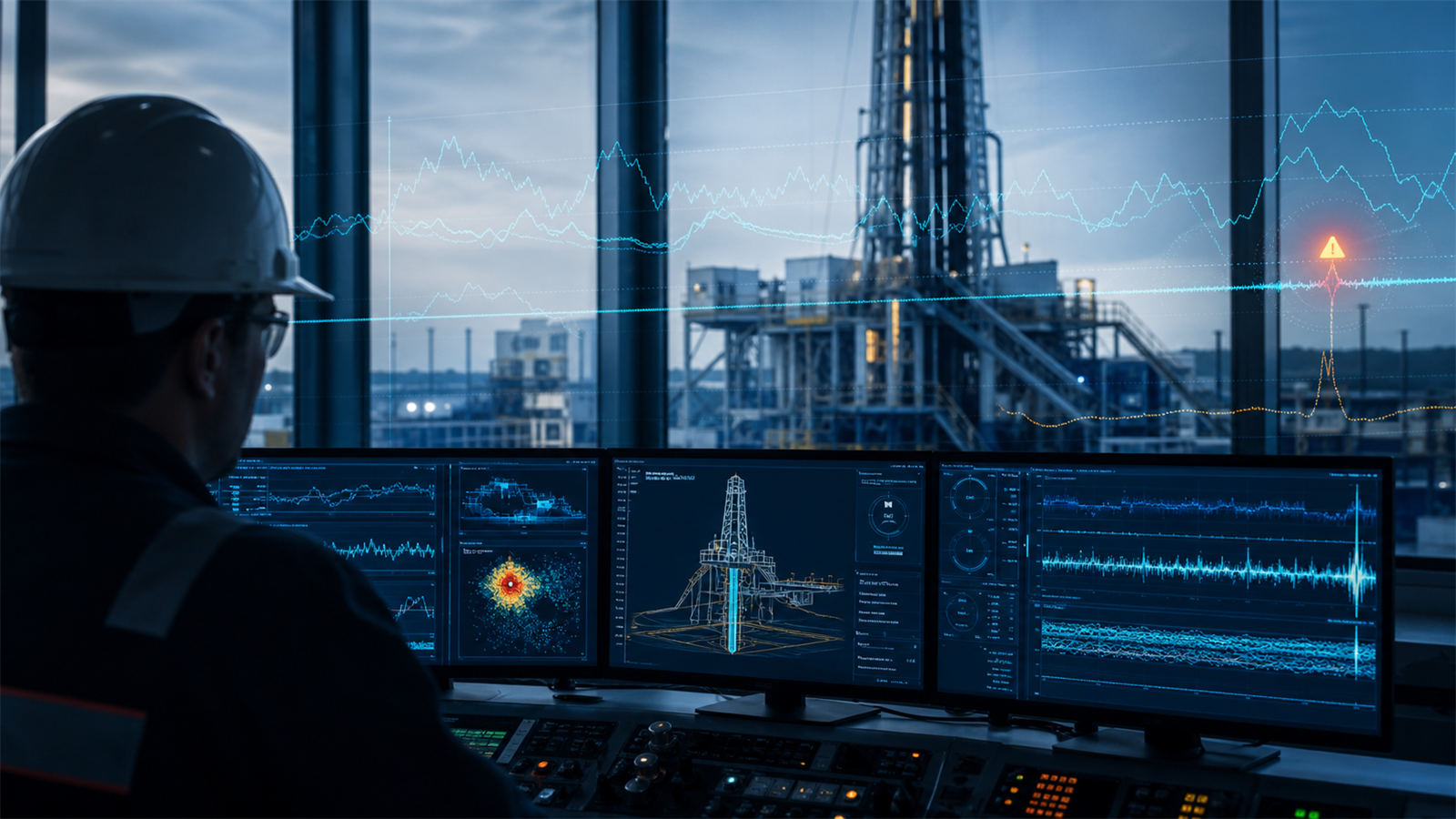
That gap between “the well kicked” and “we noticed the well kicked” is where a new generation of AI kick detection systems is quietly closing in. Not by replacing the pit-volume totalizer or the flow-out paddle, but by watching the same streams of data those instruments already produce and asking a much harder question: does this look like the well I trained on, or does it not?
Why pit-gain alarms are almost always the last to know
Conventional kick detection leans on a handful of threshold rules layered on top of a few surface measurements: flow-out versus flow-in, pit volume totals, standpipe pressure, and hookload. Each of those signals is noisy on its own — influenced by connections, surveys, mud additions, and rig-floor housekeeping — so operators set thresholds wide enough to avoid nuisance alarms. That’s a reasonable trade-off engineered for the tools available thirty years ago. The cost is lag. A real influx has to grow large enough to clear the noise floor before the alarm fires, and by then the crew is already behind the pressure curve.
A 2025 review in Processes walked through the last decade of instrumented early-kick-detection research and landed on the same conclusion from a different angle: single-threshold systems “often overestimate” kick occurrence, which pushes operators toward wider deadbands, which in turn slows the one alarm that actually matters. The fix researchers keep converging on isn’t a better threshold. It’s a model that learns what normal drilling looks like across every one of those signals at once, so it can catch the moment they start moving together in a way normal drilling never does.
How does AI kick detection actually work?
The most-cited version of this approach, published in SPE Journal in 2025, uses what’s called a 1D convolutional neural network autoencoder — a 1D CNN-AE, if you want the shorthand drillers actually use in the field. The idea is simpler than the name suggests. You feed the model long stretches of real-time drilling data — flow-in, flow-out, pit volume, standpipe pressure, hookload — from wells where nothing went wrong. The network learns to compress that signal down and reconstruct it, over and over, until it’s very good at recreating “ordinary drilling.”
Once it’s trained, you point it at a live well. At every moment, the model tries to reconstruct what it’s currently seeing. Most of the time it does a good job, because most of drilling looks like drilling. When an influx starts, the actual sensor readings drift away from anything the model learned as normal, and its reconstruction starts to miss — the gap between what it expects and what it sees, called the reconstruction error, spikes. Cross a threshold on that error signal, and the system raises a flag long before any single sensor would have crossed its own individual limit.

That’s the whole trick: the model isn’t looking for “flow-out is 40 barrels above flow-in.” It’s looking for “this combination of flow, pressure, and pit behavior doesn’t match anything I’ve seen labeled normal” — which is exactly the kind of subtle, multi-signal pattern a human on night shift, staring at one chart at a time, is least equipped to catch quickly.
What the data says: minutes, not seconds
The SPE Journal study didn’t stop at a proof of concept. The team ran the 1D CNN-AE against 730 hours of real-time monitoring data from eight offshore drilling operations across two deepwater pre-salt fields, spanning records from 2018 through mid-2025, including two documented real kick events. Against five other established autoencoder architectures from the literature, the 1D CNN-AE came out on top on every metric that matters to a drilling superintendent:

- 100% recall on the true kick events in the dataset — the model didn’t miss one.
- 31% fewer false-kick alarms than the historical baseline, which matters just as much as recall, because every unnecessary shut-in costs real money and crew trust.
- An average of roughly 100 minutes of extra warning before the event showed up in the operational report, versus the moment a conventional pit-gain alarm would have caught it.
Sit with that middle number for a second. A 31% drop in false alarms isn’t just a convenience metric. False kick alarms are the reason threshold systems get their sensitivity turned down in the field — every crew that’s been sent through an unnecessary flow check at 3 a.m. develops a healthy skepticism of the alarm panel. A detection method that’s both more sensitive and less prone to crying wolf attacks the exact failure mode that makes conventional systems slow in practice, not just in theory.
It’s not just autoencoders
The autoencoder approach is the one with the cleanest published field numbers right now, but it’s one branch of a broader research push. Long short-term memory (LSTM) recurrent networks have been used to treat kick detection as a sequence problem, learning how flow and pressure signals evolve over time rather than judging each instant in isolation. Other groups have framed it as a cost-sensitive classification problem, deliberately penalizing missed kicks far more heavily than false alarms during training, since the two error types are nowhere near equally expensive on a rig. A comparative SPE study on high-pressure wells put AI-predicted kick timing directly against what actually happened downhole and found the same pattern: earlier, more consistent warning than instrument thresholds alone.
None of these methods change the well control response once a kick is confirmed — shut in, read SIDPP and SICP, run your kill sheet, the fundamentals don’t move. What changes is how much runway the crew has before that sequence has to start, and how much confidence they have that the alarm reflects something real rather than a mud-additive blip.
What this means for the rig floor
None of this requires new hardware. The autoencoder, the LSTM, the cost-sensitive classifier — they all run on the same flow, pressure, pit, and hookload channels most rigs already stream to their data historian. That’s a deliberate design choice in the research, not an accident: a detection layer that needs an entirely new sensor package is a detection layer that never gets funded past the pilot stage. The practical shift is in where the analysis happens — a model trained on the specific field, mud system, and BHA configuration you’re running, sitting alongside the conventional thresholds rather than replacing them.
If you’re evaluating a vendor’s kick-detection claims, a few questions cut through the marketing quickly: What’s the model’s recall on your field’s historical kick events, not just a public benchmark? What’s the false-alarm rate compared to your current thresholds? And how much lead time does it actually add on your own well control incident log, not on a paper from a different basin? The SPE Journal numbers are a strong existence proof that the approach works — they are not a guarantee that any given implementation will hit them on your wells.
Does AI kick detection replace your well control procedures?
No, and none of the researchers behind this work claim it should. IADC well control certification, your kill sheet, your driller’s and toolpusher’s judgment on the floor — that stack doesn’t go away because a model is watching the data in parallel. What changes is the trigger point. Instead of waiting for pit gain or flow-out delta to cross a fixed threshold, the crew gets an earlier, statistically grounded nudge to run a flow check while the well is still easy to control. Think of it as moving the first domino earlier in the chain, not replacing any of the dominoes after it.
That distinction matters for how these systems get adopted. A driller who’s been burned by a false alarm from an over-tuned threshold system is rightly cautious about a black-box model claiming to be smarter. The honest pitch for AI kick detection isn’t “trust the model instead of your instincts.” It’s “the model watches more variables, more continuously, than any human can, and it tells you when something in that combination looks wrong — you still make the call.”
Where this fits with managed pressure drilling
Managed pressure drilling rigs are, in a sense, the natural early adopters here. MPD already closes the loop between surface choke control and downhole pressure in near real time, and it already ingests the same flow and pressure channels an anomaly-detection model needs. Layering a reconstruction-error model on top of an MPD control system doesn’t require new instrumentation — it requires access to the data stream that’s already there, plus a model trained on that specific rig’s normal operating envelope. Several of the published studies specifically target narrow-margin and deepwater wells, where the cost of a late kick response is highest and the value of an earlier flag is easiest to justify against the price of building and maintaining the model.
For conventional rigs without MPD, the same detection layer still applies — it just sits downstream of the standard choke manifold and driller response rather than an automated pressure controller. The model doesn’t care whether the response to its flag is a human closing a choke or a control system doing it automatically; it only cares about spotting the pattern early enough for either one to matter.
The same real-time sensor stream that feeds a kick-detection model is worth watching for other early-warning signs too — our look at how AI predicts stick-slip before it wrecks your BHA covers a closely related use of drilling-parameter anomaly detection, and how AI predicts ESP failures before they happen shows the same reconstruction-error idea applied downstream, once the well is on production.
Well control will always start with the fundamentals: know your kick indicators, drill your crew on the kill sheet, keep your margins honest. What AI kick detection changes is how early the fundamentals get to start.
