
By Saad Iqbal
Every pipeline controller has lived through the same scenario: an alarm fires at 2 a.m., the board lights up with a possible leak, the control room scrambles a crew, and three hours later it turns out to be a pump trip, a valve stroke, or a slow thermal transient settling out. Pipeline leak detection false alarms are so common on real-time transient model (RTTM) systems that many operators quietly turn sensitivity down just to keep the alarm log usable — which is exactly backwards from what a leak detection system is supposed to do. Machine learning residual classifiers, layered on top of the RTTM you already run, are one of the more practical fixes for this, and this post walks through how they work, what they actually change, and where they can still get it wrong.
Why RTTM Systems Cry Wolf
A Real-Time Transient Model solves the unsteady conservation equations for mass, momentum, and energy along the pipeline, using pressure and flow measurements at the boundaries (and sometimes intermediate points) to estimate what’s happening inside the line. When measured flow-in and flow-out diverge beyond what the model expects from line-pack and compressibility effects, the system raises a deviation — the classic negative-pressure-wave and mass-balance logic that’s been the backbone of Computational Pipeline Monitoring (CPM) since the API 1130 framework formalized it.
The problem is that a lot of ordinary pipeline events produce the same signature a small leak does:
- Pump and compressor transients — starts, stops, and speed changes create pressure waves that look like a sudden mass imbalance
- Valve operations — partial closures or line-up changes shift flow splits in ways the model hasn’t seen recently
- Batch interfaces and density changes — in liquid lines carrying multiple products, an interface passing a meter station can mimic a leak’s pressure gradient
- Thermal transients — temperature-driven volume changes, especially overnight or after a rate change, look like line-pack loss if the thermal model is even slightly off
- Instrument drift and meter noise — small calibration errors accumulate into a mass-balance residual that looks exactly like a slow leak
A pure physics-based RTTM has one knob to deal with all of this: the alarm threshold. Set it tight and you catch small leaks fast but drown in false alarms. Set it loose and the false alarms stop, but so does your ability to catch the leak sizes that actually matter for small, slow seepage. That trade-off is the entire reason E-RTTM and ML-augmented approaches exist.

What Does an E-RTTM Actually Add?
Extended RTTM (E-RTTM) keeps the physics-based transient model as the core engine but adds a second-stage classifier that looks at the shape of the residual, not just its magnitude, before deciding whether to escalate to an operator. Instead of a single threshold crossing, the classifier is trained on how real leak residuals evolve over time compared to how transient-event residuals evolve, and it scores every deviation for how leak-like it actually looks.

Typical features the residual classifier is trained on:
- Rate of change and persistence of the mass-balance residual (a transient spikes and decays; a leak tends to sustain or grow)
- Correlation between the residual and known operational events — pump starts, valve commands, setpoint changes pulled from the SCADA event log
- Pressure gradient shape along the line, which differs between a localized leak and a line-wide thermal effect
- Flow and pressure variance in a rolling window leading up to the deviation
- Time since last confirmed operational transient of the same type, since recently-seen transients are the most common false-alarm source
The model itself is usually a gradient boosted tree or a random forest, for the same reason it shows up everywhere else in this kind of work: the labeled dataset (confirmed leaks plus confirmed false alarms with their root cause tagged) is rarely large, and tree ensembles handle that scale of tabular data, with mixed continuous and categorical features, better than a deep architecture would. Some newer implementations use a lightweight recurrent or 1D-convolutional model directly on the residual time series, but the operational systems in wide field use today are still mostly boosted-tree classifiers sitting on top of hand-engineered residual features — easier to validate, easier to explain to a regulator, and easier to retrain when a line’s operating envelope changes.
How Much Does This Actually Reduce False Alarms?
Field deployments reported in SPE and pipeline-industry literature over the past few years consistently show the same pattern: a large cut in false alarm rate with a comparatively small loss in sensitivity to real small leaks, which is the trade the alarm-threshold knob alone could never offer.
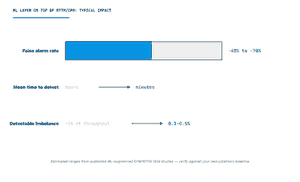
The reason this trade works is visible once you look at what the classifier is actually keying on. A transient event’s residual spikes and relaxes back toward zero as the pipeline re-equilibrates. A true leak’s residual, in contrast, settles onto a sustained offset that persists — a straightforward but surprisingly reliable discriminator once you’ve trained on enough confirmed examples of each.

Where This Still Breaks
None of this is a free lunch, and a few failure modes show up repeatedly in field experience:
- Label scarcity. Confirmed leaks are (thankfully) rare, so most of the training signal comes from confirmed false alarms. A classifier trained mostly on “what a non-leak looks like” can still struggle with leak signatures it has never actually seen, especially slow seepage at the smallest detectable rates.
- Operating envelope drift. A line that changes service, adds a new offtake, or shifts to a different product slate can produce transients the classifier wasn’t trained on, which either reintroduces false alarms or, worse, causes it to under-weight a real event that resembles a now-common transient.
- Multi-phase and slack-line conditions. RTTM accuracy itself degrades in multi-phase flow or slack (partially full) line segments, and a residual classifier built on single-phase assumptions inherits that weakness.
- Regulatory and API 1130/1175 alignment. Any ML layer added to a CPM system used for regulatory leak detection reporting needs documented performance testing consistent with API 1130 (CPM systems) and the broader API 1175 leak detection program framework — this isn’t a drop-in black box you swap in without a validation and commissioning process.
The practical takeaway: an ML residual classifier is best framed as a second opinion that filters what reaches the control room, not a replacement for the underlying RTTM’s physics or for the commissioning rigor that CPM systems already require.
What a Deployment Actually Looks Like
Operators rolling this out tend to follow a similar sequence:
- Mine the historical alarm log and tag every past deviation with its confirmed root cause — leak, pump event, valve operation, batch interface, instrument issue, or unresolved.
- Engineer residual-shape features (persistence, rate of change, correlation with SCADA event tags) from the RTTM’s existing output, without touching the underlying hydraulic model.
- Train a gradient boosting or random forest classifier on the tagged history, holding out the most recent period for validation rather than a random split, since pipeline behavior drifts with season and operating mode.
- Run the classifier in shadow mode alongside the live RTTM for a commissioning period, scoring every real deviation without yet suppressing any alarms, to confirm it isn’t quietly masking small leaks.
- Promote it to an active filter that re-ranks or holds low-confidence alarms for a short confirmation window, while still passing high-confidence leak scores straight through at full urgency.
Vendors active in this space include Atmos International, whose Atmos Pipe and SCADA-integrated analytics have been extending RTTM-based leak detection with statistical and machine learning layers for a number of years, and Emerson’s DeltaV PipelineManager, which runs RTTM-based analytical leak detection as part of a broader pipeline management software suite. Either is a reasonable starting point if you’re evaluating a commercial platform rather than building a residual classifier in-house.
This fits alongside the broader pipeline integrity toolkit most operators are already assembling. If you haven’t compared current options for the adjacent corrosion and mechanical-integrity side of the same pipelines, our look at AI pipeline integrity management software and our rundown of AI corrosion monitoring tools for oil and gas pipelines cover the complementary half of the risk picture — leak detection catches the event, corrosion monitoring is what keeps you from getting there in the first place.
The false-alarm problem on RTTM systems isn’t new, and it isn’t going to disappear just because a classifier gets bolted on. What changes is that the burden of distinguishing “pump trip” from “leak” shifts from an operator’s gut feel at 2 a.m. to a model trained on exactly the alarm history that operator has been living with for years. That’s a meaningfully better starting point, even with all the caveats above.
If your control room is sitting on years of tagged alarm history and you’re weighing whether to build a residual classifier in-house or buy into a commercial E-RTTM platform, drop a comment with what’s driving that decision for you — data volume, headcount, or regulatory comfort tend to be the real deciding factors, more than the modeling technique itself.
