
By Saad Iqbal
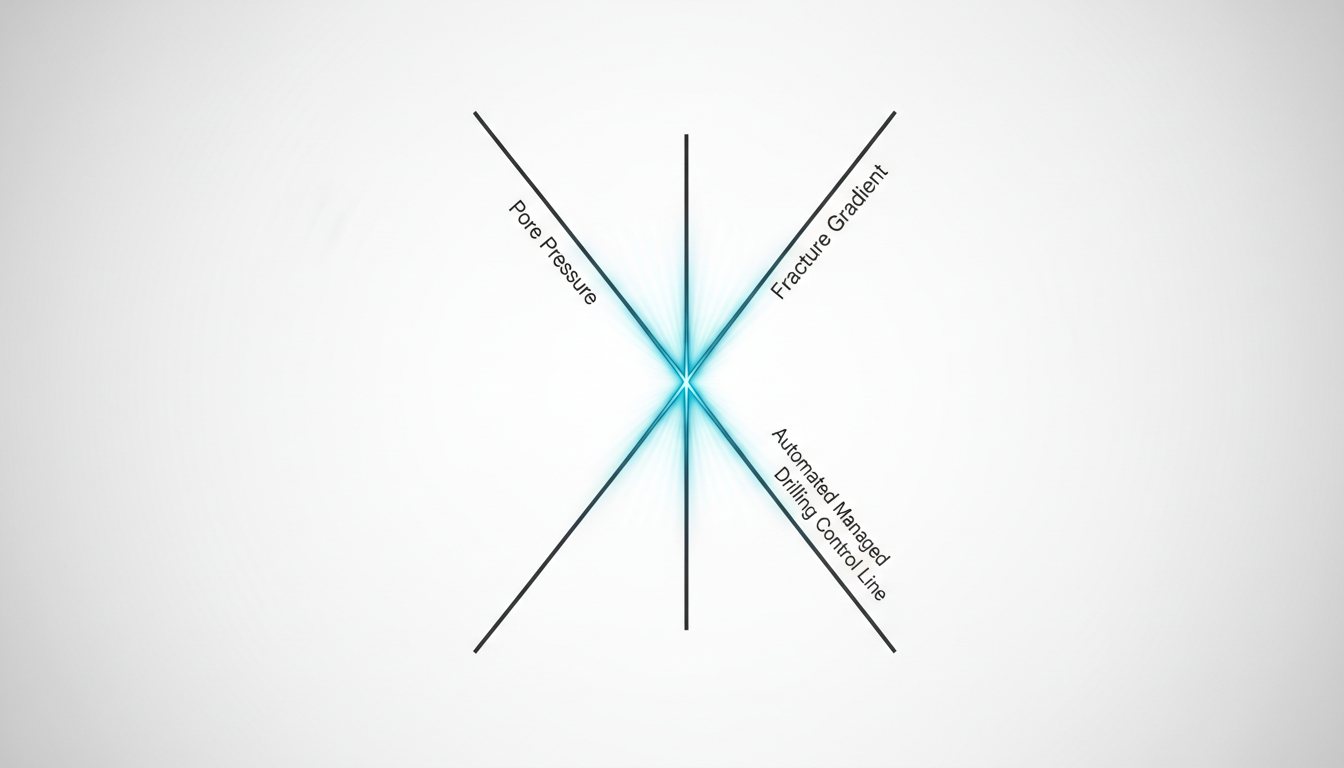
Somewhere around 11,500 ft true vertical depth, a driller is watching two numbers that are only 0.6 ppg apart: the pore pressure gradient below, and the fracture gradient above. Drift under the first and the well kicks. Drift over the second and you lose returns to the formation. A static mud weight has to clear the worst case everywhere in that string at once, which in a narrow-margin well can mean there’s no single number that works from top to bottom. That’s the exact problem managed pressure drilling automation was built to solve, and in 2026 it’s no longer a specialist service reserved for HPHT exploration — it’s an automated choke doing in real time what used to require constant manual adjustment and a very nervous company man.
This post walks through the real, currently-available MPD systems doing that automated pressure control today — what they actually control, how automated the control loop really is, and where each one fits — grounded in each manufacturer’s own published specifications.
Why a Static Mud Weight Isn’t Enough in a Narrow Window
Conventional overbalanced drilling uses one mud weight for the whole interval, high enough to hold back the highest pore pressure anywhere in the open hole. In a well with a wide margin between pore pressure and fracture gradient, that’s a non-issue. In a narrow-margin well — depleted reservoirs, deepwater salt sections, some HPHT exploration — that single static number can sit below pore pressure at one depth and above fracture gradient at another, simultaneously. You cannot drill that interval safely with a fixed mud weight, full stop.
Managed pressure drilling solves this by closing the annulus at surface with a rotating control device and applying adjustable surface backpressure through a choke, so the equivalent circulating density (ECD) — not a static mud weight — is what’s held inside the margin. Because ECD responds instantly to pump rate, pipe movement, and connections, the backpressure has to be adjusted continuously to compensate. Do that by hand and you’re always a few seconds behind the well. Do it with an automated choke and control algorithm, and the correction happens before a human could react.
How an Automated MPD Choke Actually Holds Pressure Constant
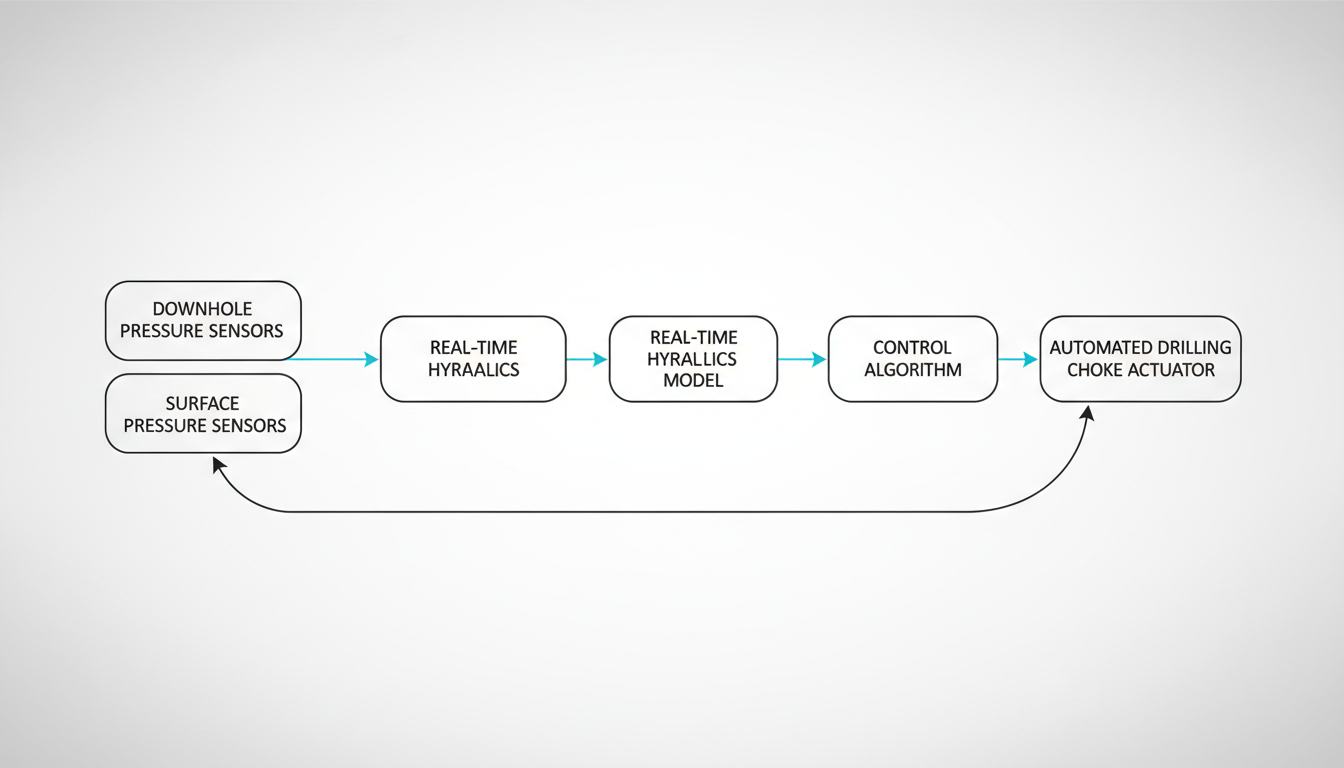
Every automated MPD system on this list runs some version of the same closed loop. Redundant pressure sensors — standpipe pressure at surface, and on the more advanced systems, downhole and annular pressure as well — feed a real-time hydraulics model that predicts what bottomhole pressure should be doing right now, given current pump rate and pipe position. A control algorithm compares that predicted pressure against the target and computes a correction. An electrically or hydraulically actuated choke applies that correction by opening or closing in a fraction of a second, well inside the window a human operator could react in. The loop then repeats continuously through connections, trips, and drilling, which is what lets MPD hold ECD inside a margin that would be impossible to drill with a fixed mud weight.
The differences between systems come down to how the choke is actuated, how much of that loop runs without an operator in it, and how much sensor redundancy backs up the correction — which is exactly what matters when you’re choosing between them for a specific well.
The Best Managed Pressure Drilling Automation Systems
1. NOV mPowerD 1500SE
The 1500SE is the most automated choke in NOV’s mPowerD line: an electrically actuated choke paired with an advanced control algorithm and triple-redundant wellbore pressure sensors, built specifically for the most precise bottomhole pressure control in the lineup. It integrates with NOV’s Comprehensive Hydraulics Model for real-time pressure prediction and can run through a dedicated NControl HMI or integrate into NOV’s NOVOS reflexive drilling system via the NControl MPD App. A Dual Choke Mode lets an operator run a secondary choke manually while the primary runs automatically, and the system can switch chokes on a fault or when the primary can’t reach its setpoint — without losing control of wellbore pressure mid-switch. For the narrowest drilling margins, this is the system built around precision first.
2. Weatherford Victus Intelligent MPD
Victus pairs a hydraulic choke manifold with Weatherford’s real-time analytics, and the “intelligent” branding reflects integration with the broader ForeSite platform for smart alerting rather than a bare manifold bolted onto the rig. It’s positioned for narrow-margin applications including HPHT and deepwater wells, where the combination of automated choke response and continuous analytics flags abnormal pressure trends before they become a well-control event rather than after. For operators already running other Weatherford drilling and evaluation services, it slots into the same data and analytics backbone as the rest of the rig’s instrumentation.
3. SLB AutoChoke + @balance Control
The AutoChoke is SLB’s pressure-balanced drilling choke, rated at 3,000 and 10,000 psi with a self-cleaning orifice and field-replaceable tungsten-carbide or Stellite-coated wear parts — engineering details that matter because MPD chokes see continuous erosive flow, and a choke that plugs or wears out mid-well defeats the entire point of automation. As drillpipe moves into the hole, a patented sliding shuttle and sleeve design automatically displaces an equal volume of fluid through the choke to hold casing pressure, which is what makes stripping pipe safer under pressure. SLB pairs the hardware with its separate @balance Control MPD systems, offering automatic, semiautomatic, and manual control depending on the operation — useful versatility across MPD, underbalanced drilling, well control, and frac flowback on the same equipment.
4. Halliburton Managed Pressure Drilling Services
Halliburton’s MPD offering is built around customized programs rather than a single off-the-shelf choke product — rotating control devices, full MPD and underbalanced drilling packages, and the Eni-patented e-cd continuous circulation system, which keeps the pumps circulating through connections instead of stopping, removing one of the more disruptive pressure transients in a conventional connection sequence. Halliburton reports a case study on an autonomous managed pressure cementing operation reducing personnel exposure and environmental risk, alongside a collaboration with Oil States Industries combining the two companies’ MPD technology into a single product-service package. If your program needs a full underbalanced drilling scope rather than just an automated choke bolt-on, this is the one built for that scope.
Managed Pressure Drilling Systems Compared
| System | Pressure control method | Control mode | Reliability notes | Best fit |
|---|---|---|---|---|
| NOV mPowerD 1500SE | Electrically actuated choke, advanced control algorithm | Fully automatic with manual override | Triple-redundant pressure sensors | Precision bottomhole pressure in the narrowest windows |
| Weatherford Victus Intelligent MPD | Hydraulic choke manifold | Automated with real-time analytics | Real-time analytics and smart alerts via ForeSite | HPHT and deepwater wells on Weatherford’s data backbone |
| SLB AutoChoke + @balance Control | Hydraulic choke, self-cleaning orifice | Automatic, semiautomatic, or manual | Field-replaceable wear parts for erosive service | MPD, UBD, well control, and frac flowback on one platform |
| Halliburton MPD + e-cd system | Rotating control device + continuous circulation (no automated choke spec published) | Supervised, program-specific | Dual-barrier well control design | Full underbalanced drilling programs |
Specifications are drawn from each manufacturer’s own published product pages, verified in October 2026. Choke ratings, control architecture, and automation scope can change between well programs — confirm current configuration directly with the vendor for your specific application.

What Automation Actually Buys You Over a Manual Choke
- Reaction time. A manual choke operator is working off a pressure gauge and experience; an automated system is correcting against a live hydraulics model before the deviation would even register to a human.
- Repeatability through connections. Pressure transients during connections are one of the most common places manual control drifts outside the margin; automated systems hold target pressure through the transient instead of chasing it afterward.
- A narrower operating margin, safely. Automation is what makes drilling a genuinely narrow pore-pressure-to-fracture-gradient window practical at all — not just faster, but possible without constantly flirting with a kick or losses.
- An audit trail. Continuous logged pressure data from the control loop gives post-well analysis a far richer dataset than periodic manual readings ever could.
Common Pitfalls When Specifying MPD Automation
- Undersizing sensor redundancy for the margin you’re actually drilling. A single pressure sensor feeding the control loop is a single point of failure in exactly the well where you can least afford one — match redundancy to how narrow your margin really is.
- Assuming “automated” means “unsupervised.” Every system here still expects an MPD engineer monitoring the loop and ready to switch to manual or secondary choke control, not a system you walk away from.
- Ignoring choke wear in erosive fluids. Sand production, lost-circulation material, or heavy mud solids will wear a choke faster than the spec sheet assumes — budget for the field-replaceable parts these systems are built around.
- Treating the hydraulics model as ground truth. The control algorithm is only as good as the model predicting bottomhole pressure — validate it against actual downhole data early in the well, not after an unexplained pressure excursion.
Which System Fits Your Well Program?
For the narrowest pressure windows where precision is the whole point, NOV’s 1500SE and its triple-redundant sensing are purpose-built for that case. For HPHT and deepwater programs that want MPD folded into a broader real-time analytics platform, Victus is the more integrated option. For operators who need one piece of equipment that flexes across MPD, underbalanced drilling, well control, and frac flowback, SLB’s AutoChoke and @balance Control cover the widest range of applications on one hardware platform. And for a full underbalanced drilling program rather than an automated choke bolted onto a conventional rig, Halliburton’s customized MPD and e-cd packages are built for that broader scope.
Automated MPD doesn’t replace the well plan — it replaces the lag between a pressure excursion starting and someone catching it. For more on the drilling-mechanics side these systems are protecting against, see our related reads on AI stuck pipe prediction, AI tools for rig state detection and NPT, and our roundup of AI rig automation tools for drilling.
