
By Saad Iqbal
Every pump, compressor and turbine on a production pad is already telling you how it feels. It just happens to be speaking in a frequency band most of us were never taught to hear. A bearing that is three weeks from failure does not fail quietly — it hums a slightly different note, one buried in a wall of noise that a human ear, or a maintenance technician’s clipboard, will never pick out. Rotating machinery has been broadcasting its own obituary for as long as it has existed; what changed in the last few years is that software finally learned to listen.
That is the quiet revolution behind AI vibration monitoring: not a new sensor, not a new physical principle, but a model patient enough to memorize the ordinary hum of ten thousand machines so it can recognize, in milliseconds, the one that is starting to sing off-key. For an upstream operator running rod pumps, ESPs, compressors and cooling fans across a dozen pads, that distinction is the difference between a planned bearing swap on a Tuesday morning and an unplanned production outage at 3 a.m. on a Sunday. Below are four AI platforms with real, verifiable deployments on rotating equipment, what each is actually built to do, the physics of the fault signatures they are hunting for, and a rollout checklist pulled from operators who have already made the mistakes you are about to avoid.
Why Vibration Is the Loudest Warning a Machine Gives You
Isaac Newton never met a worn bearing, but his second law explains exactly why one complains before it dies. A rotating shaft that is perfectly balanced, perfectly aligned, and running on a perfectly round bearing race produces a vibration signature dominated by a single, clean frequency: once per revolution. Introduce a defect — a spall on the outer race, a bent shaft, a loose foundation bolt, a cavitating impeller — and the machine starts generating extra, repeatable forces at frequencies tied to the geometry of the fault itself. A ball passing over a flaw in the outer race produces energy at a frequency engineers call BPFO (ball pass frequency, outer race); a flaw in the inner race produces BPFI; looseness shows up as harmonics of running speed; cavitation smears energy across a broad, hissing band. None of this is guesswork. It is classical mechanics, and it has been known since the 1960s. What AI vibration monitoring adds is the one thing no overworked reliability team has enough hours in the week to do: watch every one of those frequency bins, on every asset, every few seconds, forever, without getting bored or distracted.
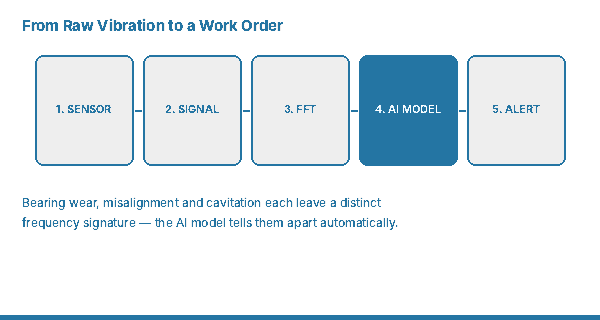
The pipeline is almost always the same shape. A wireless accelerometer, usually magnetically mounted on the bearing housing, captures a time-domain waveform. A Fast Fourier Transform converts that waveform from amplitude-over-time into amplitude-over-frequency — the spectrum reliability engineers have been squinting at on oscilloscopes for half a century. The AI layer then does the squinting for you: it compares the live spectrum against the asset’s own baseline and against a library of known fault signatures, assigns a severity score, and — critically — tracks the trend over weeks, not just the snapshot, because a small peak that is growing 10% a week is a very different problem than the same peak that has been flat for a year.
Four AI Platforms Actually Running on Upstream Rotating Equipment
The vibration-monitoring market is crowded with slide decks. These four have verifiable products, named hardware, and customers outside of a press release.
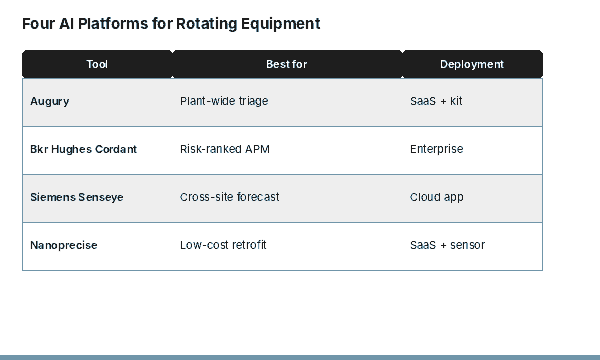
Augury — plant-wide machine health triage
Augury’s Machine Health product wires wireless vibration, acoustic, and in some configurations magnetic sensors onto pumps, motors, compressors and gearboxes, then layers an AI diagnosis engine on top that is backed by its own staff of CAT II/III certified vibration analysts — a detail worth noting, because it means a flagged alert does not just land in a dashboard, it can be reviewed by a human who has spent a career listening to machines. For an operator with assets scattered across many sites and no bench of in-house vibration specialists, that human-in-the-loop layer is often the real product.
Baker Hughes Cordant — risk-ranked condition monitoring at enterprise scale
Cordant is less a single product than a hardware-and-software lineage that traces back to Bently Nevada’s decades of turbomachinery protection work. Orbit DCM and Ranger Pro condition monitors feed continuous vibration data into Baker Hughes’s Cordant software, which ranks assets by risk rather than simply by alarm count — a meaningful distinction for a reliability team trying to decide which of forty red flags to chase first on a Monday morning. It is the heaviest-duty option on this list, and the one most likely to already be living somewhere in a large operator’s existing turbomachinery protection system.
Siemens Senseye Predictive Maintenance — cross-site failure forecasting
Senseye, acquired by Siemens, is a cloud application built to sit on top of whatever historian or IoT data an operator already has, rather than demanding a brand-new sensor fleet. Its selling point is forecasting: instead of only flagging that a fault signature is present today, it tries to estimate how many days of useful life remain, which turns a vibration alert into a maintenance-scheduling input a planner can actually act on.
Nanoprecise — low-cost retrofit for legacy pumps
Nanoprecise’s MachineDoctor is a six-in-one wireless sensor — vibration, temperature, and several other parameters in one magnetically mounted unit — paired with a predictive-maintenance SaaS layer. It is aimed squarely at the asset class every operator has too many of and too little budget to instrument individually: the legacy rod pumps, fans and small compressors that never made it onto anyone’s digital-transformation roadmap. For a retrofit on equipment that has been running since before anyone in the control room was hired, it is usually the cheapest credible way in the door.
Reading the Spectrum: What a Bearing Fault Actually Looks Like
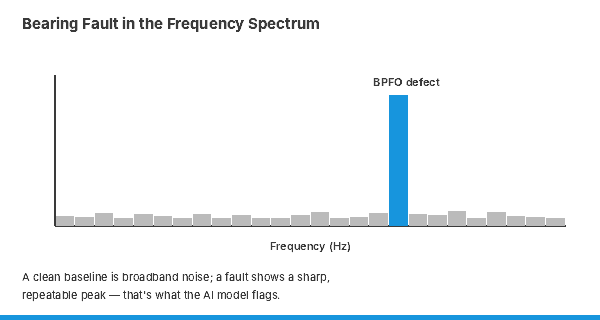
It helps to see the thing the AI is actually looking at. A healthy bearing’s spectrum is broadband noise — low, flat, undramatic, the mechanical equivalent of static. A developing outer-race defect breaks that monotony with a sharp, narrow, repeatable spike sitting precisely at the bearing’s calculated BPFO frequency, a number you can compute from nothing more exotic than the bearing’s ball count, pitch diameter, contact angle and shaft speed.
You do not need a commercial platform to see this for the first time. A $40 wireless accelerometer, a Raspberry Pi, and about twenty lines of Python are enough to build a credible proof-of-concept for a single critical pump before committing budget to a plant-wide rollout:
import numpy as np
from scipy.fft import rfft, rfftfreq

# waveform: raw accelerometer samples, fs: sample rate (Hz)
def bearing_fault_frequencies(rpm, n_balls, pitch_dia, ball_dia, contact_angle_deg):
    fr = rpm / 60.0  # shaft speed, Hz
    angle = np.radians(contact_angle_deg)
    ratio = (ball_dia / pitch_dia) * np.cos(angle)
    bpfo = (n_balls / 2) * fr * (1 - ratio)
    bpfi = (n_balls / 2) * fr * (1 + ratio)
    return {"BPFO": bpfo, "BPFI": bpfi}

def spectrum(waveform, fs):
    n = len(waveform)
    freqs = rfftfreq(n, d=1 / fs)
    amps = np.abs(rfft(waveform)) * 2 / n
    return freqs, amps

def flag_fault(freqs, amps, target_hz, tolerance_hz=2.0, threshold=3.0):
    band = (freqs > target_hz - tolerance_hz) & (freqs < target_hz + tolerance_hz)
    peak = amps[band].max() if band.any() else 0
    baseline = np.median(amps)
    return peak > threshold * baseline, peak, baseline
That last function is the entire idea behind every commercial platform on this list, just stripped down to its studs: compute the fault frequency from bearing geometry, check whether the live spectrum has an unusually tall peak sitting on top of it, and flag it if it does. The platforms above spend their engineering budget on the parts that do not fit in a blog post — baselining across thousands of asset types, filtering sensor noise, modeling gradual trends instead of single snapshots, and giving a reliability engineer a severity score instead of a raw number — but the underlying physics is this approachable.
Rolling It Out Without Drowning in False Alarms

- Inventory the critical rotating assets first and rank them by failure cost, not by which one happens to be easiest to reach with a sensor.
- Mount sensors on the inlet, outlet and motor-end bearing housings — a single sensor on one end of a pump will miss faults developing on the other.
- Baseline for two to four weeks of genuinely normal operation before trusting any alert; a baseline captured during a startup transient will haunt you for months.
- Route every alert to a named reliability engineer, not a shared inbox that three people assume someone else is checking.
- Manually cross-check the first ten AI alerts against hand-held readings before scaling to the rest of the fleet — trust is earned, not assumed.
- Review the false-positive rate monthly and retrain or retune thresholds; a model that cries wolf gets ignored, which defeats the entire purpose of buying it.
Operators chasing the compressor-specific version of this problem have already written up the gas-compressor case in detail — see AI Predictive Maintenance for Gas Compressor Failures for how the same fault-signature logic applies to reciprocating equipment. And if your rotating-equipment worries are really drilling-side torsional vibration rather than pump or compressor bearings, AI Stick-Slip Detection covers the surface-torque version of the same underlying idea.
None of these four platforms will tell you anything a sufficiently patient engineer with an FFT analyzer and infinite free time couldn’t eventually work out alone. What they actually sell is attention — the tireless, unglamorous kind that catches a three-week-old bearing fault on pump 14 of 400 before it becomes a production report nobody wants to write. Pick the one that matches your fleet, baseline it honestly, and let the machines tell you what they’ve been trying to say all along.
