

By Saad Iqbal
Frac hit prediction machine learning combines offset-well pressure, stage timing, spacing and treatment context to flag fracture-driven interaction before damage escalates.
Two wells sit on the same pad. The parent has been on production for a year, decline curve settled into a predictable slope. Then the completion crew starts pumping the child well next door — and three stages in, the parent’s casing pressure jumps, its water cut spikes, and its production never fully recovers. Nobody touched a valve on the parent well. The frac crew two hundred feet away did all the damage, and by the time anyone noticed the pressure gauge, the fracture network had already found its way home.
That’s a frac hit — fracture-driven interference between a completion in progress and an offset well, and it’s one of the least glamorous, most expensive problems in unconventional development. Frac hit prediction using machine learning is now good enough to catch this in near real time, which matters because the old approach — watch the offset pressure gauge and hope — only tells you after the damage is already circulating.
What Is a Frac Hit, and Why Should Upstream Engineers Care?
A frac hit happens when the hydraulic fracture network from an active completion propagates into the drainage area — or straight into the wellbore — of a nearby well. In tight infill programs it’s not a rare event anymore. In the Eagle Ford, child wells now outnumber parent wells on many pads, and the interference between them shows up as pressure spikes, water cut jumps, sand production, and in the worst cases, casing deformation that requires a workover before the well ever produces at design rate.
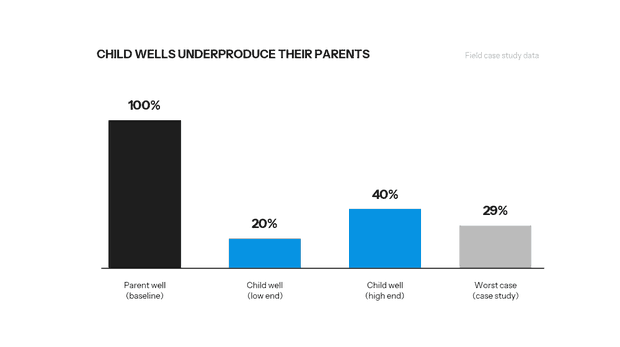
The production hit is the part that should worry engineers most. Field data from parent-child well studies shows child wells producing as little as 20-40% of parent well output in some fields — and it isn’t always the child well that suffers. A widely cited 10-well pad case study (2 parent wells, 8 child wells) found that 7 of the 8 child wells underperformed relative to the parents, with one of the parent wells showing a sharp jump in water cut and severe pressure depletion once the child completions started. Communication runs both directions, and neither side comes out ahead.
Why Watching the Pressure Gauge Isn’t Enough Anymore
The traditional defense against frac hits is offset pressure monitoring: gauge on the shut-in offset well, someone watching a trend line, a call to slow or stop the pump if pressure moves. It works, eventually — but “eventually” is the problem. A pressure response big enough to be obvious on a slowly-refreshed trend line is also big enough that damage is already underway. By the time a human catches a 400-500 psi swing, the fracture has already connected the two wellbores; the only decision left is how much worse to let it get before shutting down.
The gap between “technically monitored” and “actually protected” is exactly where machine learning has started to earn its keep. Two things had to happen first: enough historical frac hit cases had to be logged and labeled to train a classifier, and someone had to build a system that could watch dozens of offset wells simultaneously without a human staring at each chart. Both problems are now largely solved.
How Machine Learning Actually Predicts Frac Hits
One of the more instructive published approaches, developed by Baker Hughes (BHGE), treats frac hit prediction as a rule-discovery problem rather than a black-box classification problem — which matters a lot when the person deciding whether to slow a frac job wants to know why the model is flagging a hit, not just that it is. The methodology feeds well spacing, pumping schedule, and proppant concentration data into a decision tree clustering process alongside offset well pressure time series, oil and water tracer data, and prior interference test results.
Run against real field data, that process generated more than 14,000 candidate rules for what causes a hit. Subject matter experts then filtered that down to roughly 11,000 rules, ranked by three criteria: simplicity (fewest variables needed to explain the outcome), coverage (how many actual hits the rule accounts for), and efficiency (how often the rule is right when it fires). The output is a dashboard with an interactive 3D visualization of well-pair interactions and hit severity — and critically, the whole system runs on data operators already collect. No new downhole hardware, no incremental capex, just a smarter read on the pressure and tracer data that’s already flowing off the pad.

Real-Time Tools: Catching Interference While the Pump Is Still Running
Rule discovery from historical data is useful for planning the next pad. It doesn’t help the completion engineer who needs to know right now, mid-stage, whether to hold the current pump schedule. That’s the gap purpose-built real-time monitoring platforms are closing. FDai, from Momentum AI, is one example: it monitors every offset well on a pad through wellhead sensors alone — no downhole gear, no intervention required — and flags fracture-driven interference at a 50 psi severity threshold instead of waiting for the 400-500 psi swing a human would eventually notice on a trend chart.
The system doesn’t just flag a pressure change — it calculates what the pressure response would have been had no interference occurred, which lets it quantify the actual magnitude of the hit rather than just its existence. Each detected event comes with enriched diagnostics: volume-to-first-response, maximum pressure change rate, and an azimuth-based estimate of which direction the interference is coming from. In field deployments across multi-well programs, that earlier, quantified detection has translated into roughly a 60% reduction in interference severity under controlled conditions, because the engineer can upsize, downsize, or hold the frac design stage-by-stage instead of finding out after the pad is already drained into the wrong wellbore.

On the modeling side, physics-based fracture simulators like ResFrac serve a complementary role — running “what if” scenarios on well spacing and pumping sequence before the pad is ever drilled, so the real-time monitoring system has a baseline of expected behavior to compare against. Combining a pre-drill model with in-job monitoring is quickly becoming the standard playbook: model the risk before you spud, watch for the deviation while you frac.
What This Means for Your Next Completion Design
None of this replaces good well spacing decisions or a properly sequenced development plan — a model can only tell you a hit is happening, not undo the geology that made it possible. But the cost of finding out early versus finding out late is not symmetric. A frac design that gets upsized or paused mid-stage because a monitoring system caught 50 psi of unexpected pressure response costs you a schedule adjustment. A frac hit that’s discovered because a parent well’s water cut doubled three weeks later costs you a workover, a production hit that may never fully recover, and an uncomfortable conversation about why the offset gauge wasn’t watched more closely.
If you’re planning your next infill pad, the practical starting point is the same either way: get every offset well wired into real-time pressure monitoring before pumps start, not after the first child well goes on production. The historical rule-discovery models are worth running against your own field’s data too — the patterns that drive interference in the Permian aren’t identical to the Eagle Ford or the Bakken, and a model trained on your own offset well history will catch what a generic threshold misses.
Which offset wells actually need monitoring?
Not every well within a mile of a new completion needs a dedicated gauge and a monitoring subscription — budget and crew time are finite, and treating every offset as equally at risk just trains your team to ignore alerts. The wells that deserve priority are the ones with the shortest lateral spacing to the new completion, any well that’s already shown pressure communication on a prior stage in the same field, and producing wells with high current value — a mature, high-rate well has far more to lose from an undetected hit than a marginal stripper well nearing its economic limit. Rank your offset inventory by spacing and value before the first stage pumps, and the monitoring budget goes where it actually protects revenue.
For the drilling-side counterpart to this kind of early-warning thinking, see how machine learning beats the clock on kick detection — the same principle of catching a small signal before it becomes a big problem applies just as directly to well control as it does to well interference. And if you’re building out your own real-time monitoring stack, our tutorial on automating nodal analysis in Python is a solid next step for turning raw production data into decisions your team can act on immediately.
