

By Saad Iqbal
Three numbers define this week in energy AI, and all three point the same direction: upstream oil and gas is where the money, the robots and the electrons are actually converging. McKinsey put a dollar figure on AI’s upside in the oil patch, ExxonMobil put robots on the rig floor in the Permian, and the US gas industry put shovels in the ground to feed the AI boom’s appetite for electricity. Here’s what an upstream engineer needs to take from each.
McKinsey: AI Could Unlock $230 Billion a Year in Upstream Value
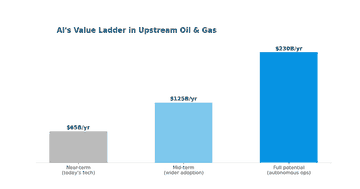
McKinsey’s analysis, covering more than 550 AI use cases across the upstream lifecycle, puts near-term value at $65 billion a year using technology that already exists, rising to $125 billion as proven tools see wider adoption, and topping out at $230 billion annually with autonomous operations at full addressability — after subtracting more than $30 billion a year in implementation cost. The finding worth remembering: value is heavily concentrated, with the top 10 use cases driving nearly half the total, and production optimization, drilling automation and reservoir management doing most of the heavy lifting. The uncomfortable flip side is that oilfield services revenue faces real exposure — $17 billion near-term, $60 billion at full potential — as the same efficiency gains that help operators reduce billable service hours.
ExxonMobil Puts Robots on Permian Rig Floors
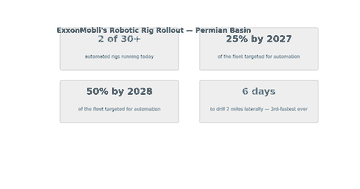
ExxonMobil is now running 2 automated rigs among its 30-plus in the Permian, using robotic machinery from drilling contractor Helmerich & Payne to handle roughly 2,000-pound sections of drill pipe that a floor hand would otherwise wrestle by hand, with a Houston operations center coordinating the moves remotely. The plan is to automate a quarter of the fleet by 2027 and half by 2028. The numbers behind the push: the first automated rig drilled 2 miles laterally in just over 6 days — the third-fastest time in Exxon’s history — and the company is targeting nearly 40% higher Permian output, 2.5 million barrels of oil equivalent a day by 2030, with 40-plus new technologies in the pipeline to double Permian recovery by the early 2030s. Roughly a third of serious rig-floor injuries happen exactly where the robots now work, so the safety case is doing as much of the argument as the speed case.
The Gas-Fired Power Buildout Feeding AI Data Centers
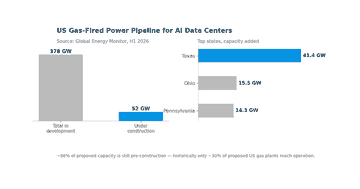
Global Energy Monitor’s latest count puts US gas-fired power capacity in development at 378 gigawatts as of mid-2026 — roughly double where it stood at year-end 2025 — with data center projects accounting for 189 GW of that pipeline. Capacity actually under construction rose 76% to 52 GW, about double China’s current build rate, and Texas leads the pack with 41.4 GW in development, ahead of Ohio (15.5 GW) and Pennsylvania (14.3 GW). The catch for anyone modeling gas demand off these headlines: roughly 86% of proposed capacity is still pre-construction, and historically only about 30% of proposed US gas plants ever reach operation — so treat the pipeline as a ceiling, not a forecast, on the gas volumes this buildout will eventually pull through midstream and processing.
What It Means for Upstream
Put together, the pattern is straightforward: the value McKinsey is pricing gets captured well-by-well, through exactly the kind of production optimization and drilling automation Exxon is now deploying at scale — and the power to run all of it, plus the AI data centers driving demand for it, increasingly runs through gas that upstream and midstream have to be ready to move. If you’re picking one automation project to start this quarter, drilling optimization and production surveillance are where McKinsey’s own numbers say the money already is. For a hands-on starting point, see today’s tutorial on automating kill sheet calculations in Python below.
