By Saad Iqbal
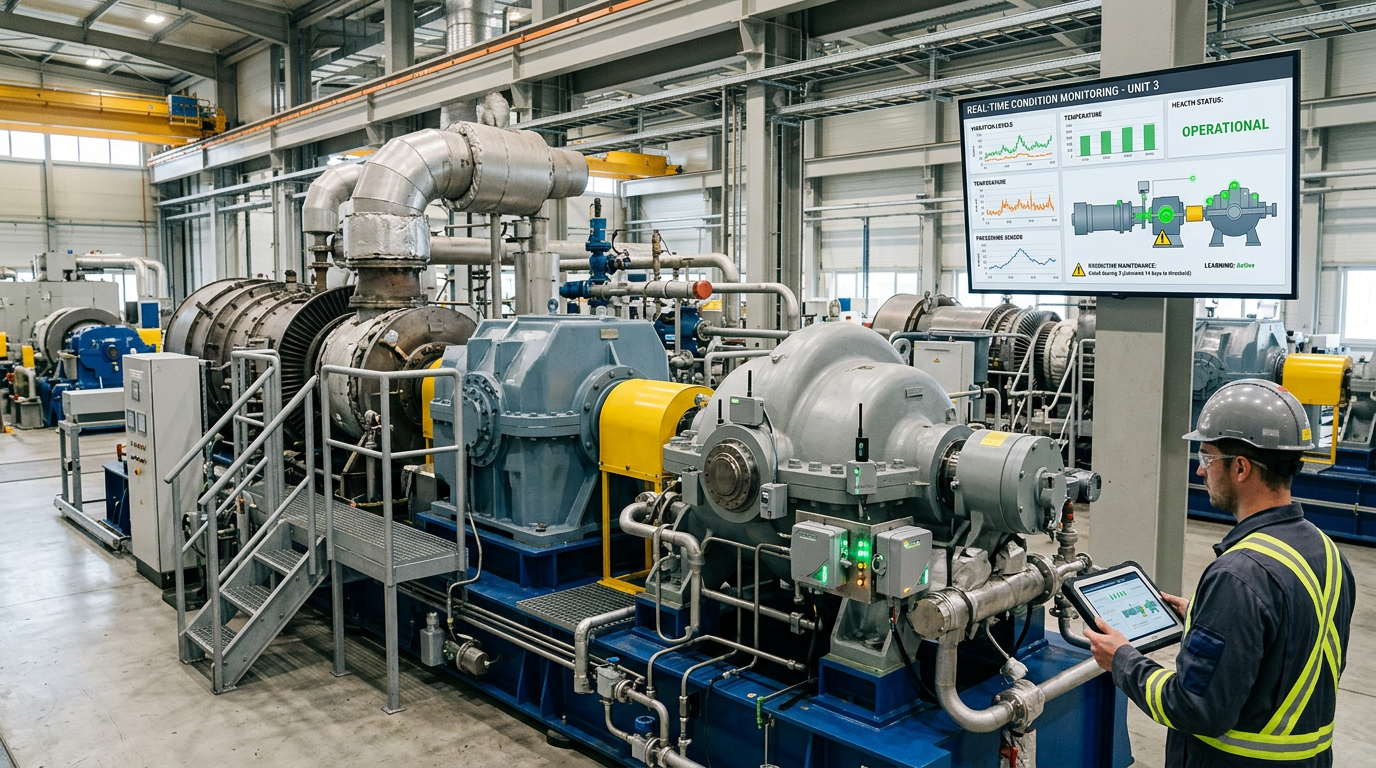
Somewhere in a Shell processing facility right now, roughly three million sensors are streaming twenty billion rows of data a week into a bank of machine learning models — about eleven thousand of them, running quietly in parallel, making fifteen million predictions a day about which pump, compressor, or valve is about to fail. No human ever asked for fifteen million answers. Almost none of them will matter. But the one that does — the bearing that would have seized on a Tuesday night, the compressor that would have gone down mid-shipment — is worth more than all the noise combined.
That is not a hypothetical. It is a real, publicly documented deployment, and it is the clearest evidence yet that predictive-maintenance AI has quietly moved from pilot project to production infrastructure in energy. But it raises the question every engineer eventually asks when a vendor shows up with a slide deck full of promises: which of these platforms is actually doing that, and which are borrowing the same three case studies everyone else cites? I went looking for the honest answer.
The Machines Watching Machines
Predictive maintenance is the idea that a piece of rotating equipment — a turbine, a compressor, a pump — broadcasts its own decline before it fails, through vibration, temperature, pressure, or acoustic signatures too subtle for a human ear or a fixed threshold alarm to catch. AI’s job is to learn what “normal” looks like for that specific machine, in that specific plant, and flag the drift long before it becomes a shutdown. For an industry where an unplanned outage can cost millions of dollars an hour and, in the worst cases, put people in danger, that early warning is the entire business case.
The market for this is crowded, well-funded, and shifting fast — company names from two years ago have already been acquired, renamed, or quietly pivoted away from energy entirely. So rather than repeat vendor copy, I dug into what each platform can actually point to: named customers, dated deployments, and figures that trace back to a real source rather than a marketing one-pager.
Six Platforms, Six Different Stories
C3 AI Reliability — the deepest documented deployment
C3.ai’s Reliability product is the strongest-sourced case study in this entire space. Shell has scaled it to more than 10,000 pieces of equipment across upstream, manufacturing, and integrated gas assets — the three-million-sensor, eleven-thousand-model, fifteen-million-predictions-a-day numbers above come directly from C3.ai’s own published account of that deployment, not a secondhand summary. Separately, Baker Hughes has a confirmed strategic alliance embedding C3 AI applications into its own Cordant platform across oil and gas, power generation, chemicals, and mining. C3.ai’s pricing isn’t public, but the company has talked openly about moving toward consumption-based billing, and it’s also available through the AWS and Microsoft Marketplaces.
GE Vernova Asset Performance Management — the widest named customer list
GE Vernova — GE’s energy-focused spinoff — lists an unusually long roster of named users on its own APM product page: Xcel Energy, AES, Eviny, RWE, Saudi Aramco, EDP, and TotalEnergies among them. Two of those come with actual numbers attached. SOCAR Türkiye cut reactive maintenance by 20 percent and total maintenance costs by 5 percent; Sasol reports “significant” savings without a disclosed figure. Worth noting: being a named logo on a vendor’s page isn’t the same as a fully quantified rollout, so treat the wider list as “confirmed user,” not “case study,” unless a specific number is attached.
Avathon (formerly SparkCognition) — the renewables proof point
SparkCognition rebranded to Avathon in October 2024, relocating to Silicon Valley with former BP chief executive John Browne chairing the board — a rename explicitly tied to the company’s energy-transition ambitions. Under its previous name, the company landed one of the best-documented renewables deployments around: in November 2023, Ørsted deployed what was then SparkCognition’s Renewable Suite across 5.5 gigawatts of U.S. wind, solar, and storage assets. The newer “Autonomy Platform” branding under Avathon talks about oil and gas, grids, and pipelines too, but as of its most recent press materials, hasn’t yet published a named customer or a number to match the Ørsted deployment.
Baker Hughes Cordant — the hardware-plus-software argument
Cordant is Baker Hughes’ umbrella brand, folding in Bently Nevada’s decades-old vibration-monitoring hardware alongside AI-driven asset health scoring and emissions monitoring. Its genuinely distinct advantage isn’t a marketing claim: Baker Hughes actually manufactures the turbines, compressors, and sensors it’s monitoring, which is a structural edge that pure-software vendors can’t easily replicate. The company has also expanded a named collaboration with Microsoft to build out Cordant further. What’s missing, at least in what I could verify, is a specific named customer case study with a hard number attached — the platform’s story rests more on its hardware pedigree than on a published deployment.
Augury — strong pitch, thin energy evidence
Augury markets its Machine Health platform directly at “hazardous and high-stakes environments,” with a dedicated blog post aimed at oil and gas. But its concrete public case studies lean toward manufacturing and pharma customers like DuPont, not energy. The company’s headline numbers — 75 percent fewer false alarms, over 300,000 machines monitored, a Forrester-commissioned 310 percent three-year ROI — are real published figures, but they’re vendor-published or vendor-commissioned, which is a meaningfully different thing from an independently audited result.
IBM Maximo Predict — the incumbent with the thinnest paper trail here
IBM maintains a dedicated energy-and-utilities page for Maximo, confirming deliberate positioning toward this audience, and the underlying platform runs on Red Hat OpenShift with genuine enterprise scale behind it. But of the six platforms here, it’s the one where I couldn’t surface a specific named energy customer case study in current public materials — worth including as a major incumbent, not as a company with a headline deployment to point to.
What the Marketing Pages Don’t Say Out Loud
A few patterns showed up across every single vendor in this list, and they’re worth knowing before your next sales call. Pricing is universally opaque — not one of these six companies publishes a rate card; all of them route you to a quote. Named, quantified case studies are rarer than the marketing pages suggest: of six platforms, only three — C3.ai’s Shell deployment, GE Vernova’s SOCAR Türkiye numbers, and Avathon’s Ørsted rollout — have a specific company name attached to a specific figure you can trace back to a primary source. The rest lean on logos, industry-benchmark statistics, or qualitative language like “significant savings.” And ROI studies with a hard percentage attached are frequently vendor-commissioned Forrester or similar reports, which isn’t dishonest, but isn’t independent verification either.
A Word of Caution on Names
This space consolidates and rebrands faster than most engineers have time to track. SparkCognition became Avathon in the space of a boardroom decision. Uptake, a name some engineers still associate with industrial predictive maintenance, has since pivoted entirely to fleet and vehicle maintenance and is in the process of being acquired by Bosch — it no longer markets to stationary energy assets at all. If a vendor name in your notes is more than a year or two old, it’s worth a five-minute search before the meeting, not after.
How to Actually Evaluate One of These
Based on what separated the well-documented platforms from the thinly-evidenced ones in this research, here’s what’s worth asking a vendor directly, before you get past the first demo:
- Ask for a named customer in your specific sub-sector — upstream, midstream, generation, or renewables — not just a logo from an adjacent industry.
- Ask whether a cited result is independently audited or vendor-commissioned, and ask to see the methodology, not just the percentage.
- Ask what happens to your historical model performance if the company gets acquired or rebrands — a real risk in this market, as the last two years have shown.
- Ask whether the platform depends on their own sensor hardware or works with what you already have installed — that changes both switching cost and lock-in.

Back to Those Fifteen Million Predictions
None of this makes any single platform the obvious answer — the honest conclusion is that the field is genuinely uneven, and the vendor with the best slide deck is not always the one with the deepest documented deployment. What Shell’s numbers actually prove isn’t that C3.ai is unbeatable; it’s that predictive maintenance AI, done at real industrial scale, produces a firehose of mostly unremarkable predictions in service of catching the rare one that would have cost a fortune. That’s the trade every one of these tools is selling. The job of an engineer evaluating them is to figure out which one is telling you the truth about how often it’s actually right.
