

By Saad Iqbal
AI P&ID digitization becomes urgent at two in the morning during a plant turnaround, when a shift supervisor is standing over a faded photocopy from 1987. Forty years of toner have turned half the tag numbers into gray smudges. Somewhere on that piping and instrumentation diagram is the block valve that must be isolated before anyone can open the vessel downstream. Nobody in the room can swear which valve it is, and the plant cannot restart until the drawing is interpreted correctly.
That scene plays out, in one form or another, at almost every aging industrial site on Earth. It is not really a software problem. It is a translation problem. A P&ID is not a picture so much as a language, dense with symbols standing in for pumps, transmitters, valves, and the exact pipe runs that connect them, written in a dialect that has barely changed since the 1960s. Read fluently, it tells you everything about how a plant breathes. Read badly, at two in the morning, under pressure, it tells you nothing at all.
What a P&ID actually encodes
Strip away the jargon and a piping and instrumentation diagram is closer to a genome than a blueprint. Every circle, diamond, and bowtie shape is a gene: a pressure transmitter here, a control valve there, each carrying its own short tag — PT-14, TT-07, XV-30 — that links it to a maintenance record, a set point, a safety interlock somewhere else in the plant’s paperwork. The lines between them are the wiring of the organism. Trace them correctly and you can answer questions like “what shuts if this valve fails open?” Trace them incorrectly, or not at all, and the plant is flying on institutional memory alone — which is a polite way of saying it is flying on whoever has worked there longest and hasn’t retired yet.
The trouble is that most of this genome was never digitized. Industry reporting on legacy piping drawings at older facilities describes a third to nearly half of them existing only as third- or fourth-generation photocopies, with degraded symbols, faded line weights, and handwritten redline notes that were never folded back into the master drawing. You cannot search a photocopy. You cannot query it, link it to a work order, or hand it to a digital twin. It just sits there, a static image of knowledge that used to live in someone’s head.
The afternoon I decided to test this
I wanted to see how far a general-purpose AI assistant with vision could get on this problem without any specialized software — just a scanned drawing, a chat interface, and a clear set of instructions. Here is roughly how the afternoon went.
Step 1: Scan once, read forever
I started with a single sheet — a compressor skid P&ID — scanned at a reasonably high resolution. That first scan matters more than people expect. Enterprise digitization benchmarks report symbol recognition accuracy above 90 percent on native digital PDFs and mixed-condition scans, but that number falls to roughly 70 to 78 percent once you are working from a genuinely degraded photocopy. Garbage in, garbage out is not a cliché here — it is a measured accuracy curve.
Step 2: Teach the model the symbol language
Rather than asking the AI to “read this drawing,” I gave it context first: this is an ISA 5.1-style P&ID, circles are instruments, the first letters in a tag indicate function (P for pressure, T for temperature, F for flow), and bowtie shapes are valves. Vision-capable models are surprisingly literate in these conventions already, but a short primer up front measurably improves how carefully they distinguish a control valve from a check valve, or a local indicator from a transmitter that reports back to the control room.
Step 3: Extracting the tag index
With that framing in place, I asked for a structured table: tag number, equipment type, and its nearest labeled connection point. This is the same output enterprise-grade platforms are built to produce — tag numbers, specifications, and parent-child asset hierarchies flowing into systems like IBM Maximo or AVEVA PI. My version was smaller in scope, a single sheet rather than a thousand, but the underlying task was identical: turn a picture into a table a database can use.
Step 4: Tracing the topology
This is where things get genuinely hard, and where I want to be honest about the limits. Reading a tag off a symbol is pattern recognition. Tracing which pipe actually connects to which downstream vessel, especially across a multi-sheet set where a line disappears off the right edge of page 3 and reappears on the left edge of page 7, is closer to solving a puzzle. Most tools, AI-assisted or not, handle isolated symbol recognition far better than they handle this connectivity resolution — and that gap is exactly what separates a nice-looking tag list from a P&ID that can actually feed a digital twin or a process safety review.
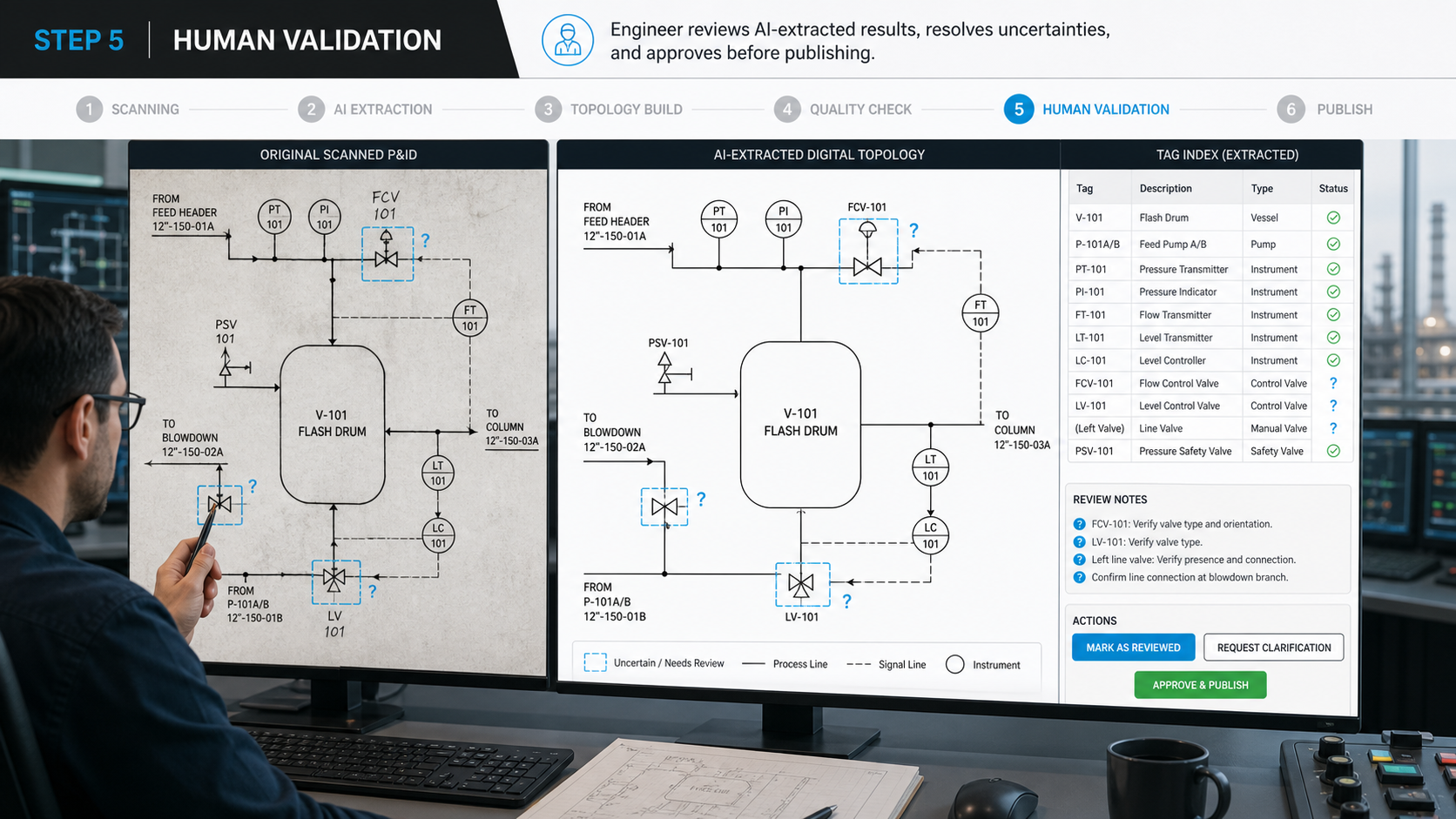
Step 5: The human pass
I did not trust the output blindly, and neither should anyone else. Digitization pipelines at scale typically flag somewhere between 8 and 12 percent of extracted symbols for human confirmation, and that felt about right for my single sheet too — a handful of tags where the AI had guessed reasonably but a technician’s eye caught something the scan had blurred into ambiguity. That review pass is not a failure of the tool. It is the whole point of using it as an assistant rather than an oracle.
What happens when you do this at scale
My afternoon was one drawing. Enterprises are running this same idea across thousands. Reported figures for full digitization projects are striking: a package of 1,000 sheets that takes 18 to 28 weeks by manual redrawing can be compressed to roughly 4 to 6 weeks with an AI-assisted pipeline, cutting manual labeling hours by around 83 percent and saving an estimated $680,000 to $2.05 million per project.

Platforms built specifically for this — names like OpenDrawing, SymphonyAI’s P&ID Ingestion, Acuvate’s DiagramIQ, and Markovate’s AI Blueprint Classifier — exist because the underlying task, multiplied across a whole asset’s drawing set, is worth automating properly rather than reinventing sheet by sheet with a chat window. Even at that scale, the honest numbers include friction most sales pages leave out: raw extractions typically require 20 to 40 hours of taxonomy alignment per site before they will load cleanly into a CMMS, and tools that only hand back static PDF redlines quietly reintroduce the manual re-entry work they were supposed to eliminate.
Where the machine still needs a second pair of eyes
None of this replaces the person who has walked the unit. AI is good — sometimes remarkably good — at the pattern-matching layer: recognizing that a particular bowtie is a valve, that a particular tag prefix means pressure. It is considerably less reliable at judgment calls that depend on plant-specific history: a valve that was field-modified after the drawing was last issued, a redline scrawled in pencil during a 2009 turnaround that never made it into the official set, a symbol that looks like a check valve but was actually replaced with a different model entirely. Treat the AI’s output as a very fast, very literate first draft, not as ground truth, and the two-in-the-morning version of this story ends with someone finding the right valve in minutes instead of hours.
The bigger pattern
Every industry eventually accumulates a library of knowledge trapped in a format nobody can query — index cards before databases, film before digital imaging, and now, for energy, a few million faded piping drawings. What AI vision tools are doing to the P&ID is not a novelty trick. It is the same shift that turned paper card catalogs into searchable databases, just arriving forty years late to the control room. The valve gets found either way, eventually. The only real question is whether it takes a supervisor forty minutes with a coffee-stained flashlight, or four minutes with a well-prompted assistant and a decent scan.
