

By Saad Iqbal
Six hours on a well pad. Two and a half more at a desk afterward, turning what just happened into a document someone in an office will skim in ninety seconds. That’s the trade every field engineer quietly accepts — and almost nobody stops to ask why it has to be that way.
Here’s the strange part: the job itself is rarely the bottleneck. Pressure curves behave the way pressure curves behave. The bottleneck is turning what you already know into something readable by 9pm. Multiply that gap across an entire career, and you start to see the real cost — not of engineering, but of translating engineering into English.
The numbers back this up in a way that should bother every engineering manager reading this. Across disciplines, engineers report losing close to a quarter of their working hours to documentation and administrative overhead — time spent recording what happened, not improving it. Manufacturing engineers alone report burning nearly a full workday every week on paperwork. Zoom out far enough, and it looks less like an individual inefficiency and more like a tax the entire profession has agreed to pay without ever voting on it.
I stopped paying the full rate about six months ago. Here’s the workflow that actually moved the needle — not by skipping the thinking, but by relocating where the thinking happens.
Start with the mess, not the template
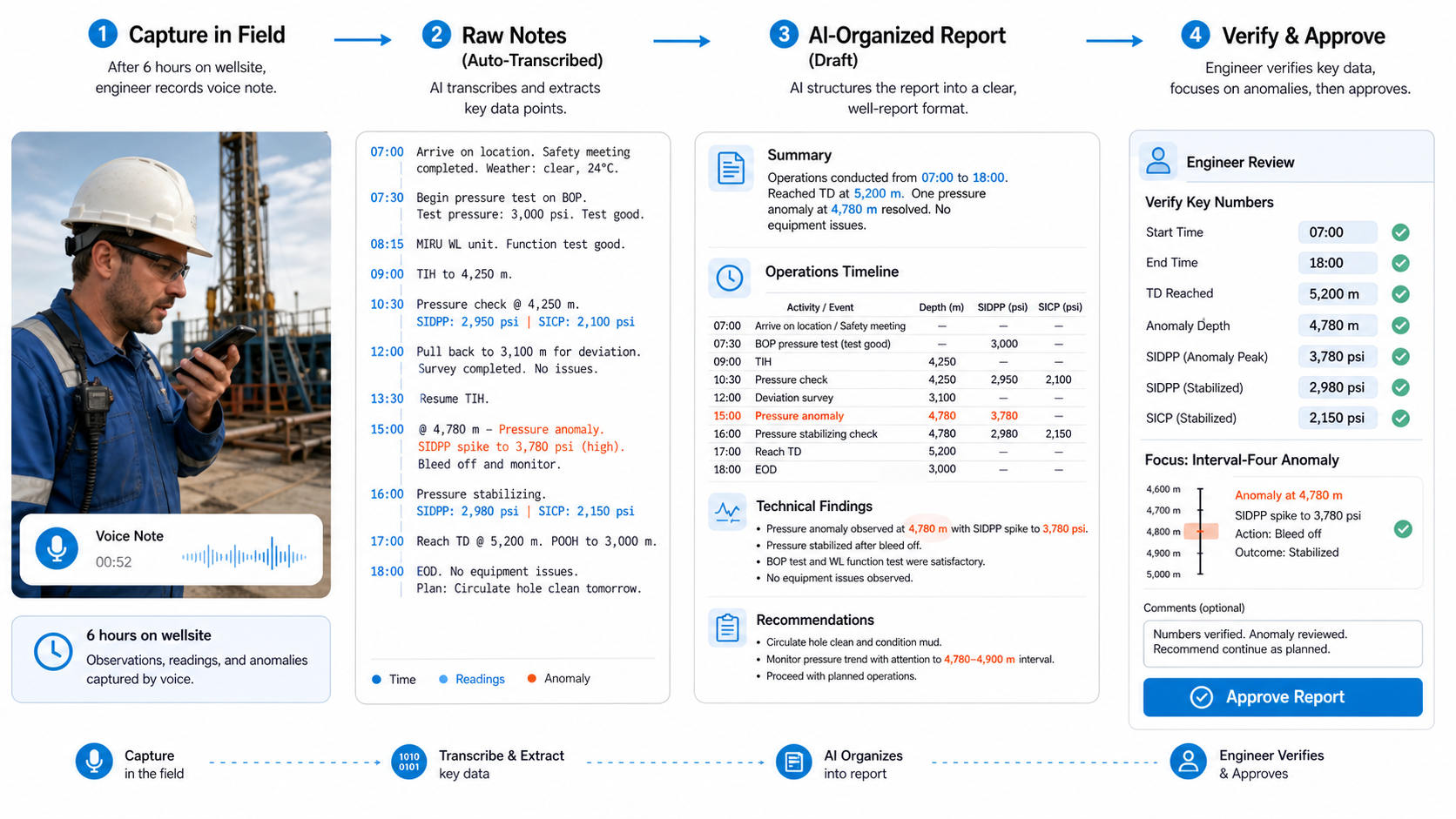
The old failure mode was staring at a blank report at 6pm, trying to remember what mattered from a day that already felt like a blur. Now I dump everything in raw — pressure readings, depth intervals, the weird thing that happened at interval four that I’ll forget by tomorrow. I let Claude take that mess and shape it into the skeleton my reports actually need: summary, operations timeline, technical findings, recommendations. Structure, for free.
A walkthrough: from six hours in the field to a finished report
Here’s roughly what that looks like end to end, because the abstract version undersells how mechanical it actually is. On the drive back from location, I open a blank note on my phone and talk through the day out loud — what time we started, what the pressure looked like at each interval, what surprised me, what I’d flag if I were reviewing someone else’s job instead of my own. It’s messy, it repeats itself, and it’s nowhere near client-ready. That’s fine. That’s the point.
Back at a laptop, I paste the whole thing into Claude along with the standard section headers my company expects — summary, operations timeline, technical findings, recommendations — and ask it to sort my rambling into that shape. What comes back is never final copy. It’s closer to what a sharp assistant would hand you after their first pass at your notes: organized, readable, and wrong in at least one small way that only someone who was actually on the pad would catch. Finding that wrong detail is the job now, not building the scaffolding around it.
Where this breaks down
It’s worth being honest about the failure modes, because a workflow you oversell is a workflow you’ll eventually stop trusting. This falls apart fast if the raw notes are thin — if you wait three days to write anything down, no amount of drafting help rescues a memory that’s already gone soft. It also falls apart if you read the draft the way you’d skim a text from a coworker, nodding along because the sentences sound plausible. Fluent prose is not the same thing as correct prose, and the entire value of this workflow depends on you never confusing the two.
There’s a narrower failure too: novel or ambiguous situations, the kind where the right call depends on judgment that lives in your head and nowhere else. A draft can propose a clean explanation for an odd pressure reading. Whether that explanation is the right one is not something a language model was on location to know. That verdict stays with the engineer, every time, no exceptions.
Let the machine draft. Never let it decide.
This is where people get it backwards, and it’s worth saying plainly: the draft is scaffolding, not a verdict. Every number, every read on a pressure anomaly, every recommendation gets checked against my own judgment before it reaches a client’s inbox. What AI is actually good at is turning “here’s roughly what happened, in the order I remember it” into something coherent. What it is not good at — and never will be, for this kind of work — is knowing whether the anomaly at interval four means something or means nothing. That’s still mine to decide.
Use it to sharpen work you’ve already done
Even reports I write entirely myself get a tightening pass. AI is good at stripping the hedging language engineers reach for under deadline pressure, and at making an executive summary something a non-engineer could actually absorb in one read.
What this buys back
A report that used to eat two and a half hours now takes about one — and most of that hour is still me, verifying the parts that matter. The saved time doesn’t vanish into nothing. It goes back into the field, or into actually sitting with why a pressure curve looked the way it did, instead of formatting the same table for the third time that week.
Getting started, if you want to try this
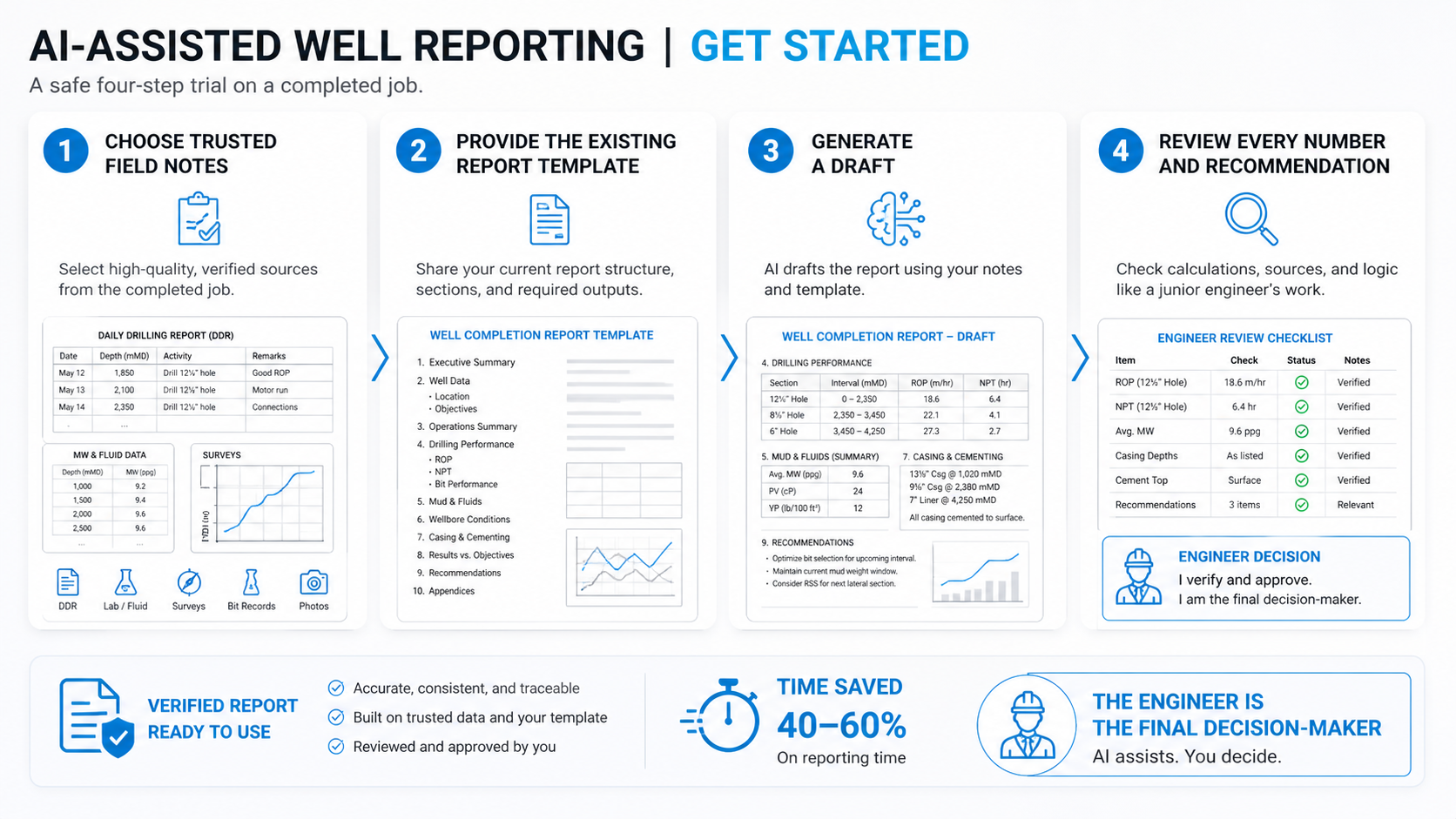
You don’t need a special tool license or a change-management memo to test this on your next report. Try it once, on a job that’s already finished, with notes you already trust: dump your raw field notes into Claude, ask for a draft organized around your existing report template, then read it the way you’d review a junior engineer’s first attempt — generously, but with your name on the line. If the draft saves you real time on that one report, extend it to the next one. If it doesn’t, you’ve lost twenty minutes, not your afternoon.
The bigger pattern
Zoom out and this stops looking like a story about one engineer and one AI tool. It’s a story about where expertise actually lives versus where it gets spent. A field engineer’s real value was never the ability to type a coherent paragraph by 9pm — it was six hours of reading pressure curves, catching the thing at interval four that a less experienced pair of eyes would have missed, and knowing what that thing meant. Documentation overhead has just been sitting on top of that value for decades, charging rent. Any tool that lowers the rent without touching the judgment underneath it is worth taking seriously, whether that tool is Claude, a different assistant, or whatever comes next. The technology will keep changing. The part that stays constant is the discipline of never letting the tool make the call that was always yours to make.
If you’re an engineer buried under field reports, HSE paperwork, or client deliverables, this was never about handing over your judgment. It’s about refusing to spend your best hours doing what a template could have done for you.
