
By Saad Iqbal
Nine thousand feet under a deepwater platform, a well is doing exactly what it was designed to do: producing hot reservoir fluid up a string of nested steel casing. Nobody is watching the annulus between casing string B and casing string C. There’s no valve to bleed it off, no gauge an operator checks every shift. It is sealed brine, trapped between pipe and pipe, and it is getting warmer by the hour. As the fluid heats up, it tries to expand. It can’t. So instead, the pressure climbs — quietly, for weeks, sometimes for years — until one day it exceeds what the casing was rated to hold, and something gives.
That phenomenon has a name — annular pressure buildup, or APB — and it has been a known hazard in deepwater well design since the Gulf of Mexico’s earliest subsea completions. What’s changed recently isn’t the physics. It’s how precisely engineers can now predict it before the well is ever completed, using machine learning models trained on the same casing-cement-formation mechanics that petroleum engineers have modeled by hand for thirty years — just modeled better.
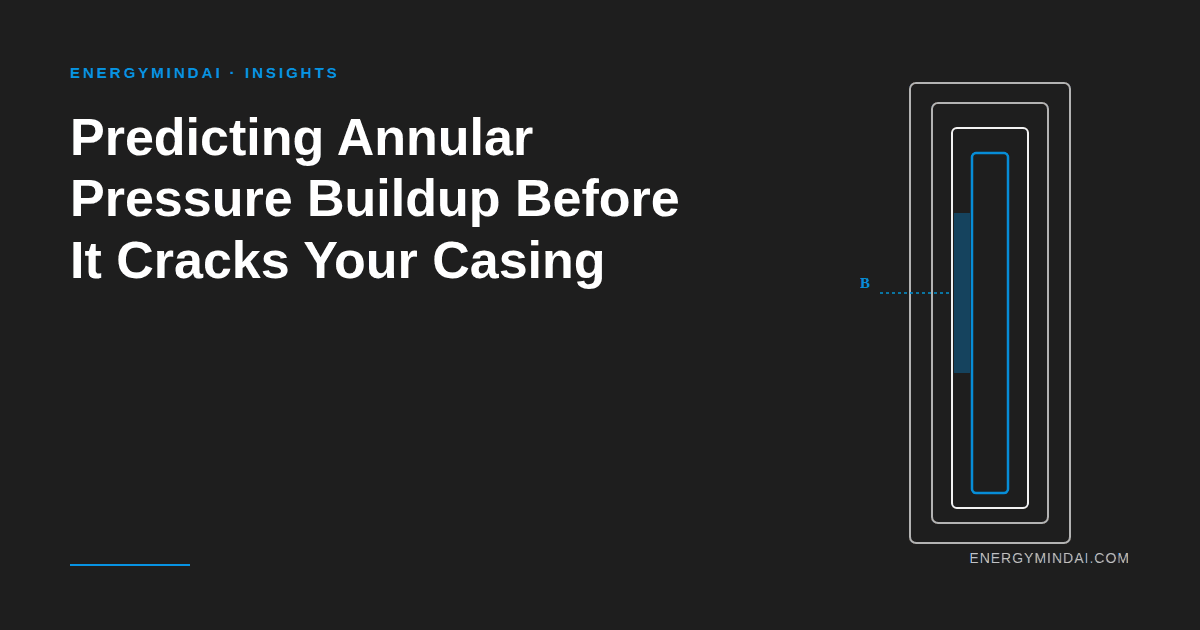
What Is Annular Pressure Buildup, and Why Can’t You Just Bleed It Off?
Annular pressure buildup prediction starts with understanding the trap itself. Every deepwater well has multiple concentric casing strings, and the space between two of them — usually an inner, fully cemented annulus like the B or C annulus — ends up sealed at both top and bottom by cement. On land, if pressure builds up in an annulus, you open a valve at the wellhead and bleed it down. On a subsea wellhead sitting on the seafloor with no direct human access, that option barely exists. The annulus is a closed pressure vessel from the moment cement sets.
Fluid trapped in that annulus is nearly incompressible. When the well starts producing, heat from the reservoir fluid — often 200°F (93°C) or hotter — conducts outward through the production tubing and casing, warming the trapped annular fluid. That fluid wants to expand thermally, but the steel and cement around it won’t yield much. The result is a pressure spike that can run into the thousands of psi, and in the worst documented cases has been enough to collapse intermediate casing from the outside in.
The Mechanism, In One Picture

Traditional APB design uses a fairly straightforward mechanical energy balance: model the annulus as a fixed volume, apply the fluid’s coefficient of thermal expansion and compressibility, and solve for the pressure rise given a temperature change, ΔP ≈ (β / c) × ΔT, where β is the fluid’s thermal expansion coefficient, c is its compressibility, and ΔT is the temperature rise at that annulus depth. That equation gets you in the right neighborhood. It does not, by itself, account for something engineers have known about for years but historically simplified away: the casing, the cement sheath, and the surrounding formation all deform elastically as pressure builds, which quietly relieves some of that pressure by giving the fluid a little more room to expand into.
Ignore that deformation and you overdesign — spec heavier casing, or burn rig time installing rupture discs and syntactic foam annular fluids you might not have strictly needed. Model it wrong in the other direction and you underdesign, which is the failure mode nobody wants to explain to a regulator.
Where Machine Learning Actually Earns Its Keep
This is where the recent research gets interesting, and where the “AI” label on annular pressure buildup prediction is doing real work rather than marketing work. A 2024 study published in Applied Sciences built a coupled mechanical model of casing, cement sheath, and formation deformation for offshore wells, then compared it against the traditional approach that treats the annulus as a rigid, non-deforming volume. Accounting for that sealed-section deformation cut prediction error by roughly 13% against measured field APB data — a meaningful gap when the difference determines whether you spec an extra casing grade.

Separately, SPE Drilling & Completion has published work specifically evaluating machine-learning tools for APB estimation precision, testing how well data-driven models track measured downhole annulus pressure and temperature against the analytical baseline. The pattern across this research is consistent: machine learning models don’t replace the underlying thermodynamics, they get trained on enough historical downhole pressure-temperature-volume behavior that they implicitly learn the deformation and heat-transfer corrections engineers used to leave out for the sake of a tractable hand calculation. Feed a gradient-boosted tree or a neural net enough labeled examples — annulus geometry, mud and completion fluid properties, expected flowing temperature profile, and the actual measured APB — and it starts predicting the correction factor directly, without you re-deriving elasticity equations for every new well design.
That matters most for the wells sitting outside the range of historical rules of thumb — ultra-deepwater, high-pressure-high-temperature, or unusual completion fluid combinations — which is exactly where analytical shortcuts tend to break down and where a well integrity failure is most expensive to fix after the fact. If you want the fuller monitoring picture, our roundup of AI well integrity monitoring tools covers the broader category this fits into.
Building a Real-Time APB Early-Warning System
The design-stage prediction is only half the story. The more operationally useful application is continuous: comparing predicted APB against real-time downhole gauge data for the life of the well, so a slow upward drift gets flagged long before it approaches the casing’s rated collapse or burst pressure. A minimal version of that pipeline looks like this:

- Downhole P/T sensors — annulus and tubing pressure/temperature gauges, ideally with fiber-optic distributed temperature sensing along the wellbore for a full thermal profile rather than a single point.
- Real-time data stream — SCADA or a historian pulling gauge readings at whatever cadence your platform supports, typically seconds to minutes.
- An ML prediction model — trained offline on historical wells with known APB outcomes, then run inference against live data. Gradient-boosted trees (XGBoost, LightGBM) tend to outperform simple regression here because APB response is nonlinear across annulus geometries.
- A comparison against casing rating — the model’s predicted APB gets checked against the casing’s actual burst and collapse rating with a safety margin, and crosses a threshold that pages the integrity engineer rather than waiting for a scheduled review.
You don’t need a data science team to prototype this. A working proof of concept is realistic with Python and scikit-learn — train a gradient-boosted regressor on your field’s historical completion and gauge data, export it, and score new readings against it in a scheduled job. If you’d rather work from a petroleum-engineering-native toolkit instead of building the PVT and thermal-expansion utilities from scratch, petropt is a Python library with built-in fluid PVT and hydraulics functions that can feed the physical inputs your model needs. None of this requires exotic infrastructure — the bottleneck is almost always getting clean historical gauge data into a usable training set, not the modeling itself.
What This Actually Changes for Your Next Completion Design
A few practical takeaways worth carrying into your next well design review:
- Rigid-volume APB calculations still work as a sanity check, but treat them as a conservative upper bound, not a design number, on any well where casing-cement-formation coupling matters — which is most deepwater completions.
- A roughly 13% error reduction from including deformation effects can be the difference between one casing grade and the next. On a subsea well, that’s real money either way — overspec or under-protect.
- Machine learning APB models are only as good as the historical dataset they’re trained on. If your field has limited APB history, lean harder on the physics-based deformation model until you’ve accumulated enough labeled data to train something field-specific.
- Real-time monitoring closes the loop that design-stage prediction alone can’t — reservoir behavior, injection changes, and workover history all shift the thermal profile over the life of the well.
Annular pressure buildup has always been solvable with enough manual iteration — nobody is claiming otherwise. What machine learning changes is the economics of doing that iteration properly on every well, including the ones that don’t fit the historical rules of thumb, instead of reserving the careful analysis for the handful of wells that trigger a red flag. If you’re setting up your own coiled-tubing or well-integrity automation pipeline next, our stick-slip detection walkthrough is a good companion piece — same underlying pattern of turning trapped downhole physics into a live, trainable signal.
